
Comedy is stupid again. It's about time.
Gail Daughtry and Jackass: Best And Last herald a new wave of lizard-brained laughs.
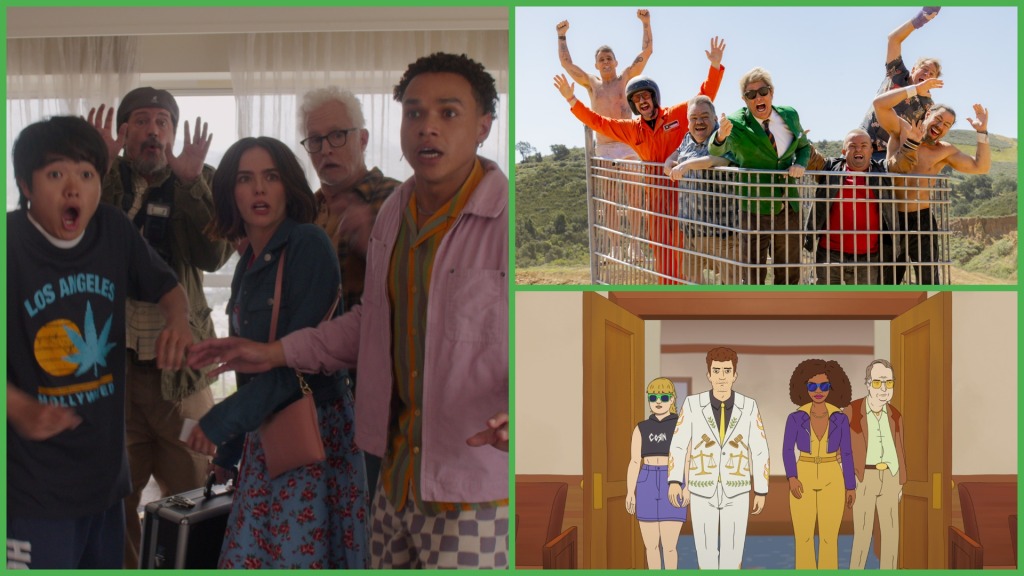
Clockwise from left: Gail Daughtry And The Celebrity Sex Pass (Photo: Courtesy Sony Pictures Classics), Jackass: Best And Last (Photo: Paramount Pictures), Strip Law (Image: Netflix)
Confess, Fletch was there when I needed it the most.
In the winter of 2023, in the throes of a funk that wouldn’t fully lift until the middle of summer, I paid a visit to one of my oldest and dearest friends, and we spent the evening as we had many evenings since we were teens: watching something funny. Three years on, I struggle to remember any of the real specifics of Greg Mottola’s thwarted attempt to start a new film franchise built around wiseass writer-cum-amateur-sleuth Irwin Maurice “Fletch” Fletcher, but I do remember we laughed. And I remember that after the credits rolled, my friend turned to me and said, “What ever happened to stupid comedies?”
I’m probably misremembering her exact phrasing—it might’ve been “dumb comedies,” or “goofy comedies”—but the point stands. For most of our lives, there had been ample space for lizard-brained delights in film and TV comedy. Slapstick, wordplay, blackouts. Spoofs, parodies, lampoons National and international. Zucker, Abrahams, Zucker. But with the death of the theatrical studio comedy, and comedy itself turning into an increasingly irksome battleground in the Forever Culture Wars, it became more difficult to find the proudly silly and the inventively asinine. The art of the hard joke seemed to escape an entire generation of TV writers. Every new Adam Sandler Netflix movie felt cheaper and lazier than the last. David Zaslav did his best Judge Doom impression and tried to drop two whole Looney Tunes features into The Dip.
But in this wet, hot, American summer of 2026, the tide seems to be turning. A new Jackass opened a few weeks ago; the latest from David Wain, Gail Daughtry And The Celebrity Sex Pass, is out this weekend. Coyote Vs. Acme finally sees the light at the end of the tunnel painted onto a rock wall in August. A new age of stupid comedy is dawning. It’s about damn time.
It’s worthwhile to define some terms here. When I say “stupid comedy,” it’s more of an aesthetic distinction than a value judgement. It’s not entirely lowbrow (the hijinks of the Marx Brothers fit in, as do the fast-talking dames and the hapless bachelors of the screwball classics), but it’s certainly not highbrow (this is Three Stooges territory). It may be brainy (the conceptual buffoonery of Mr. Show‘s “Pre-Taped Call-In Show” or “24 Is The Highest Number“), but without any pretensions toward the intellectual (even at its most farcical, Frasier would never qualify). The characters are broad, the performances often loud, and the jokes densely packed. The MTV lineup of the 1990s provides us with a useful dichotomy: It’s Beavis And Butt-Head, not Daria.
And while it’s at its best when all involved are committed to the bit and taking the project seriously, stupid comedy does not take itself too seriously. This is part of why this mini-renaissance feels so rejuvenating to me: Yes, comedy is vanishing from movie theaters, but at the same time, it’s come perilously close to disappearing up its own ass. Somewhere between the printing of the first “Stewart/Colbert 2008” bumper sticker and the grim reality of “Joe Rogan, frequent White House guest,” the idea of comedy as the sacred realm of unassailable truthtellers gained a cultural foothold. Its noisiest adherents decided their equal-opportunity-offender mandate meant they didn’t have to craft setups and punchlines anymore—they could just throw out any old slur and call it a day. At the same time, some of TV’s most celebrated comedies were grappling with weighty subjects like mental health, gender identity, and immigration policy. Some of these shows were quite good; I can’t deny that I was one of the critics lifting up You’re The Worst, Transparent, and One Day At A Time as the contemporary comedy vanguard. (Not to mention, uh, Louie.) But in hindsight, it’s a little easier to see that some of the TV made in this vein was more important than it was funny.
There’s nothing necessarily wrong with that: That change in tone was a positive course correction from an era of more caustic sitcoms and talk-show monologues. And from the student of comedy’s perspective, it’s always nice to have the top of your intelligence played to. But on the flipside, it’s also nice to laugh, and laugh a lot, at the things you’re watching—and it feels like ever since I Think You Should Leave broke Netflix containment in 2019, there’s been a renewed demand for writers, performers, and directors to get a little sillier and aim for the most explosive, comedy-for-comedy’s sake laughs. That always felt like the target for Detroiters, the show I Think You Should Leave creators Tim Robinson and Zach Kanin were making during the heyday of the streaming dramedy. (Karn On The Cobb, anyone?) It remains the case with their follow-up, The Chair Company, whose pilot just nabbed a pair of Emmy nominations: One for Andrew DeYoung’s stylish direction, the other for a script in which Robinson tells us all we need to know about his character, Ron Trosper, in one brief non sequitur: While his wife, Barb (Lake Bell), sleeps soundly beside him, Ron thrashes about before exclaiming “I swear I have the worst pillow in town!”

The Chair Company is just that kind of show, and its creators will gladly dig in on a dumb idea if it makes them laugh. In an interview with IndieWire, Bell recalled shooting a flashback that would’ve been entirely pedestrian if not for one distinctly Robinson-Kanin flourish: Ron gets sucked into a conversation at a Christmas party, but the guy who’s talking his ear off is, for no particular reason, is huffing and yammering like The Three Stooges’ Curly Howard. Turns out, the actor was a professional Curly impersonator.
“[T]hat on the page was just like some random dude, could have been a day player,” Bell said. But the creators had found a different kind of performer for the role that suited their madcap sensibility, and they squeezed all they could out of this ludicrous casting choice: “[T]hey would have him turn up his Curly and then turn down his Curly and they were like seeing, ‘OK, let’s try it with full Curly and then like half Curly and then turn completely Curly off.’ He actually couldn’t even speak. The guy, he was so sweet. He just was like, ‘I don’t know how to do this without being Curly.’”
 Keep scrolling for more great stories.