C-

Romeo Is A Dead Man slyly parodies multiverse nonsense before playing it too straight

The latest from SUDA51 and Grasshopper lives up to its “Ultra-Violent Science Fiction!” tagline.

Romeo Is A Dead Man slyly parodies multiverse nonsense before playing it too straight

The multiverse can be a black hole. While the concept of infinite parallel realities has been a staple of speculative fiction for a long time, in recent years, pop culture has frequently leaned on this idea for fan service. What if one version of your favorite character met a different one? What if a fateful death could be averted? What if familiar events could be remixed, with old stories repackaged in the guise of something new? It’s a setup that seems limitlessly vast, but often ends up curbing any traces of originality while flattening everything on screen with the suggestion that this is just one version in a limitless assortment of similar, slightly different permutations. It very much fits a corporate vision of “storytelling” where well-established intellectual property can be slightly altered without fundamentally changing or challenging anything.

Through its opening chapters, Romeo Is A Dead Man, the latest from SUDA51 and Grasshopper Manufacture, is quite self-aware about how much of a drag the multiverse can be. As a result, instead of being diminished by its space-time warping premise, it fully leans into absurdity, contradicting its own logic and throwing out any sense of continuity as it escalates to hilarious extremes; at its best, it understands that the ideal answer to this kind of cosmic convolutedness is to make us laugh.

This tongue-in-cheek vibe is very present in the game’s mile-a-minute introduction. Romeo Stargazer is a conspiracy theorist and sheriff’s deputy in the small Pennsylvanian town of Deadford. His life is normal until one day, while on patrol, he is suddenly mauled by a pale monster that rips his arm and half his face off, leaving him for dead. Luckily, his grandfather (who has more than a slight resemblance to Doc Brown) suddenly appears on a time-traveling motorcycle and injects him with some strange substance that saves his life; after a trippy bit of hand-drawn animation, he’s transformed. He isn’t just Romeo anymore; he’s Deadman, a henshin hero-looking crime fighter.

While that all makes some amount of sense, this intro quickly begins to fold in on itself. The previously mentioned events were all a dream, but also not? A “Previously On” comic book recap tells us that Romeo is in love with Juliet (subtlety is for cowards, as SUDA51 has long believed), a mysterious woman who is also a harbinger of doom; after her appearance, reality was destroyed, leaving shards of specific times and places scattered throughout the cosmos. Also, Romeo’s grandpa, Professor Benjamin, died off-screen and is now a talking decal on the back of Romeo’s jacket. Our protagonist joins the FBI Space-Time Police to find his (sort of) girlfriend, hunting down her variants and other time criminals while trying to reunite with the “real” Juliet he knew before Deadford was scattered across four-dimensional space.

It’s a lot, man. The first 15 minutes play out at such an unhinged pace that it feels like a deliberate parody of confusing interdimensional storytelling. To get across this reality-hopping vibe, the game switches mediums and modes with abandon: The introduction goes from live-action diorama footage, to an in-game cutscene, to a 2D animated sequence, to a series of comic book illustrations. The Game Over screen is an all-timer stop-motion nightmare that may or may not be a reference to a face-melting moment from Raiders of the Lost Ark. When you return to base, the Space-Time Police’s mothership, the aesthetic switches to pixel art that’s completely different from the main game’s 3D visuals. Among other things, this base is home to an unusual leveling mechanic where you navigate a little creature through a maze to grab permanent upgrades; what if skill trees were replaced with retro arcade simulacrums?

Everything’s here, and it’s all swirling in an orchestrated chaos punctuated by optional dialogue with your crew, at least one of whom has absolutely no narrative impact outside of talking about Manchester United players (sorry, Liverpool fans). The nonsense logic isn’t just a one-off gag but is fundamental to a weirdly cohesive presentation that embraces pulp curiosities and fine art alike—there are references to Edward Hopper and Shakespeare, alongside professional wrestling finishers and The Clash.
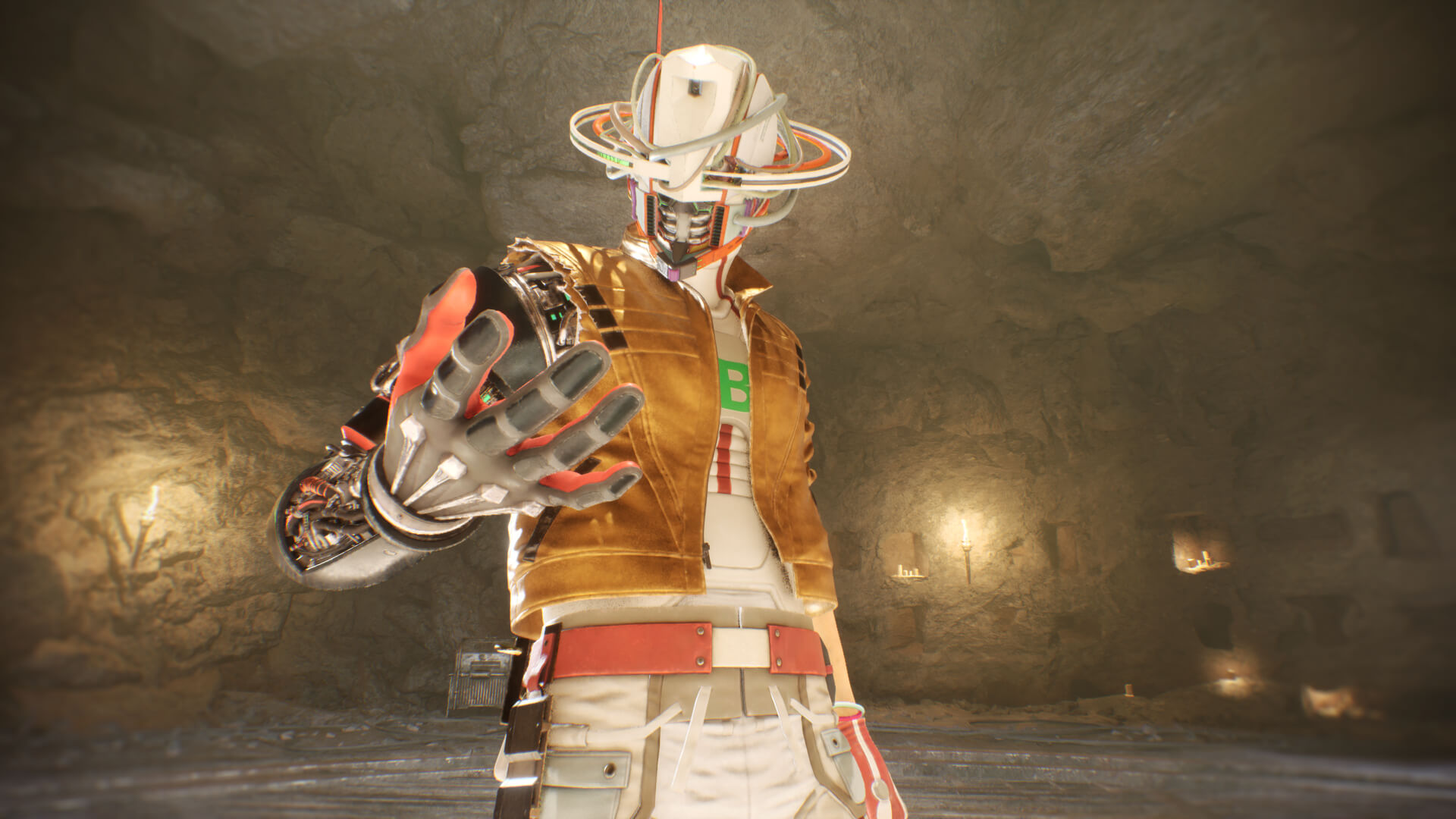

While the act of playing the game isn’t quite as strange, it’s defined by a baseline competence that is elevated by a general sense of eccentric style—those who’ve played GrassHopper and SUDA51’s other games, especially No More Heroes, will feel quite at home here. In his search for Juliet and other space-time criminals, Romeo travels to fragments of reality from across the decades: at one point, he’s in the ’70s, investigating a sunny cult, while at another, he’s in a shuttered asylum that leads to a horror game sequence. Getting through these areas will also involve crossing into “subspace,” an abstracted world of digital cubes that conveys the game’s generally disorienting vibe. Adding to this otherworldiness is an anonymous man on a floating TV set who waxes poetic about North American cryptids and other half-discernible topics, talking to you dozens of times as you cross the border between the real world and this digital one. Admittedly, some of this oddness is eventually blunted repetition—you’ll be going through subspace a lot—but the process of working through these areas largely holds up until the closing hours.

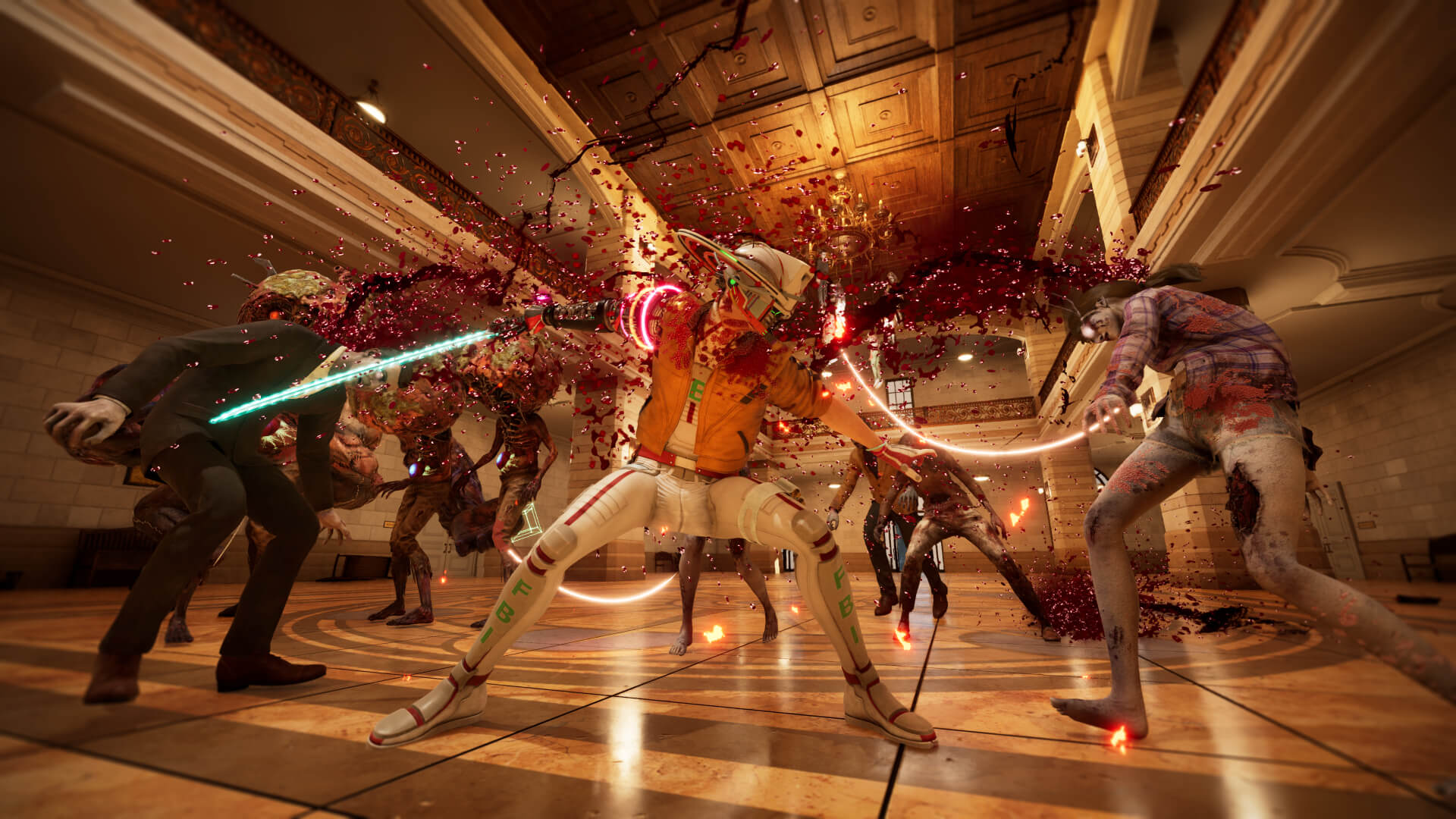
Along the way, Romeo has to battle “Rotters” (which are basically zombies but with a much more convoluted backstory). These fights start very simple: You can do a light or heavy attack with your melee weapon, aim and shoot your guns, or do an invincible dodge move to get around incoming attacks. There’s also Bloody Summer, a damaging, psychedelic strike that builds up after slicing and dicing enemies at close range.

The process of battling these not-zombies isn’t quite as complicated or fluid as a spectacle fighter like Bayonetta, and not as heavy and deliberate as FromSoftware’s strain of action game, but somewhere in-between, instead relying on the theatricality of gore explosions and liberally applied slo-mo to give your strikes a sense of fatal weight. You’ll also be relying on your guns a lot compared to other games in this style, and instead of using a pair of pistols to keep a combo going like in Devil May Cry, you’ll be targeting glowing weak points for massive damage (most likely using the rocket launcher, which is the clear standout). In practice, this is more of a shooter/action game hybrid than you might expect, a twist that largely works out until this small stable of Rotters becomes a bit too familiar. The bosses fare much better, though, and on top of their gross-out looks, they make for tightly designed showdowns that offer room for very different strategies; in a smart move, there’s an optional boss challenge mode that lets you relive these battles and earn some in-game currency if you can clear them in a set time.

Fitting with the game’s general vibe, there’s also at least one idiosyncratic inclusion when it comes to these fights: the Bastards. These guys are creepy humanoid creatures that you can cultivate and bring into battle, beginning as piddly pea shooters before eventually becoming harbingers of destruction. Yes, this is basically a Pokémon minigame. The presentation here is appropriately strange; you literally pull these dudes out of the soil, and if you dismiss them after running out of space, they’ll send you sad letters in the mail. You can also fuse them together to power up existing Bastards and create new variants, which is a bit disturbing considering they’re apparently capable of written speech.

Reminiscent of something like Yakuza 8’s Sujimons, it’s dangerously easy to fall face-first into this minigame, obsessively returning to your ship mid-mission so you can tend your garden of nasty, rotting monsters. There’s a reward for having this kind of green thumb, because you can eventually craft a lineup of Bastards that positively trivialize even the hardest boss challenges; these guys are fun, bizarre, and at least partially make up for the increasing tedium of the latter levels.

But while the Bastards fully bloom, the same can’t be said for what is initially the game’s biggest hook, its weirdo narrative. After evocatively channeling sensory overload, the final stretch attempts to tie together its fragmented cosmos into an overly tidy picture, a move that diminishes what came before. Frankly, it will probably feel even worse for many longstanding Grasshopper fans who’ve been trained to expect some kind of eleventh-hour rug pull. Here, it never comes. Romeo Is A Dead Man lives and dies by its eccentricity, delivering multiversal strangeness and zombie Pokémon before losing steam as it approaches a conclusion it doesn’t know what to do with. Given its galaxy of possibilities, it’s rather disappointing that its climax is so terrestrial.

Romeo Is A Deadman


Romeo Is A Dead Man was developed and published by Grasshopper Manufacture. Our review is based on the PlayStation 5 version. It is also available for PC and the Xbox Series X/S.

 
Join the discussion...
Keep scrolling for more great stories.