

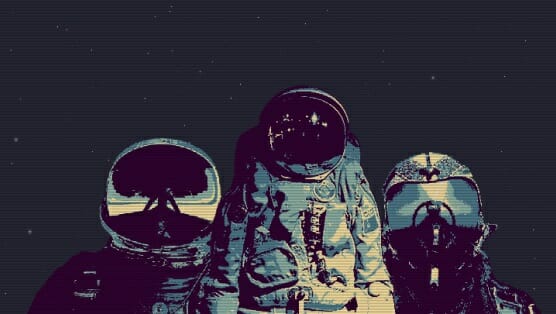
To be honest, if I was trapped alone in the vacuum of space without companionship, purpose, or stimulation, I might become a bit esoteric, too. When I find myself alone in a park, I often take out a notebook and scribble vague and metaphorical sentences down on paper. I used to look at them like I was trying to say something. Now it looks more like brain vomit.
The masculine-sounding avatar the player inhabits in RymdResa, a new game created by independent Swedish game studio Morgondag, often speaks in short, poetic sentences, and likes to think about mundane subjects in dramatic fashion. He wanders around space for years trying to find what he calls “hope,” talking about his past and future in brief stanzas of pedantic-sounding philosophy. Sometimes when he flies through clouds of stardust, space decides to spout prose back. It’s unclear why astronomical phenomena decide to communicate with you when you’re at your lowest point psychologically, but you get used to it.
It’s understandable that this is the mood we are introduced to when Earth explodes before the title menu shows up. As a species, we love the idea of space. Many of us want to leave Earth, explore the “final frontier,” and find what else is out there. Look at Russian billionaire Yuri Milner and Stephen Hawking for instance, who are working on a $100 initiative to find extraterrestrial life. Humans want to hang out in space, despite technology constraints and funding issues. We want to explore, even if what we find is empty, dead, dangerous, or bone-chilling. It’s why we have so much media concerning the mystery of space. The unknown is reflected on our unnamed protagonist as he is forced to confront infinity with nothing but his machinery and a goal to maybe find more life. The developers of RymdResa are hoping to tap into the sense of wonder but loneliness that surrounds space.
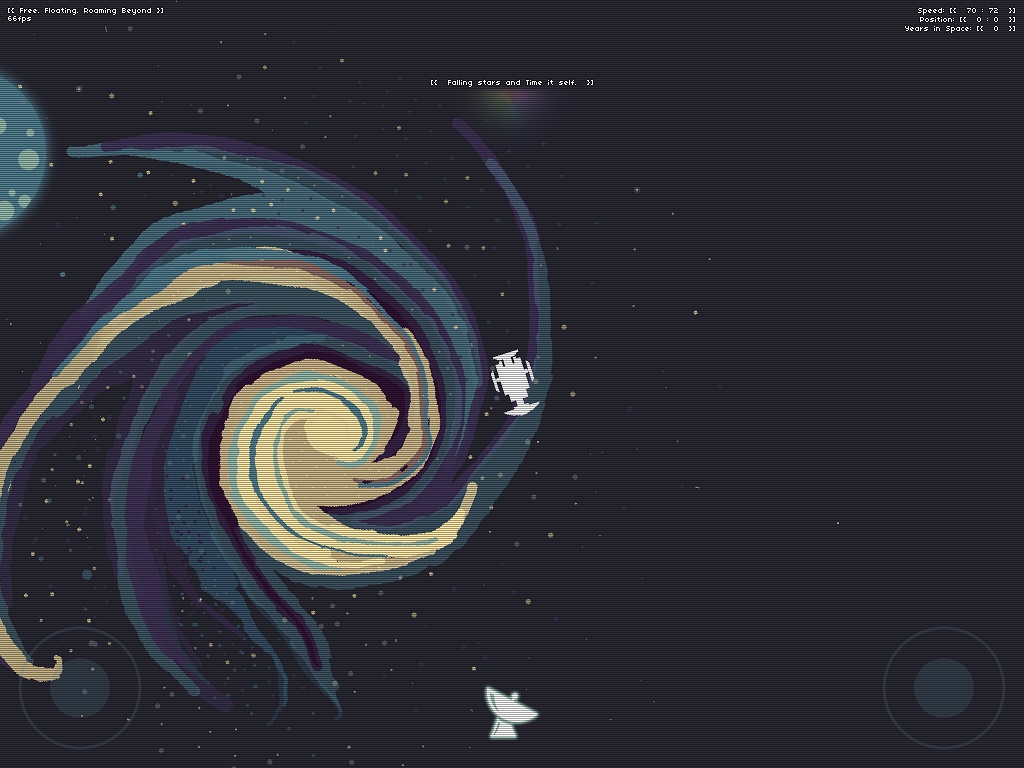
That sense of discovery is there too as you move your little pixelated ship through procedurally generated space. You have the generic-sounding “resources” to power your spacecraft and as you explore, you collect materials from planets, moons and NASA space debris. Because the environment is procedurally generated, you never know what you’re going to run into. You could run out of resources by flying and not finding anything or you can explode within the first 30 seconds by colliding with an asteroid. There is an arrow that points you in the direction you have to go, but it doesn’t take into account the giant suns that pull you in with gravity and burn you alive. Passing an array of solar panels could trigger nothing (you could actually fail an exploration task or waste resources), or you could suddenly enter a poetic state, talking about your daily routine of nothing. The randomness of it is compelling enough to keep you playing for hours, wanting to get at each corner of the game and complete all three chapters.
 Keep scrolling for more great stories.