In 2024, Sacha Baron Cohen summed up the genius of his Ali G character in a single sentence: “Take the most stupid person in the world and put him next to the world expert.” By placing his clueless white rapper alter ego opposite a dignified individual such as Buzz Aldrin—or a self-important megalomaniac like Donald Trump—the friction between the two very different men was practically guaranteed to be funny.
More than 25 years ago, Ali G was an avatar for our superficial, dumbed-down culture, which was stuffed full of self-promoters and wannabe celebrities, all of them blissfully walking through life without a care for how ignorant they were. Like Baron Cohen’s other popular creation Borat—who was introduced to the wider world on Da Ali G Show—Ali G proudly shared his regressive views with anyone who’s been stuck in a room with him. For his on-camera subjects, the experience was hell, but for those of us enjoying watching his targets squirm, it was comedy heaven.
But there was always a larger point to Baron Cohen’s cringe comedy. It wasn’t simply that he wanted to make his subjects uncomfortable, he also wanted to expose the misogyny, racism, and hypocrisy rampant in so-called polite society. And although Baron Cohen got his start skewering his British homeland, he found his greatest success—and his most appealing target—by visiting the United States. Da Ali G Show, which ran from 2000 to 2004, found him talking to notable Americans, but it was 2006’s Borat that highlighted something deeply rotten—but also, occasionally, truly beautiful—about our country. One of this century’s pinnacles of prank comedy, Borat had Baron Cohen’s Kazakhstani journalist making an ass of himself—and of many ordinary Americans he encountered along the way—while chronicling the widening ideological divides that were ripping the nation apart after 9/11.
Borat may have gone back to Kazakhstan at the end of that smash film, but it’s fair to say that, metaphorically, Baron Cohen never left America. Nearly everything he has made since Borat has been about this complicated, terrible, fascinating nation. Baron Cohen is back again this week with Ali G taking aim at the U.S. But while the country has only grown more challenging and unrecognizable, Baron Cohen’s played-out comedic style has failed to keep pace.
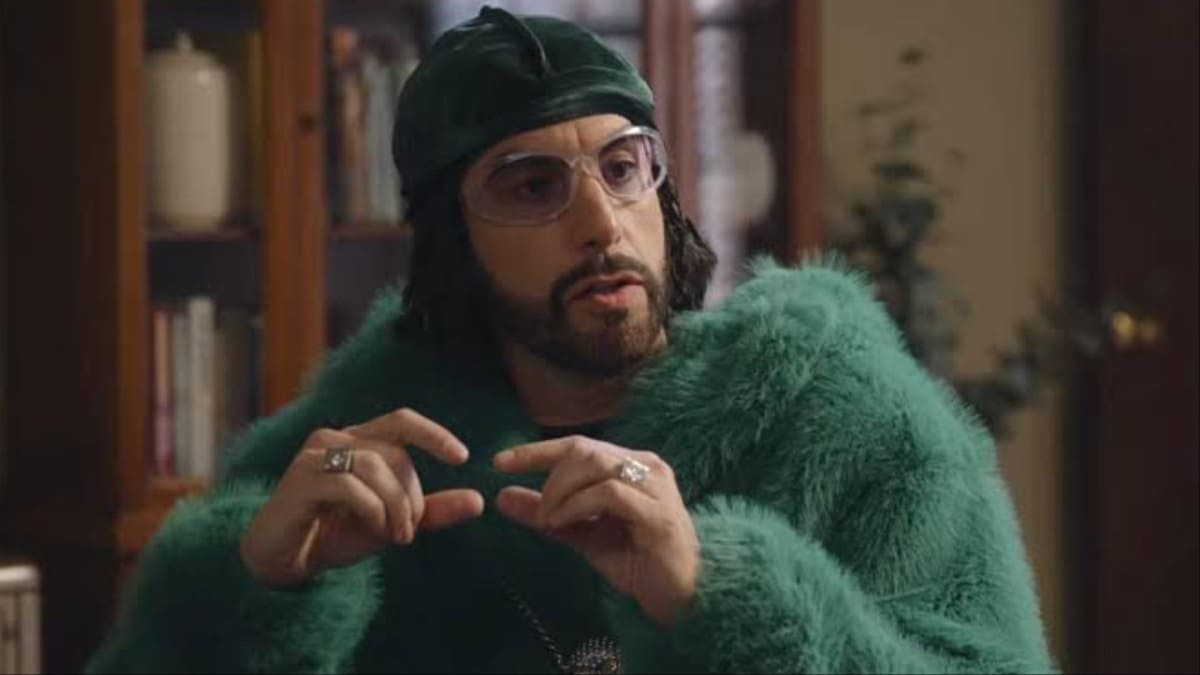
Ali G: Who Iz I? is the first Ali G film since 2002’s Ali G Indahouse, and it follows the misadventures of the woeful British musician/personality as he tries to launch a comeback. Unbeknownst to Ali G, however, he has landed in the crosshairs of Who Is America?‘s smug, woke white intellectual, Dr. Nira Cain-N’Degeocello (also played by Baron Cohen in disguise), who wants to out Ali G as a cultural appropriator. Also showing up is Who Is America?‘s Erran Morad (Baron Cohen again), an Israeli antiterrorism expert who ends up briefing some real-life right-wing politicians and conservative conspiracy theorists on the finer points of ass weaponry.
As in Borat, Brüno, The Dictator, and Borat Subsequent Moviefilm, Ali G: Who Iz I? is about Baron Cohen’s buffoonish characters interacting with befuddled Americans who struggle to make sense of these weirdos. The film is the expected combination of a loose, overarching narrative and a series of prank segments in which, for instance, Ali G tries to unload a pricey Los Angeles mansion he bought but can’t afford. But unlike Baron Cohen’s earlier prank films, he directed Ali G: Who Iz I? himself, opening the movie with a very solemn (and very real) quote from French philosopher Voltaire: “Those who can make you believe absurdities can make you commit atrocities.” Ali G: Who Iz I? may be about bringing a once-popular comic character out of mothballs, but that Voltaire line announces Baron Cohen’s serious intentions.
Even if there’s nothing particularly fresh anymore about Baron Cohen’s satirical approach, it can still be effective. The new film’s opening credits take pains to let the audience know how few actual actors are in the movie, and how many of the people we will see are not in on the joke. Doubling down, Baron Cohen points out every single individual in the end credits who didn’t realize the whole thing was a bit. You would think, at this point, everyone on Earth would be aware of Ali G—especially folks who work in media—and yet Ali G: Who Iz I? contains some remarkable sequences in which record-label executives and Republican operatives fall for the comedian’s shtick. Without spoiling some of the film’s surprises, it’s shocking what he and his doppelgängers are able to get people to do.
It’s in these moments when his serious intentions pay off. The comedy of Ali G may have started out as a dumb guy talking to a smart guy, but like Baron Cohen’s other characters, the faux-rapper eventually evolved to make room for different kinds of interactions. Baron Cohen’s prey soon also included hucksters, fools, and people willing to go along unquestioningly with absurd or offensive behavior. The infamous incident from a 2003 Da Ali G Show episode in which Borat convinced patrons at an American honky-tonk to join in on his song “In My Country There Is Problem”—a.k.a. “Throw The Jew Down The Well”—was a prime illustration of that Voltaire quote. Even if, as some who were at the bar later claimed, everybody knew it was a joke, Baron Cohen provocatively demonstrated how frighteningly easy it is to rally a permissive crowd in a spirited antisemitic singalong.
Since then, he has only been more fixated on how Americans can be seduced by bigoted ideology. If the original Borat exposed pockets of xenophobia and sexism within the country—while also highlighting our penchant for kindness and generosity—the 2020 sequel Borat Subsequent Moviefilm seemed more despairing about the state of the union, made by a man who feared what had become of America in the wake of Trump.
“I feel very privileged to have been brought up in a democratic country,” Baron Cohen toldThe Washington Post in 2021. “And you know, democracy, with all its faults, it was something that I felt you have to…actually be active to defend. I’m not saying I defended it, but it was my attempt and it was the reason why the crew I had and the writers, and Maria Bakalova, the brilliant actress who plays Borat’s daughter, took these real risks making that movie, because we were just really scared that American democracy was disintegrating.”
Anybody who lives in the U.S. knows that his concerns are well-founded. But too often, whether it’s in Brüno,Who Is America?, or his latest film, the tortured fussiness of his prankster satire has overshadowed his cogent points. Even worse, he has now spent two decades making those points in the exact same way. Right-wingers being exposed as morons or monsters is funny the first time, maybe even the fifth time. But even when Ali G: Who Iz I? lays bare the idiotic paranoia around “woke” or transgender issues, it never feels like a revelation. Mostly, you’re focused on trying to figure out how Baron Cohen managed to fool people. What was once a marvelous magic trick now feels like a bundle of convoluted machinations.
But it’s not just the familiarity of his comedic approach that nullifies its effectiveness. While Ali G: Who Iz I? is not, strictly speaking, a documentary, Baron Cohen (as always) is operating in the nonfiction space by staging stunts and engaging in unscripted conversations with real people. And in a year of so many incredible documentaries that challenge the format’s conventions and, crucially, innovatively investigate many of the same societal worries that Baron Cohen does, Ali G’s unfunny bits feel dreadfully insufficient at meeting this perilous cultural moment.
It may be unfair to stack a unicorn like You Can See Everything up against Ali G: Who Iz I?, but Nathan Fielder and Lance Oppenheim don’t just examine the precariousness of our post-truth reality, they also invite the audience to question the authenticity of literally everything they’re seeing on screen. But there are plenty of other examples of smarter, sharper work than Baron Cohen’s that get to the heart of America’s messy, beautiful, troubling weirdness. Take The History Of Concrete, which serves as a natural extension of HBO’s How To With John Wilson, both projects allowing filmmaker John Wilson to meet “everyday” Americans and letting their eccentricities speak for themselves—as opposed to through the filter of some “crazy” fictional character acting nonsensically in front of them. And while there’s nothing funny about the stark documentaries My Undesirable Friends (about exiled independent Russian journalists trying to start new lives) and NAZA (which consists of Israeli military operatives’ damning testimony about the ongoing genocide in Gaza), their exploration of authoritarianism and cruelty elsewhere—while tying those atrocities to America’s complicity—is far more urgent and devastating than anything in Baron Cohen’s weak spoofs. Comedy can be a powerful force of social criticism, but only if the comedy has teeth.
All great comics face the same dilemma: They blaze new trails, then become victims of their own success. Something that was once hilariously shocking is eventually considered passé, inspiring newer talents to further push the boundaries of taste or edginess. Whether it’s The Colbert Report or Philomena Cunk, others have built on Baron Cohen’s ideas, with the “fake” Stephen Colbert discovering fresh approaches to play the idiot in order to reveal the stupidity and greed of U.S. politicians. And then there are the lovable bozos of Jackass, who have been going about as long as Baron Cohen. Johnny Knoxville and company’s outrageous tomfoolery, which incorporates stunts and pranks and lots of broken bones and male bonding, has far more pointedly (and hysterically) dissected and subverted traditional American masculinity.
To varying degrees, these comics and documentarians are standing on the shoulders of what Sacha Baron Cohen first dreamed up, utilizing absurdity and role-play to confront a country that is increasingly ridiculous and dangerous. (His influence is sometimes readily apparent: Fielder was a director on Who Is America?, and Nathan For You alum Jason Woliner helmed Borat Subsequent Moviefilm.) Ali G: Who Iz I? has little original to say about the many ills plaguing America, but it is a reminder that Baron Cohen gave subsequent generations the tools to attack the land of the dumb and the home of the shameless in invigorating new ways.


 Keep scrolling for more great stories.