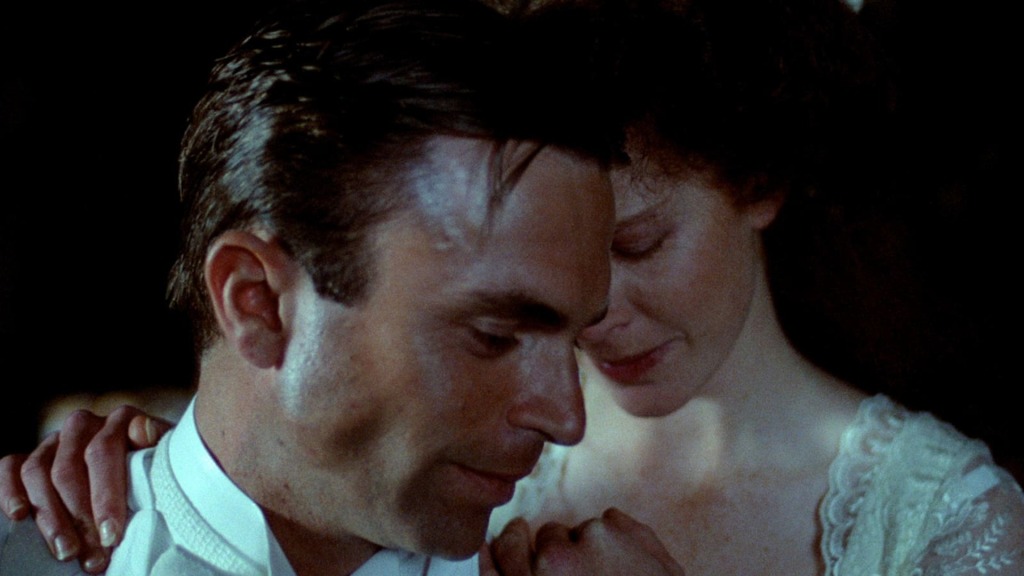
Neill plays Harry like a man who’s cracked open his heart too widely, leaving him open to getting hurt. His insecurity and youthful inexperience cause him to make hasty moves, and the career-focused Sybylla realizes he’s too in love with her. When she tells him, “There’s something I must say…” he whips around so quickly, so hungry for affirmation, that even when she asks for more time before committing to him, his response is to melt around her, gently kissing her as passion sweeps over them both. Later, when they’re reunited, and Sybylla tells him what he doesn’t want to hear, he begs her, “Don’t you love me even a little?” Throughout the rest of the scene, he winces silently from the pain of heartbreak while sharing one last tender moment in the remote Australian bush before going their separate ways.
A few years later, Neill played another character in the throes of heartbreak, this time in the messy divorce fable Possession. As Mark, Neill swings through many extremes as a husband aggrieved to learn, upon returning back home, that his wife is leaving him for someone else. Within a few short scenes, Neill deconstructs his character into an unhinged performance of raw emotion, one even more disturbing than his turn in John Carpenter’s In The Mouth Of Madness. It may be Isabelle Adjani’s character who’s possessed by an otherworldly psychosexual monster, but opposite her, Neill’s character becomes equally consumed. As Neill warps into a self-destructive powerhouse, he shows an ability to cut loose and let chaos reign through every maniacal smile and twitch. His bright blue eyes shift from panic, stuck on the horror that everything has gone terribly wrong, to downright hateful, ready to tear himself apart over losing his beloved and burn down the world around him with it.
It’s a physically and emotionally demanding role that sends Mark (Neill) through a drug-induced withdrawal after she leaves him, rocking menacingly in a chair while demanding she stay with him, or scream and cry in the kitchen after yet another fight. In his pain, he lashes out, maybe not as cinematically as Anna (Adjani) spilling milk all over a tunnel, but in a threatening, disturbing way, vacillating between falling apart and regaining minute-to-minute lucidity. It’s the kind of wounded intensity Neill returns to as the villain in Jane Campion’s The Piano, who, after learning that his wife has cheated on him, maims her in an attempt to keep her to himself.
Later in Neill’s career, he shifted that ability into his many roles as a reluctant father figure, bringing a calming presence to worlds that feel out of control. Many of these characters, like Dr. Alan Grant in Jurassic Park and Hector in The Hunt For Wilderpeople, are stoic types, guarded from taking on any new responsibilities—like kids. As Dr. Grant, Neill became an international superstar, and his narrative arc is just as crucial to the story as the dinosaurs. Neill played a man who didn’t want to grow up and potentially leave a travel-heavy career for the sake of the children that his partner wanted. He has no fatherly instincts, or so he thought, until he has to step up to save the grandchildren of the park’s proprietor. He reassures them, talks through their fears, and protects them like few other adults on the island. He even plays a dad joke on them when scaling the electric fence for good measure. It’s that shape––that of a man learning to care more about others and getting back in touch with a vulnerable side––that Neill made into his sweet spot.
It’s no surprise that Neill was as vulnerable offscreen as he was on it, passionately advocating for causes near to his heart. He championed New Zealand cinema throughout his career, especially in a 1995 special he led called Cinema Of Unease: A Personal Journey By Sam Neill made around the height of his fame. His calming, reassuring demeanor also became an oasis on social media, where Neill thrilled his followers with updates on nearby animals, and championed Aboriginal recognition and environmental issues. Cinema has lost one of its most thoughtful and vulnerable performers, one who left audiences with so many good movies to remember him by because he found the aching heart inside each role.


 Keep scrolling for more great stories.