
Wingspan designer Elizabeth Hargrave hits the beach with Sanibel
Hargrave's lightest release yet is a real shell game.
Images: Avalon Hill
Elizabeth Hargrave has carved her name into board game history with Wingspan, one of the most popular and acclaimed games ever published, which is about to get its third major expansion this year with Americas. Her latest game, Sanibel, is one of her lightest games yet, a thematic shift from her more science-driven titles, but a game you’re more likely to be able to play with your kids.
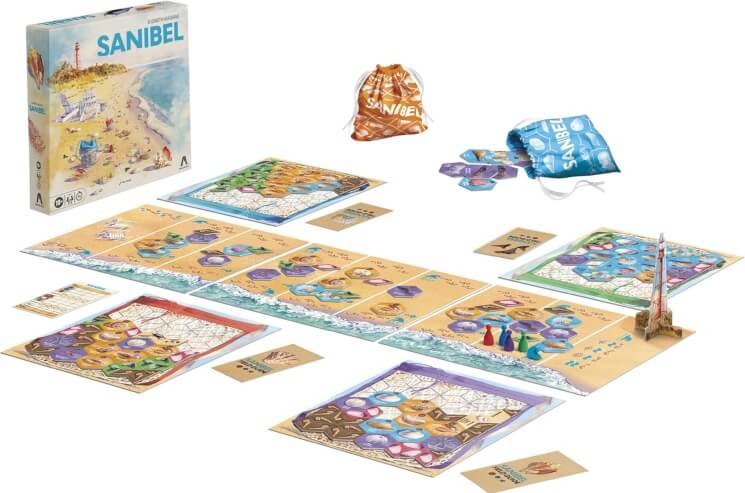
Sanibel is a light set collection game where the complexity only appears in the scoring, although that means to play it well you do have to have a plan. There are six types of shells you can collect while you move your meeple along the beach, three that come on diamond-shaped tiles and three on hexagonal tiles, and each of those six scores in a different way. Each shell type has a different colored background and symbol for easier identification. Some shell types want to be next to each other, some want to be in pairs, some can’t touch each other at all to score. Some score just through sheer quantity; some want a giant cluster but only of unique shells within that group.
On your turn, you’ll move your beachcomber at least one section forward—you can move more than one section but it’s usually going to make more sense to go one—on to a space marked one, two, or three. You then select that number of diamond and/or hexagonal shells from that section of the beach and place them on your board as if you were dropping them into a bag, so gravity pulls them down until they hit the bottom or they hit at least one edge of a piece already on your board. Each player’s board has lines on it marking various spaces; you can place shells across those lines, but you can’t split a space into two.
Turn order isn’t fixed in Sanibel, which is why you might sometimes choose to take fewer shells from a section. The player the furthest back on the track goes next, and in each section, the space numbered one is the furthest back while space three is the farthest forward. (In the vernacular of board gaming, this is called a “time track.” I first encountered it in Glen More, and it appears in popular games like Patchwork, Tokaido, and The Search for Planet X.) Grabbing space three in the next section means you’ll get the two or the one in the section after that.
 Keep scrolling for more great stories.