Although it doesn’t become clear until nearly two hours into this 149-minute film, Sound Of Falling is a ghost story. The spirits that haunt writer-director Mascha Schilinski’s sad and transcendently beautiful family drama don’t shake bedframes or knock over vases; at most, they’re a soft exhale, a blurry smudge at the edge of a photograph. And although the living, especially children, occasionally acknowledge their presence, for the most part they hover unseen, watching helplessly as the cycles that caused them so much suffering repeat themselves over the generations.
These ghosts are introduced to as living girls, with names and personalities and relationships with their family members. Some of these dynamics are relatively healthy, while others are deeply malignant. It’s not clear at first which are which, nor is it obvious which of these initially bright and playful youngsters will have the light in their eyes extinguished by the end of the film. But Schilinski doesn’t withhold this information in order to create suspense. She’s more interested in weaving a layered, multi-generational portrait of four generations of daughters, all growing up in the same stone farmhouse in the German countryside.
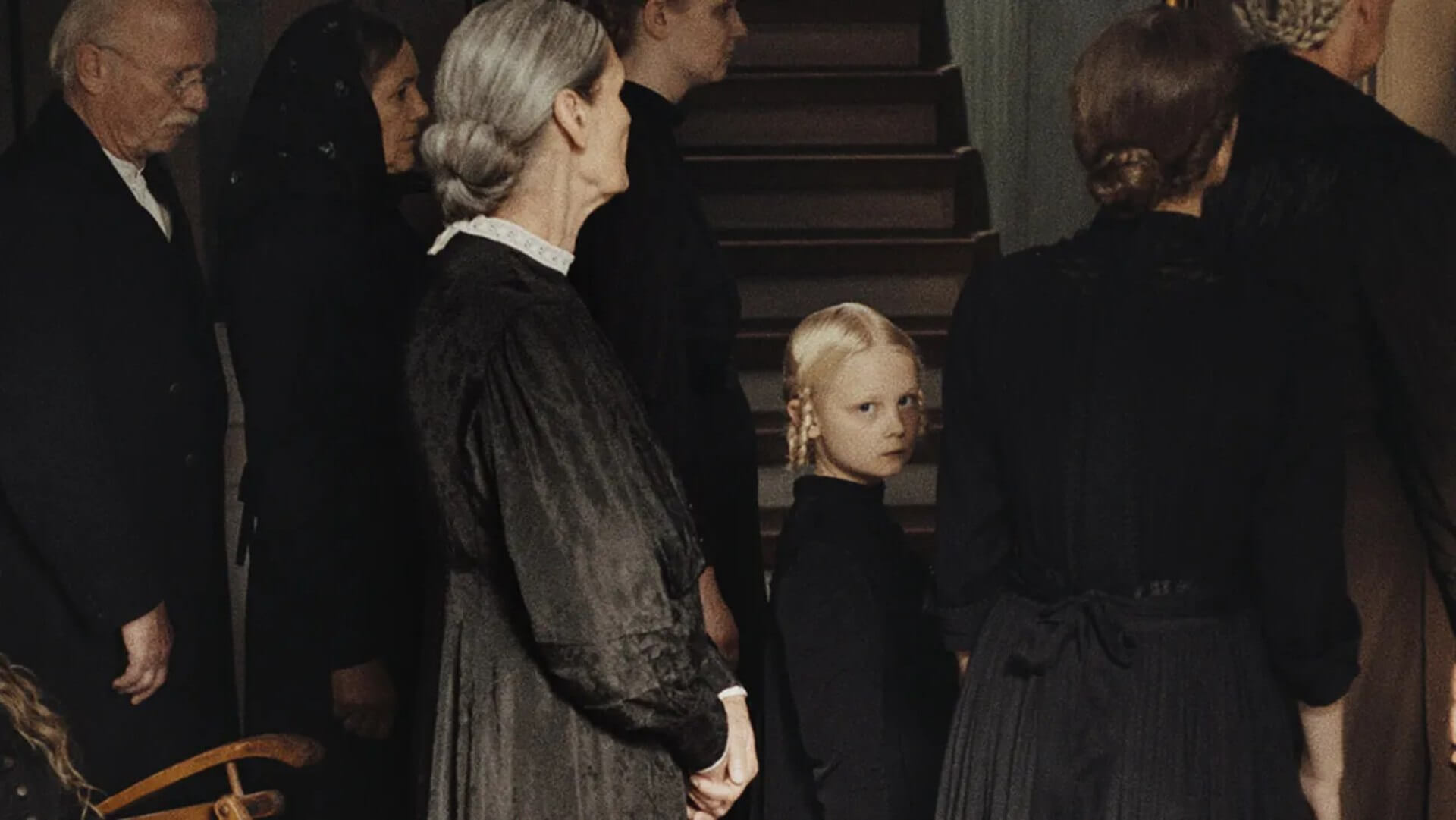
Will it be Alma (Hanna Heckt), a seven-year-old girl and the youngest of many siblings on a working farm in the shadow of WWI? Erika (Lea Drinda), Alma’s niece, who’s introduced as she practices hobbling around on one leg, binding it tightly to mimic an amputation? Or perhaps Angelika (Lena Urzendowsky), who doesn’t dare burden her already-troubled mother—Erika’s younger sister—with the secret of her uncle and cousin’s unwanted sexual attention? By the time we meet Lenka (Laeni Geiseler) in the 21st century, some of these cycles seem to have been broken. Then a neighbor girl, Kaya (Ninel Geiger), re-introduces an element of danger to Lenka’s lazy summer afternoons, and the echoes of the past are heard once more.
All of these girls—and their sisters, who fill out the ensemble alongside brothers, uncles, lecherous farmhands, distant fathers, and mothers with stomach issues—have a certain morbid sensibility. Schilinski does as well. Throughout Sound Of Falling, the filmmaker sprinkles in moments of grim poetry, from the post-mortem photograph of a deceased sibling (also named Alma, wearing the same dress as the living girl) that fascinates Alma during family gatherings to the throat-catching moment when you realize what the film’s title actually means. These characters are drawn to the void. They desire weightlessness, imagining what it would feel like to catch the breeze and be lifted into the sky. And why wouldn’t they? Every day, the world finds a different way to tell them that they don’t matter.
Schilinski’s style is impressionistic, using recurring images of phallic eels, buzzing flies, and murky, mysterious water to express the psychosexual pressure building inside these characters. Several references are made to mothers whose bodies “do what they want;” they’re keeping the score, one might say, reminding them of emotions that these women—the ones who managed to survive their girlhoods—have tried to forget. In this family, work and duty are all that matter, and feelings and trauma are not discussed. That repression is killing these girls, and that is what Sound Of Falling is about.
Schilinski and cinematographer Fabian Gamper combine evocative closeups with long, composed wide shots that observe the family with the distant, but detailed eye of a painter—or perhaps one of the souls that once inhabited the house, taken before her time. These combine with haunting sound design and music, with Swedish singer-songwriter Anna von Hausswolff‘s ethereal “Stranger” serving as a sort of anthem for the film. It’s a song about uncertainty and fear, and it suits Schilinski’s film perfectly.
Every detail in Sound Of Falling is in service of creating its dreamy yet unnerving atmosphere, and Schilinski’s aesthetic judgement is exquisite throughout. That being said, the film does require patience, making its points with small details and subtle rhymes rather than grand drama. This approach will be too slow and rigorous for some, but it, too, has a purpose: The profound sorrow of Schilinski’s film comes on slowly, but it clings to the viewer after the movie has ended like the smell of smoke on a winter coat. Or, perhaps, like a lonely ghost who just wants to be heard.
Director: Mascha Schilinski
Writer: Mascha Schilinski
Starring: Hanna Heckt, Lena Urzendowsky, Laeni Geiseler, Susanne Wuest, Luise Heyer, Lea Drinda
Release Date: January 16, 2026


 Keep scrolling for more great stories.