In the year-long series Sounds Of Blaxploitation, Craig D. Lindsey plays the hits that defined a genre, drawing connections between the music of the moment and the films that gave it a platform.
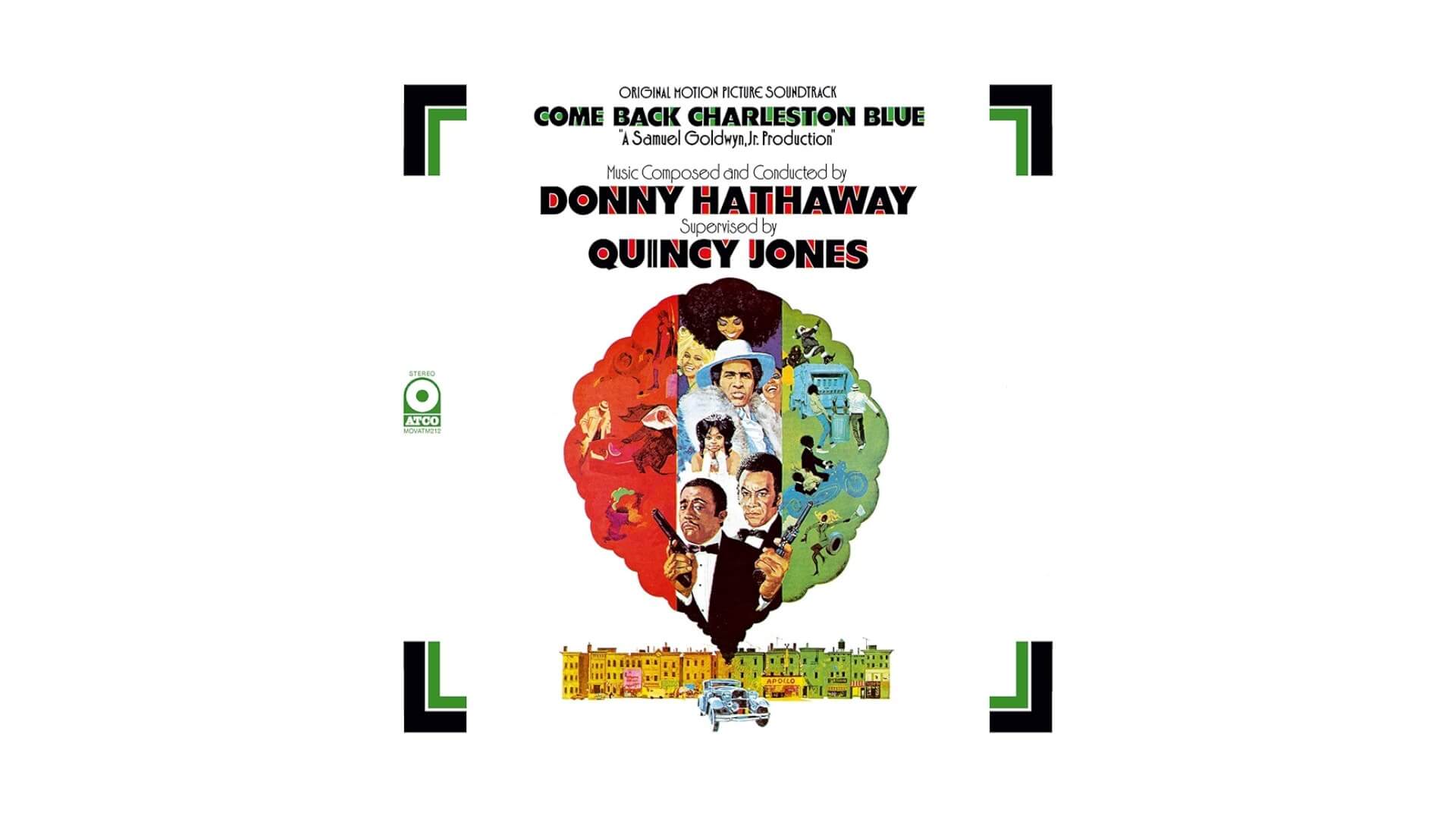
If it wasn’t for musician-producer-composer Quincy Jones having a lot on his plate back in the early ’70s, we would’ve never gotten the single great soundtrack album made by a musician who died far too early: Donny Hathaway. When Jones got the offer, he was simply too busy to score Come Back, Charleston Blue, the 1972 sequel to Ossie Davis’ pulp adaptation Cotton Comes To Harlem.
Come Back, Charleston Blue (based on Chester Himes’ 1961 novel The Heat’s On, from the Black novelist’s legendary Harlem Detective series) sees comedian Godfrey Cambridge and stage/screen veteran Raymond St. Jacques return as Gravedigger and Coffin Ed, a pair of sarcastic, rule-breaking cops who go after anyone—Black or white—who brings crime and corruption to the slums of Harlem.
To handle the soundtrack for this follow-up, Jones hollered at a young Chicago singer-songwriter whom he toured with in 1971. Jones had taken a liking to Hathaway, who already had two solo albums under his belt and previously wrote songs over at Curtis Mayfield’s Curtom Records. According to Jones’ memoir Q: The Autobiography Of Quincy Jones, he tutored the on-the-rise R&B star on orchestration, beginning with Maurice Ravel’s score for his ballet/concert work Daphnis Et Chloé. “Donny got it quick; he was truly a genius,” Jones remembered. Jones even gave him a public co-sign back then, stating in print, “His is a creative musical talent that comes once in 50 years. Black people need him.”
With Jones taking on a supervisor role, Hathaway was given the reins on his first movie gig: composing and arranging for Come Back, Charleston Blue, which was directed in madcap fashion by Black TV staple Mark Warren (Sanford And Son, The Dukes Of Hazzard). In the film, Coffin Ed and Gravedigger investigate a string of murders and robberies that people on the street believe is being committed by Charleston Blue, a straight-razor-carrying vigilante who’s been missing and presumed dead since the ’30s.
Since the movie’s tone is all over the place—going from screwball to action-packed to downright dour—Hathaway’s score is just as loose and unpredictable. It all starts with the main theme, a rousing, Dixieland-style romp that plays over the opening title sequence, which features the surreal sight of two tuxedo-wearing goons—a tall guy and an actor with dwarfism—getting into a motorcycle/sidecar left by a guy in nun drag.
They’re on their way to a gala where Coffin Ed and Gravedigger are serving as security. We also get Hathaway showing off his skills as a big-band arranger during this scene, as an on-screen band pretends to play his foxy, swinging numbers (aptly titled “Basie” and “Come Back Basie” on the soundtrack album) for guests on the dance floor.
The old-timey music returns with “Scratchy Record,” a ragtime number that shows up whenever the dialogue or action in a scene is related to Charleston Blue. (It sometimes sounds like it’s coming out of a vintage tube radio.) But on the whole, it’s mostly ’70s-era soul and funk on the score. The chase scenes are predictably, ferociously funky, with Hathaway composing anxious, ticking instrumentals filled with squirrelly keyboards, rabid bongos, and an oily bass riff. There’s little information available about the session musicians appearing on the Charleston Blue soundtrack, but there are several guitar licks that sound like they’re from guitarist and longtime Hathaway collaborator Phil Upchurch.
Hathaway also gives us a taste of the sweeping, soulful orchestrations he would bring to Extension Of A Man, his third and final solo album, only one year later. During a montage of early-morning Harlem, the amazing “Harlem Dawn” plays, with Hathaway twinkling the keys and making some joyful noises while commanding a hellacious horn and string section. For the film’s most dramatic sequence, which follows a junkie getting high and wandering the scenes, Hathaway goes sinister-then-solemn on “Tim’s High,” ratcheting up the screeching strings before sliding into cascading harp notes and more key-twinkling from Hathaway, who also hits us with some “Lord have mercy” ad-libs.
Speaking of the Lord, Hathaway adds a sorrowful church organ to a scene where a funeral service for Gravedigger and Coffin Ed (don’t worry—they fake their deaths so they can go undercover) is held at their police station. Aptly titled “Gravedigger Jones And Coffin Ed’s Funeral,” the track features dialogue from the scene, including that aforementioned junkie putting a less-than-sober spin on “Swing Low, Sweet Chariot.” (“Gravedigger and Coffin Ed / They was mens but now they dead.”)
We also get a brief snippet of “Little Ghetto Boy,” Hathaway’s oft-sampled tale (find it on Dr. Dre and Wu-Tang tracks) of a kid’s inner-city blues, which is playing in a junk store in one scene. Although Hathaway first dropped the tune on his Donny Hathaway Live album, released earlier that year, the Charleston version is a studio-quality jam produced by Atlantic Records’ Jerry Wexler and Arif Mardin, and remains one of Hathaway’s most lasting creations. (Lalah Hathaway, Donny’s daughter, recorded a cover of it back in 2015.) The film closes with the title track, a jazzy, ethereal duet between Hathaway and Valerie Simpson (of the singer-songwriter duo Ashford & Simpson), written by Hathaway, Jones, and veteran Motown songwriter Al Cleveland, playing over the snowy end credits. (Hathaway sings the tune with ATCO labelmate Margie Joseph on the album.)
Come Back, Charleston Blue was just one of many major projects Hathaway did in 1972. Along with his live album, he teamed up with Roberta Flack for their Grammy-winning duets album Roberta Flack & Donny Hathaway. He also produced First Taste Of Sin, the third album from Oakland blue-eyed soulsters Cold Blood. He even performed the theme song to the All In The Family spinoff Maude, starring future Golden Girl Bea Arthur.
Sadly, during this time, Hathaway was frequently hospitalized, and eventually diagnosed with paranoid schizophrenia. The mid-’70s saw him fall into a career-sidetracking spiral of depression, mood swings, and paranoid delusions. In 1979, after working with Flack in New York on another album that was aborted due to Hathaway’s erratic behavior, he took his life by jumping off his hotel room balcony. He was only 33. (The two songs he did with Flack were posthumously released on her 1980 album Roberta Flack Featuring Donny Hathaway.)
Like most wunderkinds whose personal demons led to a tragic death, Hathaway left behind a small but awe-inspiring body of work. In just one year, he proved he could be a producer for other artists, an award-snapping duet partner, a TV-theme composer, and—as Come Back, Charleston Blue wonderfully demonstrated—a worthy replacement for someone as legendary as Quincy Jones. Although one always wonders what could’ve been with a talent like Hathaway, the music he did leave us with—from his handful of solo albums to his one-and-only film score—remains timeless, masterful, and more than enough.
Next time: The hardest-working man in show business gets into the Blaxploitation game.


 Keep scrolling for more great stories.