In the year-long series Sounds Of Blaxploitation, Craig D. Lindsey plays the hits that defined a genre, drawing connections between the music of the moment and the films that gave it a platform.
It was inevitable that James Brown would score a Blaxploitation movie. The man they called, among other things, the Hardest Working Man In Show Business, was dropping funky, Black-and-proud anthems all throughout the late ’60s and early ’70s. Providing theme music for a big-screen antihero of color was the next logical step. Released in 1973, Black Caesar is another Blaxploitation fave that Quentin Tarantino has lifted bits and pieces from throughout his career (yes, a sliced-off ear does make an appearance).
Writer-director (and B-movie veteran) Larry Cohen’s darker-skinned, Afro-filled take on such pre-Code gangster classics as The Public Enemy,Scarface, and—of course—Little Caesar, Black Caesar chronicles the meteoric rise (and inevitable fall) of power-hungry Harlem crime boss Tommy Gibbs, played by former pro-football player Fred Williamson. As expected, Brown’s soundtrack for the gangster saga is a ferocious collection of righteous funk. “The other soul-oriented soundtracks were excellent, but the albums sounded like another good collection of soul songs,” Brown said in 1974. “Our album doesn’t sound like any other James Brown album, nor does it sound like any other soundtrack album.” Just as Williamson’s character was billed in promotional material as “The Godfather Of Harlem,” Brown gave himself a new moniker for the soundtrack, crediting himself as “The Godfather Of Soul.”
There are actually two bands Brown worked with on this album. One saw Brown and trombonist/bandleader Fred Wesley collaborate with session musicians (including trumpeter Randy Brecker, drummer Steve Gadd, bassist Buster Williams, and guitarists Hugh McCracken and David Spinozza) for some incidental pieces and a couple of narrative numbers.
During the opening credits, where a young Gibbs flees the scene of a mob hit he participated in, they perform the theme “Down And Out In New York City,” penned by film and TV songwriters Bodie Chandler and Barry De Vorzon. Brown mightily belts out Gibbs’ backstory—growing up poor, desperate, and shining shoes for “all the fat cats in the bad hats.” The ensemble performs again for the somber “Mama’s Dead,” during a cemetery scene where Gibbs visits his late mother (Minnie Gentry). It’s hard not to inappropriately chuckle when you heard Brown utter the titular words out of nowhere, basically filling a plothole and notifying the audience of an offscreen death that Cohen either cut out or didn’t have the time or money to film.
As for the rest of the score, Brown brought in his backing band The J.B.’s, fresh from making their vinyl debut the year before with the Food For Thought LP. They came up with furiously funky tracks—from sessions where they were clearly riffing and ad-libbing until they hit rhythmic paydirt—that would end up being incessantly sampled in hip hop songs. Somanysongs from my youth flashed in my head when I heard longtime Brown guitarist Jimmy Nolen’s famed groove from “Blind Man Can See It,” heard when we’re introduced to a grown-up, lame-legged Gibbs, walking down the street.
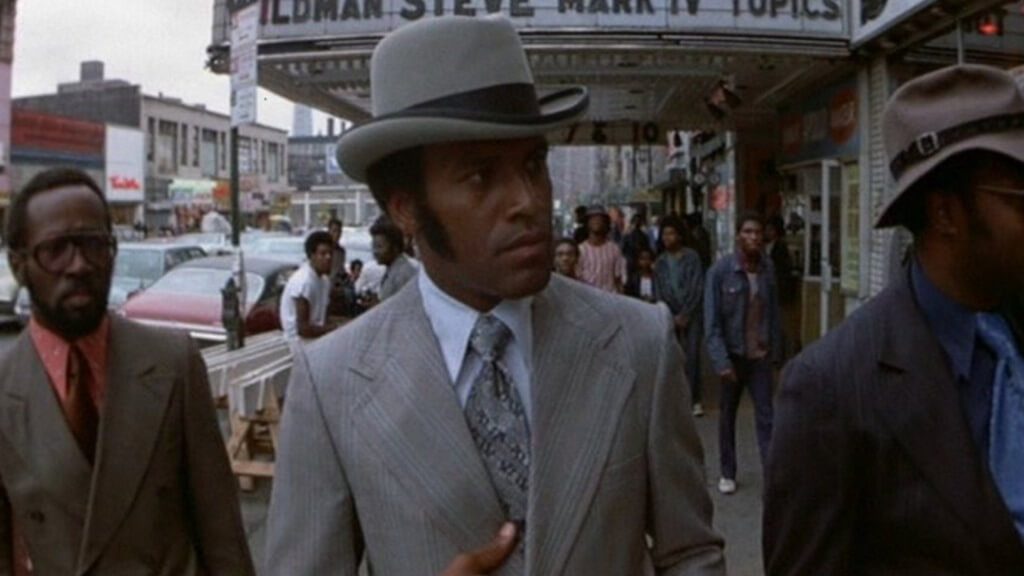
It’s also on the street where we see Gibbs and his boys walking to the horn-heavy classic “The Boss.” Now in kingpin mode, Gibbs saunters around like Harlem royalty, while Brown sings about paying “the cost to be the boss.” It’s used ironically in another street scene, where he gets shot by a hitman and stumbles around New York—a victim of his own greed, wallowing in the muck of avarice, as an erudite wrestling legend once said.
Although Black Caesar spans nearly 20 years, beginning in 1953, Brown’s music is usually playing, even during times when Brown wasn’t a (Black) household name yet. In a scene where young Gibbs is laid up in the hospital with a cast-up leg, after a scuffle with a corrupt cop/future nemesis (Art Lund), he’s listening to Brown’s rowdy “Make It Good To Yourself.” Brown enthusiasts might find this a bit hard to swallow, since he didn’t record any music until 1956, when he and the Famous Flames released “Please, Please, Please.” But “Good” pops up again during a more appropriate era, playing at a party the adult Gibbs is throwing at his pad.
The bluesy “Like It Is, Like It Was” also plays twice in Caesar. A different lyrical version plays during a bed scene with Gibbs and his lounge-singing gal (Gloria Hendry) that unfortunately turns into a rape scene. (In a nightclub scene, Hendry appears onstage lip-syncing to the Brown rouser “Mama Feelgood,” performed by Brown protege Lyn Collins.) “Like It Is, Like It Was” appears again when Gibbs, still holding that gunshot wound, gets on the subway and travels back to his torn-down neighborhood. While the song begins with Southern gentleman Brown riffing, “New York City’s alright, but I wanna go home,” it starts in the movie with “I wanna go home” as Gibbs staggers down the stairs. “The Boss” also appears ironically one last time when Gibbs is surrounded by some ’70s era YNs.
While Black Caesar the movie became a box-office hit, taking in $2 million, Black Caesar the soundtrack also flew off record shelves, peaking at number two on Billboard‘s Soul LPs chart. With Brown now officially a film composer, he moved on to scoring the Jim Brown sequel Slaughter’s Big Rip-Off later that year, once again featuring the J.B.’s and Lyn Collins. When Cohen and WIlliamson predictably made the Black Caesar follow-up Hell Up In Harlem in 1973, of course Brown had an album of tunes all ready for them.
Unfortunately, distributor American International Pictures rejected it for its lengthy numbers, replacing it with a soundtrack by Motown songwriters Fonce Mizell and Freddie Perren, with vocals from Edwin Starr. Considering that Brown eventually released his Hell Up In Harlem album in 1974 as the gold-selling The Payback, featuring the immortal, vengeful title track (an obvious fuck-you to AIP), it was definitely their loss.
Next time: How a Stax legend won an Oscar, thanks to a Black private dick that’s a sex machine to all the chicks. Can you dig it?


 Keep scrolling for more great stories.