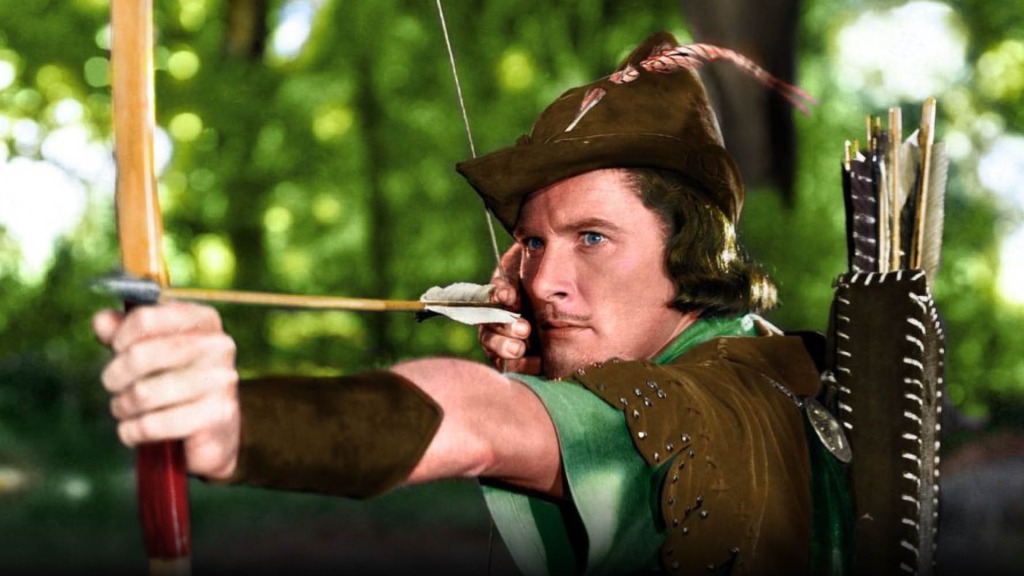
When it comes to reviving classic stories for new generations, the dark and gritty reboot is still the model du jour. This summer Hugh Jackman delivers a grim reimagining of Robin Hood, of all characters, in A24’s The Death Of Robin Hood. It’s part of the inevitable march of time that’s slowly leading to anything made before 1990 being considered an “old movie.” As streaming makes entertainment an on-demand thing and not a “stumble onto something on TCM” activity, we’re increasingly running the risk of losing nearly a century of film history to a generation who find Classic Hollywood filmmaking styles a little bit alien. Luckily, there exists a perfect 100 minutes to convert old-movie skeptics into old-movie fans: 1938’s The Adventures Of Robin Hood, the Errol Flynn romp that holds up as well as any Golden Age Hollywood film.
Like its swashbuckling descendants The Princess Bride and Pirates Of The Caribbean, The Adventures Of Robin Hood seamlessly achieves everything it sets out to do. It’s fun, it’s exciting, it’s romantic. It looks great thanks to its gloriously saturated three-strip Technicolor and the lush Milo Anderson costumes designed to show it off. And it’s filled with genuinely cool swordfights and stunts—many of them performed by the cast themselves. Plus, it’s got a strong moral backbone about the importance of standing up to tyrants and helping the downtrodden; the same sort of principled message director Michael Curtiz would bring to Casablanca a few years later.
Indeed, even if you haven’t seen The Adventures Of Robin Hood, you’ve probably felt its impact somewhere—not just on future Robin Hood stories like the 1973 Disney animated version and Mel Brooks’ 1993 parody Men In Tights, but on the entire action-adventure genre. Composer Erich Wolfgang Korngold all but invented the idea of scoring adventure films to sweeping symphonic scores, and John Williams has cited him as an influence on his own work. The film’s athletic swordplay also served as a huge inspiration on the lightsaber battles in Star Wars—particularly the famous final fight that sees Robin Hood battling down a staircase while his larger-than-life shadow looms on the wall behind him.
Unlike other influential epics that followed, like Lawrence Of Arabia and Ben-Hur, however, The Adventures Of Robin Hood goes down easy. It clocks in at a fleet 102 minutes and maintains a light comedic tone that makes it just as enjoyable for kids as it is for adults. The pacing is incredible, as is the level of spectacle that still looks impressive to modern eyes. And the setting helps bridge one of the biggest complaints people have about “old movies”—that their more heightened, theatrical style of acting feels unnatural. In the banquet halls of medieval England, it all just feels like the haughty banter of Game Of Thrones. (Or at least its lighter spin-off, A Knight Of The Seven Kingdoms.)
On the villain side, Claude Rains, Basil Rathbone, and Melville Cooper have a blast chewing the scenery as, respectively, Prince John, Guy Of Gisbourne, and the Sheriff Of Nottingham; three very different takes on how evil manifests. Meanwhile, Robin’s motley crew includes Alan Hale Sr. as Little John—a role he previously played in Douglas Fairbanks’ acclaimed 1922 silent film version of Robin Hood and would play again in 1950’s Rogues Of Sherwood Forest. (Eat your heart out, Marvel cameos.) The other Merry Men are characters like “guy who is small,” “guy who loves eating,” and “guy who wears red.” The Adventures Of Robin Hood isn’t one to waste screentime on needless backstory.
At the center of it all is Flynn in his signature role—a riff on the same swashbuckling archetype that first made him a star in 1935’s Captain Blood (also directed by Curtiz). If The Adventures Of Robin Hood has a lesson that still feels relevant today, it’s about the importance of finding joy and camaraderie in social revolution. Flynn’s performance serves as the perfect embodiment of that ethos—balancing Robin’s cocky, confident side with a genuine humility and a love of companionship. It feels sincere when he loses his meet-cute duel with Little John and laughs it off with an enthusiastic, “I love a man who can best me!” He’s so charismatic, it’s not hard to believe he could recruit an entire army of men to come live in the woods and fight for justice with him.
In that way, the film’s light touch makes its cheesiness easier to swallow and its earnestness more impactful. Robin has something tangible he’s fighting for, which makes the bravura set pieces that much more exciting—from the famed arrow-splitting scene to all the impressive leaps and bounds around the massive sets. Though Warner Bros. was known at the time for producing smaller gangster films, the studio went all-in on its first big-budget costume drama. The Adventures Of Robin Hood was Warner’s most expensive film to date and it shows in the size of the production and the scope of its action sequences. The whole look of the film is elevated by Curtiz, who was a prolific director in Europe before he came to Hollywood in the 1920s and brought with him a love of sweeping crane shots, complex compositions, and high-contrast lighting in the tradition of German Expressionism. (He replaced original director William Keighley after WB realized his take on the action wasn’t working.)
The real grace note, however, is how well The Adventures Of Robin Hood does by its female characters. There’s a misconception that old films must be inherently more sexist than contemporary ones, but classic Hollywood is actually filled with strong roles for women. Character actress Una O’Connor turns in a hilarious performance as a 50-something lady-in-waiting with an active love life of her own. Meanwhile, Olivia de Havilland’s Maid Marian has great, sparky chemistry with Robin in the third of what would be nine onscreen collaborations with Flynn. In one of the movie’s best exchanges, Marian gasps, “Why, you speak treason!” to which Robin smiles, “Fluently.”
Yet Marian isn’t just there for romance, she has a real moral backbone of her own too. In fact, she has the biggest arc in the whole film—growing from a sheltered noble who assumes the men in charge of the kingdom must be doing the right thing to someone who sees just how much the people of England are suffering under Prince John. As her perspective expands, so does her role in the rebellion. When Robin is captured and sentenced to death by Prince John, Marian is the one who comes up with the plan to save him, which is a very fun role reversal. And though she does ultimately become a damsel in distress in the third act, it’s not because she’s an innocent, weak woman—it’s because she refuses Robin’s suggestion to run away with him and instead decides to stay in Prince John’s castle and actively work as a spy against him.
All of this gives The Adventures Of Robin Hood the same kind of thoughtful, adventure-romance quality as Disney renaissance movies like Beauty And The Beast and Aladdin, which is another reason it remains so accessible to modern audiences. The tone and the story are familiar, it’s the details that are surprising. To some degree, every four-quadrant action blockbuster is still chasing this movie’s highs, including later Robin Hood adaptations like Kevin Costner’s Robin Hood: Prince Of Thieves and Taron Egerton’s Robin Hood. Nearly 90 years later, however, it’s the original Flynn version that’s held up the best.


 Keep scrolling for more great stories.