[Editor’s note: This piece contains spoilers for A Knight Of The Seven Kingdoms.]
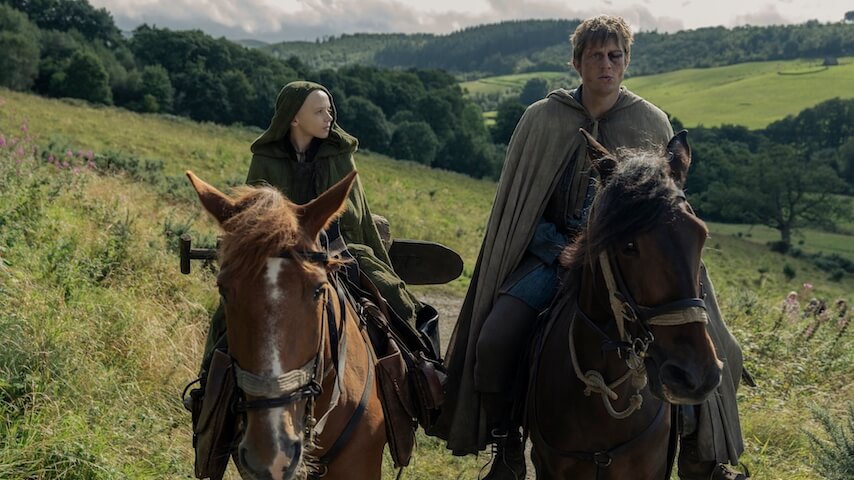
The season finale of A Knight Of The Seven Kingdoms ends with a scene straight out of a Fast & Furious epilogue. Newly battle-worn knight Ser Duncan The Tall (Peter Claffey), his young squire Egg (Dexter Sol Ansell), and a ghostly vision of his former mentor Ser Arlan Of Pennytree (Danny Webb) ride off into the sunset together. Then after a few moments, Ser Arlan peels off, leaving Dunk and Egg to chart their own path. It’s a perfect visual snapshot of the themes of knighthood, mentorship, and legacy that have characterized this funny, sweet, surprisingly emotional little Westeros spin-off. Because while all Game Of Thrones shows have, to some degree or another, been about parenthood, A Knight Of The Seven Kingdoms is the first to put the idea of chosen family front and center.
That speaks to the overall change in perspective that anchors the series. While Game Of Thrones and House Of The Dragon concern themselves with the great houses of Westeros and the hereditary lineages that shore them up, Seven Kingdoms roots itself in the point of view of the smallfolk. Orphaned Dunk has no parents. Hedge knight Ser Arlan has no children. And yet, together, they create a makeshift family legacy that could very well go on to influence the whole seven (well, actually, nine) kingdoms of Westeros. Ser Arlan took a chance on an orphan from Flea Bottom as his squire; now Dunk finds himself as a paternal figure to a Targaryen prince of the realm.
It’s a slight shift from the Tales Of Dunk And Egg novellas, where Dunk is only about 16 years old, which gives him a more brotherly dynamic with nine-year-old Egg, a.k.a. Aegon Targaryen. In casting 29-year-old Claffey in the role, however, Dunk’s dynamic with Egg becomes a more overtly parental one. It’s an idea the show emphasizes with flashbacks to Dunk’s years squiring for Ser Arlan. Dunk grew up with a harsh, often irresponsible, and yet ultimately pretty noble father figure to guide him. Now he’s trying to carry on Arlan’s legacy while also doing a little bit better by his own quirky, bald protégée.
It’s something a lot of characters in the Game Of Thrones universe have tried to do before. Ned Stark may have only lasted a single season, but his children spent the rest of the show trying to live up to his proud, honorable values in slightly less rigid ways, bringing some of their mom Catelyn’s pragmatism into the mix too. Meanwhile, multi-generational families like the Lannisters, the Tyrells, and the Targaryens on House Of The Dragon intertwine love, legacy, and “the family business” in complicated ways.
What makes someone like Tywin Lannister such an incredible character is that he’s at once a fantastic protector of the family lineage and also a really shitty dad to his own children. In the sort of harsh medieval hereditary system that George R. R. Martin created, it’s nearly impossible not to sacrifice one for the other. For her part, his daughter Cersei longs to make her father proud by using her children to claim the kind of power that Tywin craves. And yet she’s also torn between wanting to protect her kids in a way she herself was never protected.
House Of The Dragon takes that core of an idea and expands it into an entire series. The fatal flaw of King Viserys is that in his desire to be seen as both a good king and a good dad, he refuses to make the kind of hard decisions that would allow him to be either. He’s passive where he needs to be decisive. And that spills over into the way his second wife Alicent and his daughter Rhaenyra parent their own kids into a literal civil war. House Of The Dragon is a show about how the messy bonds between parents and children can literally drive a realm apart.
What’s unique about Dunk compared to most Game Of Thrones protagonists, however, is that he doesn’t have a great house to think about. He’s not building a physical legacy to leave behind. In fact, he knows that any squire he takes on will never carry his sigil, just as he wasn’t allowed to carry Ser Arlan’s. And that’s a big part of what makes the relationships on the show so pure. “I was not Ser Arlan’s blood, but I have followed his example,” Dunk tells a crowd of onlookers in the show’s fifth episode. “As your sons will follow yours.”
For Dunk, the idea of paternal legacy isn’t tied up in land or money or renown, but in values like honor, duty, and kindness—the qualities that make a knight noble. And that means continually reassessing how he’s living up to his own ideals. Dunk starts his relationship with Egg by threatening to punish him, the way Ser Arlan so often did with his own squire. Yet he quickly realizes he has a chance to carve out a different sort of relationship with his protegee. He can teach Egg, feed him well, and try to lift him up rather than squash him down. He gets to rewrite the playbook on what being a “dad” looks like.
Naturally, things become way more complicated once Dunk discovers Egg isn’t a fellow orphan but a kid with a whole lot of messy family baggage of his own. In fact, there’s a bit of House Of The Dragon-style strife to the Targaryens of Seven Kingdoms too. There’s a clear distinction between honorable Prince Baelor (Bertie Carvel) and his spikier brother Prince Maekar (Sam Spruell), who literally wind up fighting on opposite sides of a Trial Of Seven. In a classic Westeros twist of fate, it’s Baelor who loses his life defending a hedge knight from the royal family’s mistreatment—leaving the kingdom in far less stable Targaryen hands. But showrunner Ira Parker isn’t content with the idea that Targs like Aerion (Finn Bennett) and Daeron (Henry Ashton) are simply born evil or cowardly.
Instead, the finale introduces some welcome nuance to its portrait of Targaryen family dynamics. As Daeron points out, Aerion himself was once a “glad child” before something about growing up in a Targaryen household corrupted him. That would presumably put Maekar in the classic Thrones bad-dad category. And yet, when Egg sneaks into Aerion’s room with a knife, it’s Maekar who’s there to gently steer his youngest son away from vengeance. The heroes and villains of this Targ family aren’t so easy to categorize. There’s no simple coin toss to decide how a Targaryen is going to turn out. Yet even Maekar understands that his youngest son needs a different kind of influence than the one his brothers had, which is why he asks Dunk to join the Targaryen family home as Egg’s teacher.
Dunk, however, realizes that growing up in the soft privileges of a palace won’t do Egg any more good than it did for Aerion and Daeron. The only way for Egg to truly walk a different path is to experience a whole new kind of world—and a whole new kind of family. And while Maekar can’t see that, Egg can. Back when Dunk was a kid, his fiery childhood friend once told him, “You want a family? Go out there, get a family.” And that’s ultimately what the young Targaryen prince does for himself.
Much like Dunk lied about being formally knighted, Egg lies about being allowed to squire for a roaming knight (like pseudo-father, like pseudo-son). Each understands there are some things more important than following the rules to the letter. Where past Game Of Thrones shows have been about surviving the family you’re born into, Seven Kingdoms argues that we have a choice in which parental influence we follow too. That’s a new idea for Westeros—and a big part of what makes Seven Kingdoms such a refreshing new take on a classic Game Of Thrones theme.
Caroline Siede is a contributor to The A.V. Club.


 Keep scrolling for more great stories.