
Modernizing a classic: The evolution of Agatha Christie onscreen
The Queen Of Crime has cast a long shadow over the world of entertainment for decades.
Agatha Christie's Seven Dials (Photo: Netflix), Agatha Christie's Poirot (Photo: BritBox/ITV), The Pale Horse (Photo: Prime Video)
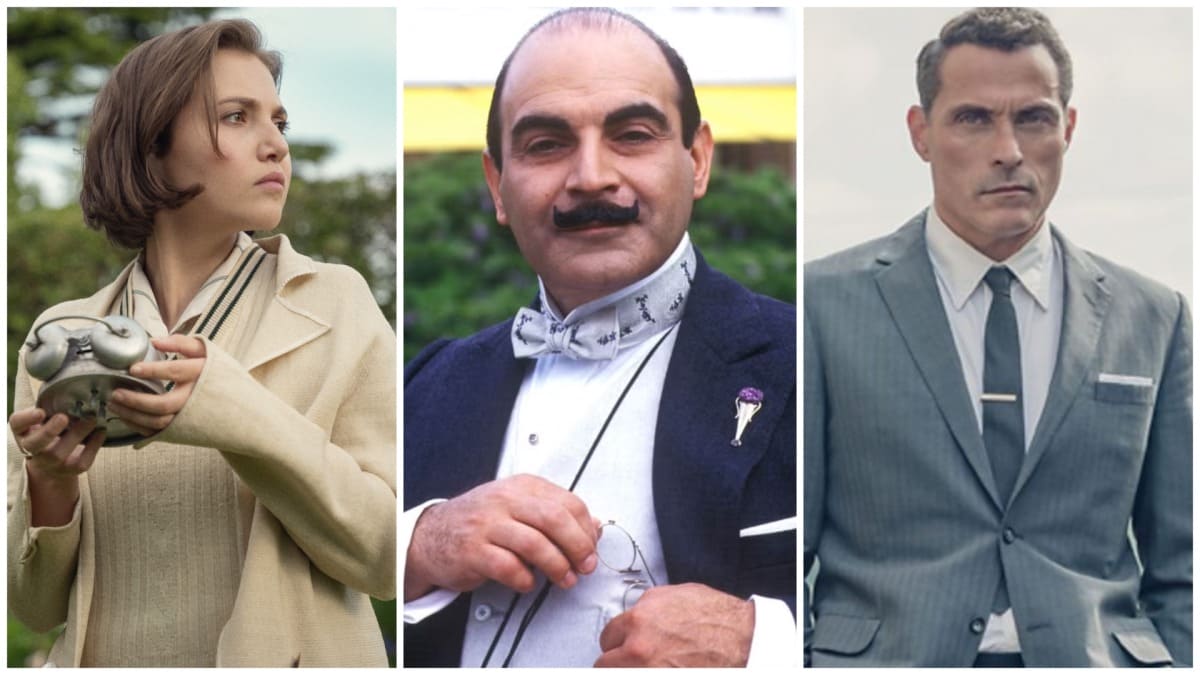
Agatha Christie is a British institution. A shockingly prolific writer, she wrote 66 novels, 154 short stories, and 20 plays. The bestselling novelist of all time and the third most widely published author—her books rank just slightly behind William Shakespeare and The Bible—her work has sold roughly 2 billion copies worldwide and been published in over 100 languages. But she’s not just in bookshops. Her influence can be felt far and wide in the world of entertainment too.
There have been (at least) 300 adaptations of Christie’s stories, from feature films and television series to stage plays, radio dramas, and even video games. These projects have brought some of her most iconic characters to life, featured some of the greatest actors of multiple generations, and perfected the art of depicting the puzzle-box whodunit onscreen. Yet, because we keep returning to these stories again and again—And Then There Were None has been adapted at least a dozen times in various formats—they not only reflect the specific interests of the cultural moments in which they were created, evolving from star-studded mysteries and prestige series to cozy comfort viewing and subversive reimaginings that wrestle with more contemporary themes.
Let’s take a look back at the way that Christie’s work has been interpreted and re-interpreted over the past near-century, from a TV movie that Christie wrote herself to BritBox’s brand new, very modern take on Agatha Christie’s Tommy And Tuppence.
The Wasp’s Nest (1937)
The only film that Christie herself adapted for television, The Wasp’s Nest is based on a Hercule Poirot short story in which the detective attempts to stop a murder before it even happens. It stars Francis L. Sullivan as Poirot and was only broadcast in the London area due to the technical restrictions of the time. It was not recorded, and the film is considered lost media. In fact, the only evidence of its existence is a Radio Times listing and a three-line review in The Observer. (Feels like a case for Poirot to solve!) Luckily, Christie’s script survived and is available to be used by stage productions. If you’re curious about the story itself, you can find it in the U.K. anthology Poirot’s Early Cases.
Three Blind Mice (1947)
Originally a radio play penned by Christie at the request of Queen Mary as a present for her 80th birthday, Three Blind Mice was inspired by a real-life 1945 news case about abuse in foster care. While no text or recording of this original radio play exists, its story was developed into a 30-minute BBC TV short directed by Barrie Edgar and later into an episode of the CBS anthology series Sure As Fate. But most people likely know this mystery by another name—The Mousetrap. Christie ultimately turned her radio play into a short story and, later, a stage play, which is still running in London’s West End today.
Witness For The Prosecution (1957)
Widely regarded as one of the best adaptations of Christie’s works in any format, Billy Wilder’s star-studded feature film version of Witness For The Prosecution nabbed six Oscar nominations, including Best Picture, Best Director, Best Actor, and Best Supporting Actress. Wilder’s more daring directorial flair is a great fit for the twisty story about the murder of a wealthy widow, and the cast features Tyrone Power, Marlene Dietrich, Charles Laughton, and Elsa Lancaster.
Murder On The Orient Express (1974)
Is this the most famous Christie film adaptation? Maybe. It’s almost assuredly the one that most people know the ending to prior to seeing it, and yet that foreknowledge dulls none of Murder On The Orient Express’ many delights. Albert Finney garnered an Oscar nomination for his theatrical turn as Poirot, sporting heavy prosthetics and an intense accent. (Fun fact: Christie herself apparently liked this adaptation, save for the fact that she didn’t think that Finney’s mustache was impressive enough.) Directed by Sydney Lumet, the supporting cast is full of stars, including Lauren Bacall, Ingrid Bergman, Sean Connery, John Gielgud, Vanessa Redgrave, Michael York, and Anthony Perkins.
Death On The Nile (1978)
Peter Ustinov’s warm, witty take on Poirot isn’t particularly book accurate, but the 1978 feature film version of Death On The Nile is entertaining enough that you probably won’t mind much. An intricate mystery that revolves around the murder of an heiress on a luxury cruise, the film’s starry supporting cast includes Maggie Smith, Bette Davis, Angela Lansbury, and Mia Farrow. It was shot on location in northern and southern Egypt (including at a hotel where Christie herself stayed while writing the novel) and won an Oscar for its lavish costume design.
Why Didn’t They Ask Evans? (1980)
The first Christie adaptation to be produced after her death, this version of Why Didn’t They Ask Evans? Is notable for several reasons. It marked the return of Christie’s work to British TV—the author wasn’t a fan of the medium, having been particularly irked by a sloppy 1949 production of And Then There Were None, which featured several glaring errors. Though the three-hour miniseries ended up being broadcast as a single special, its notable cast—which included Francesca Annis, John Gielgud, James Warwick, and Eric Porter— and attention to detail were a success with audiences and critics alike, and influenced many of the adaptations that came after it, including Miss Marple, Agatha Christie’s Poirot, and more.
 Keep scrolling for more great stories.