(Yes, that is my real name. The coincidence is astounding, I am well aware.)
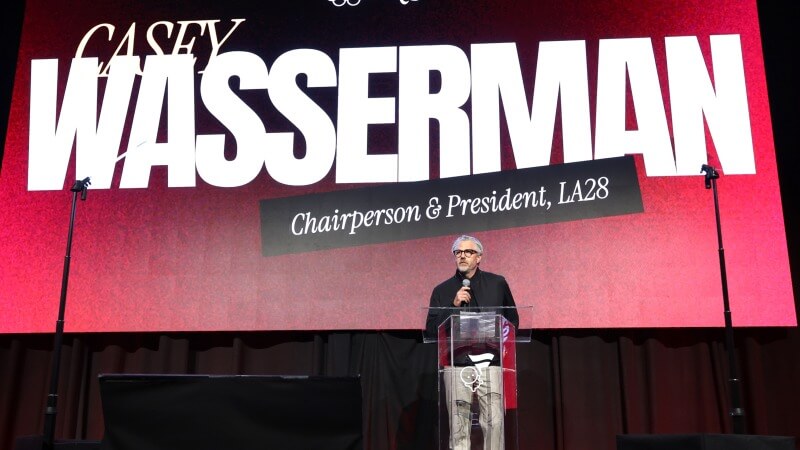
If you missed the first round, the short version is: newly released Epstein files show the LA28 chair and CEO of Wasserman Music trading horny little missives with Ghislaine Maxwell in 2003, the same Maxwell who is now serving 20 years for helping Jeffrey Epstein traffic girls. Casey Wasserman insists he barely knew Epstein, that the Africa trip was a Clinton Foundation humanitarian junket, and that these emails are ancient history he deeply regrets, delivered from the familiar perch of a powerful man asking everyone else to move on.
However, that sanitized version of events now sits alongside reporting from the LA Times that discusses newly released FBI notes from a doctor who was also on that jet: he recalls “about four women ages 20 to 22” on board, one calling herself a masseuse, another a model, a third a ballerina, and admits he “thought it [was] weird that Epstein flew with his former girlfriend, Maxwell, and four other women that no one knew why they were there as everyone else had a purpose.” There is still no evidence that Wasserman, who stayed up front with the Clinton entourage, witnessed Epstein “grab and rub” one woman’s buttocks behind a quickly shut bedroom door—but the fuller picture of who supplied the plane, who stocked it, and who was along for the ride makes his insistence that this was simply a noble AIDS tour look a lot less convincing.
When I first wrote about this, it was largely a story about one artist refusing to be drafted into that PR rewrite: Best Coast’s Bethany Cosentino saying, in public, that she did not consent to having her name tied to a man flirting with a future convicted sex trafficker and that regret without real consequences is just damage control. Now, we’re seeing more and more of Wasserman’s own ecosystem lining up behind her.
According to TheWrap, a group of the company’s top music agents including Duffy McSwiggin and Marty Diamond have given their boss an ultimatum: sell them the music division and step down, or they will leave the agency. These are not anonymous junior bookers—they represent artists like Joni Mitchell, OK Go, Lake Street Dive, and Coldplay, the kind of names agencies trade on when they call themselves a global powerhouse. And some of those artists are themselves starting to walk: the same report claimed that Chappell Roan is expected to leave Wasserman over the Maxwell revelations, even as her profile and bargaining power are skyrocketing. Billie Eilish left the agency last year amid allegations that Wasserman carried on multiple affairs with women in or around his professional circle—allegations that now sit alongside the emails with Maxwell and the FBI’s description of the women on Epstein’s jet as part of a longer, uglier pattern.
For bands somewhat lower down on the marquee, the calculus looks different but the disgust is the same. Beloved indie-rock act Wednesday posted on Instagram earlier this afternoon that they were “aghast” to learn about Wasserman’s communications with Maxwell, emphasize that they have “never met or communicated” with him, and go out of their way to describe their team at the agency as “decent and trustworthy people” they’ve worked with since before the Wasserman-Paradigm merger in 2021. At the same time, they say “continuing to be represented by a company led by and named after Casey Wasserman goes against our values and cannot continue” and announce that they are beginning the process of extracting themselves from Wasserman altogether. They also echoed Cosentino’s demand: Wasserman should step down and the company should be rebranded, so that agents and employees are not punished when artists refuse to keep carrying his name.
Similarly, Beach Bunny’s statement calls Wasserman’s involvement with Maxwell “abhorrent and disturbing on every level” and demands that he remove himself and his name from the agency altogether, flatly rejecting the idea that vague “deep regrets” are enough when you’re talking about a man flirting with a convicted sex trafficker. Water From Your Eyes recently declared that they have “absolutely zero intention of condoning [Wasserman’s] actions by silently remaining under his namesake banner,” but must currently wait “to understand what our options are.” The producer salute posted on X that he’s looking to leave and urged anyone on the roster to talk seriously with their agents about doing the same, while Dropkick Murphys have already cut ties, spelling it out in one sentence: they love their agents, but “the namesake of the agency is in the Epstein files so… we GONE.”
Then there are the bands for whom “just leave” is not a realistic option, no matter how much they desperately want to. In a long, painfully honest statement, Alexis Krauss of Sleigh Bells laid out what it means to be a smaller act inside an industry that runs through companies that are fundamentally exploitative and, at times, criminal. She talks about wanting to pull their catalogue from Spotify, boycott Ticketmaster and Live Nation, and yes, walk away from Wasserman entirely—and then explains that doing so would likely destroy their ability to earn a living, from the streaming visibility they rely on to the sync checks that pay for basic necessities like health insurance in a country that doesn’t provide it to working musicians.
Krauss insists, correctly, that it is not the job of struggling artists—or individual agents working well below Wasserman himself—to “fix these broken systems” while billionaires at the top continue to profit. Her band is caught in the same bind as many others: they want out, they are disgusted, and they are painfully aware that none of these corporations will flinch if a mid‑level act disappears from the roster. But the band will absolutely feel every lost tour, every lost check. That gap between what artists know is right and what the industry makes economically possible is the part polite statements always skip over, which is exactly why Krauss saying it out loud matters so much.
Because that’s the throughline here, underneath all the individual posts and careful press quotes: the people with the least power are being asked to pay the highest price for Casey Wasserman’s choices. The artists and agents who actually make Wasserman’s money are being told, implicitly, that if they want to live their values, they can gamble their already‑precarious livelihoods while he hangs onto every title he’s accumulated. If there is any justice to be wrung out of this, it won’t come from one more finely-tuned apology about “deep regrets” and “ancient history.” It will come from fewer bands being forced into impossible choices, and from the burden finally landing where it belongs—not on mid‑tier acts and individual agents scrambling to hold onto health insurance and rent, but on the man whose name is in the Epstein files and on the boards that keep deciding he’s worth the cost. To quote Water From Your Eyes’ statement, “May the oppressors fall to the furthest pits of oblivion. There is no future for the cruel and corrupted.”


 Keep scrolling for more great stories.