The Lord Of The Rings: The Rings Of Power relishes in the mythic. It’s one thing to read about a Dwarf singing to a mine or a Dark Lord carrying on a conversation with a beast made of shadow and flame, but another to depict and visualize it. There’s a reason Peter Jackson’s Rings movies stay mostly locked into positions themselves on Frodo’s shoulder and push the ethereal otherness of J.R.R. Tolkien’s legendarium to the edges of the frame: The sublimely strange and otherworldly imagery Tolkien conjures has no practical explanation. Thankfully, there’s a plot reason to ignore it, too. In the Third Age, when The Lord Of The Rings is set, most people have forgotten the old ways, languages, and gods. Getting into how Middle-earth was formed by a song by Eru Ilúvatar would confuse and distract from the simple story of tossing a Ring into a volcano. Rings Of Power, to its credit, does not shy away from name-dropping Manwë or the Istari, despite most of its audience having absolutely no context for it.
Depicting the mythic can also be flattening. There’s a specificity vacuum in how Sauron forges the One Ring from inside of an active volcano. Pick up an illustrated copy of The Silmarillion, and you won’t find answers in Ted Nasmith’s beautiful rendering of Sauron in the fiery workshop. Instead, you’ll wonder who built those stairs and how a Ring can be forged by the fires that can also destroy it. What exactly does it mean for Sauron to bind the other Rings to this one or pour his cruelty, malice, and will into it? “Orodruin” seeks to answer that question, and it does so with uncanny ceremony. For Sauron to pour himself into the Ring, he’d have to give all of himself to the Flame Imperishable and do the one thing he’s loath to do: Submit.
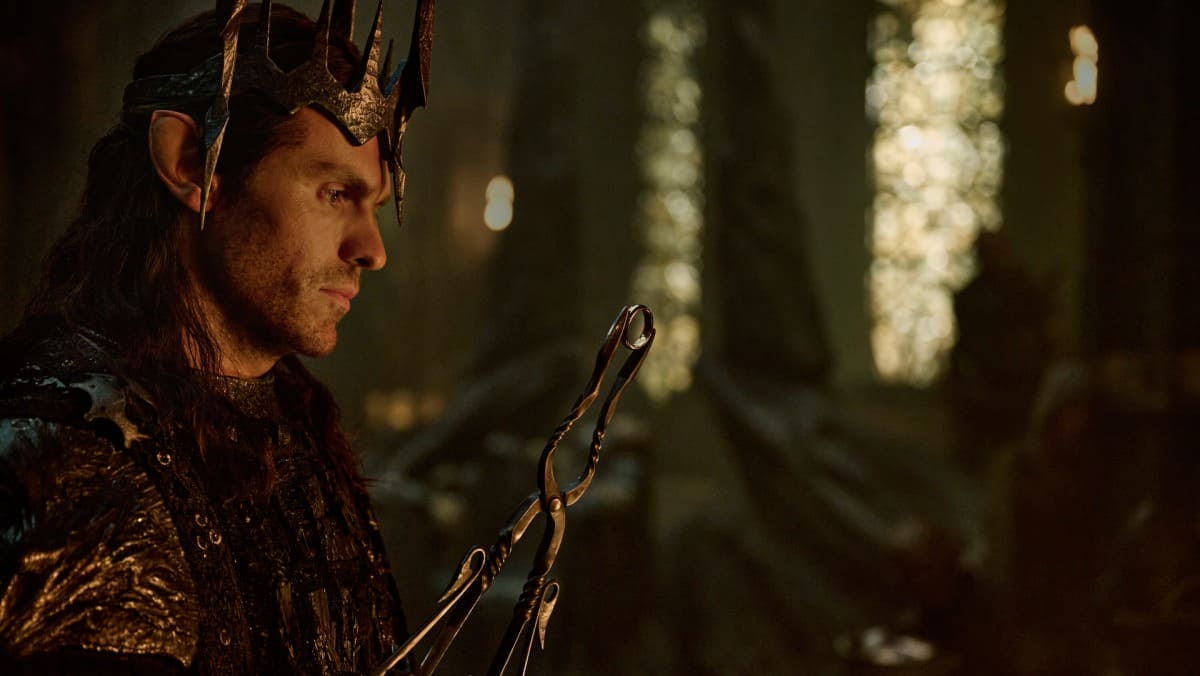
Like Sauron himself, Rings Of Power finally reached its true form in season three. The creators love to compare their show to Breaking Bad, the watching of a slow-moving car crash driven by one’s foolish ambition. This batch of episodes finally let go of its Elven chaperones and focused squarely on Sauron—hence why his story arc this season feels the most complete and least hurried. In “Orodruinm” (the title being the Sindarin name for Mount Doom), we see him fire up the forge, toss some mithril on the table, and shape his Ruling Ring. He has the tools, but not the know-how. For that, he must speak to the Balrog (voiced by Simon Pegg for some reason), whose name constitutes a spoiler, so we’ll skip over it for now as the show doesn’t bother to name him anyway. It’s another moment of uncanny myth-making, which deserves credit for not looking or sounding overly ridiculous. Again, it’s easy to write dialogue for fantastical creatures; it’s another to hear Benedict Cumberbatch’s voice coming out of Smaug’s mouth. A big lizard’s mouth just doesn’t operate that way. There’s enough debate over what Balrogs look like, let alone how their jaws move.
Sauron and the Balrog aren’t strangers. They fought together under the banner of Morgoth, the original Dark Lord, on the fields of wrath in the First Age. But the Balrog, who is technically higher on the pecking order than Sauron, thinks Sauron pathetic in his meat suit, having disgraced himself by bothering to control the fleshy world around him. It’s Fëanor’s hammer that becomes the great equalizer. This is the hammer that built the Silmarils and, harnessing the power of the Valar, can withstand the heat of the Balrog’s flaming sword, allowing Sauron to overpower the Balrog and strike a deal. In exchange for control over the Mines of Moria, the Balrog tells Sauron what he wants to hear. In order to withstand the endless fire of Udûn, he must give himself over to it.
If Rings Of Power completes its proposed five-season arc, and there’s no reason to suspect it won’t, Sauron’s forging of the One Ring will sit in the exact center of the series, making “Orodruin,” arguably, the most consequential and important episode of the entire run. It’s a job episode director Stefan Schwartz is mostly up to. The eerie forging scene is one of high drama and strange forging techniques. (I’ve seen my fair share of Forged In Fire and never saw a gold band formed from vibrations. Forging experts can sound off in the comments if this is rooted in any kind of reality.) However, any opportunity for the show to establish its own visual vocabulary is a welcome one, and Sauron’s crafting is about as thrilling a centerpiece a show as strange as this one can ask for.
With the Ring forged, there’s nothing stopping Sauron from completing his Middle-earth takeover, and here’s where season three gets a little shakier. The show has refocused itself on Sauron, allowing Galadriel and Elrond to retreat into the background as they tried to stay apace with the Dark Lord’s evil machinations. There were developments this season for the Elves, Men, and Dwarves, but they were, on the whole, a bit passive. None of their attempts to slow Sauron down worked, and they often found themselves running back and forth from dungeons and Númenórean temples begging people to work with them. While Sauron was moving the plot forward, Galadriel and Elrond were laying the foundation for later seasons. Yet, in its desire to keep things moving along as quickly as possible, Rings Of Power never gave the audience much time to feel the gravity of the moment. Just like Galadriel and Celebrimbor’s reunion, it kept getting interrupted by new problems that had not yet been considered.
This had a disastrous effect on Númenor, which was stuck in neutral for most of the season. Elrond and Gil-Galad’s plan to convince Ar-Pharazôn to fight with them was a necessary component for the plot, but rarely one that felt urgent and immediate. Our Númenórean guides, Elendil and Isildur, stood aside as decisions were made without their input, and the show teased one battle after another. First, it was the battle between the Kingsman of Númenor and the Faithful, a beef Míriel squashed by marrying Pharazôn. Then, later in the season finale, “The Doom Of Men,” the great battle between Orc and Númenórean ends before it begins—we’ll get back to that.
For much of the season, Gandalf has also felt like a supporting player, too. His confrontation with Pallando moved in a straight and orderly path that never offered much in the way of drama or suspense. In “Doom Of Men,” we finally get somewhere with it. Pallando and Khamûl carry Gandalf to Barad-dûr, where he has his first face-to-face with the Dark Lord—and possibly the last. Sadly, we don’t learn much about Khamûl as he’s knocked off the tower before we can. (Though he is among the first to show off the powers of the Rings, something the show has always been good at. See: The Elves realizing it was time to remove theirs.) But we do learn more about Gandalf and his role in Middle-earth: He’s not here to destroy evil, but to inspire good. In Sauron’s captivity, he does that by being overly polite when turning down Sauron’s offer of pork cheek, which was a welcome bit of humor buried in two bummer episodes. He even uses Sauron’s gift for deception against the Dark Wizard. After quickly spotting a false Nori in his cell, he plays possum on Pallando and removes his ring, inspiring good inside the once-Dark, now-Blue Wizard (this is why you hire a Ciarán Hinds, an actor can do so much with so little), who now considers Gandalf an old friend. Pallando’s Ring sickness isn’t as strong as Theo’s, who actually goes through the act of destroying his Ring before being beckoned back to it. The two Wizards make for the top of the tower and dispose of Khamûl by blasting him from the balcony but not before Pallando is fatally stabbed and uses his last bits of strength to redeem himself.
Pallando’s death feeds directly into the season’s anticlimax. As is often the case, the Elves realize too late that Sauron has led them into a trap, surrounding them in a ring of enemies. Of course, Pharazôn, with the Númenórean blood pumping through his veins, finds nothing more tantalizing than an honorable death and is willing to ride out and face Sauron to give the poets a battle worth writing about. However, Pallando’s death breaks Sauron’s spell over the Easterlings, who throw down their swords and head back to Rhûn, evening the playing field and making Sauron’s victory ever more uncertain. With no other options, and as he did with the endless fire of Udun, Sauron submits to Pharazôn, who cackles with delight.
Withholding the battle likely won’t earn Rings Of Power the respect of its dwindling audience. Nor will it gain new viewers who love a show that teases a big action set piece and never gets to it. It’s a move House Of The Dragon pulled a few years ago but might work better here if only because there’s some resolution, even if it isn’t the most exhilarating one. It’s risky. As a mainstream proposition, fantasy audiences will stick with the more out-there idea as long as the work delivers on some sword-clashing, spear-stabbing violence. About 90 minutes into these final two episodes, I began to wonder if it would even happen. The show frequently returned to the Númenóreans lined up and ready to go, and it delivered one of those night-before-the-battle scenes where Elrond rallies the troops with words of wisdom from his brother, Elros. Death is the gift of men; it gives them strength and a reason to fight, he says. None of them would end up giving that gift.
Elros’ words don’t have much currency in Rings Of Power. By following Sauron so closely, the show loses what’s at stake. We no longer have a sense of what a normal life in Middle-earth even looks like, so why should we care whether Sauron finishes his plan or not? This all runs headlong into the inherent problem of prequels: We basically know how they end. Star Wars attempted to get around this through the downfall of Anakin, from kid to man. But Sauron’s story isn’t a tragedy, and no matter how many times J.D. Payne and Patrick McKay compare him to Walter White, the Dark Lord doesn’t harness the tension of someone choosing a dark path. He is on a dark path, and it’s the only one he walks. The suspense of Breaking Bad came from whether Walt would be found out and how that would affect his family life. The ripple effect of his actions created the drama. Season three of Rings Of Power moved way too fast for the audience to lock into what Gandalf, Galadriel, and Durin have to lose, and until the show’s creators can reestablish those stakes, the show will continue to ring a little hollow. We know their story doesn’t end with season five. The road goes ever on, after all.
Stray observations:
- • That does it for season three of Rings Of Power. I don’t think it was the best of the run, but it was a consistently entertaining and often beautifully staged one. Amazon did not provide us with screeners for the final episode, so I watched in 4K on Prime Video, and man, seeing this show sans my email address in the center of the screen is a good reminder of how visually spectacular this production is.
- • I loved Celebrimbor’s decomposing corpse in Sauron’s office and loved Galadriel recognizing it even more. There’s something very Leatherface or Hannibal Lecter about it.
- • Pallando rejects Sauron’s offer to become the Witch-king of Angmar (one of the sickest names ever given to a character), clearing the way for Theo to take the job.
- • I’m disappointed by the lack of Khamûl because he’s a genuinely fascinating character to explore. He’s featured in some of Tolkien’s most famous stories but has yet to have anything resembling a complete character. Anything we can learn about the Ringwraiths, I’m interested in. Thankfully, I doubt this is the last we see of Khamûl, as he’s already cracked some of the Ring’s invisibility powers and was wearing it when he fell.
- • I didn’t mention it at all this season, but Bear McCreary’s music continues to be a high point of the show. In these finale episodes, in particular, the weaving together of individual themes continues to play like gangbusters, generating the excitement and character that’s missing from the script.
- • I am all about mad Pharazôn. Trystan Gravelle is quickly becoming one of the show’s most entertaining and captivating presences.
- • I was excited to see Nori again and think halflings are pretty crucial to making this story feel like one with actual stakes. Hopefully, they’ll make it back next season.
- • Celeborn didn’t really turn out to be that funny and quickly became just another Elf. I hope he gets more to do next season. How often can one Elf get captured?
- • If I may make another ill-advised prediction. Based on where this season leaves us, season four will focus on the Fall of Númenor and season five the Last Alliance of Men and Elves for the siege of Barad-dûr.
- • Speaking of which, Rings Of Power did not make Barad-dûr seem like a particularly difficult tower to besiege. Galadriel and Gandalf break in and out of that place without much trouble.


 Keep scrolling for more great stories.