Appropriately enough, The Testament Of Ann Lee began with a song. While researching American folk music for her film The World To Come, director Mona Fastvold came across “Pretty Mother’s Home,” a 19th-century hymn written by Patsy Roberts, a formerly enslaved Black woman who spent most of her life in a Shaker community in Kentucky. That song led Fastvold down a path of ecstatic utopianism that eventually inspired her own visionary work, a collective feat accomplished against great odds that not everyone understands.
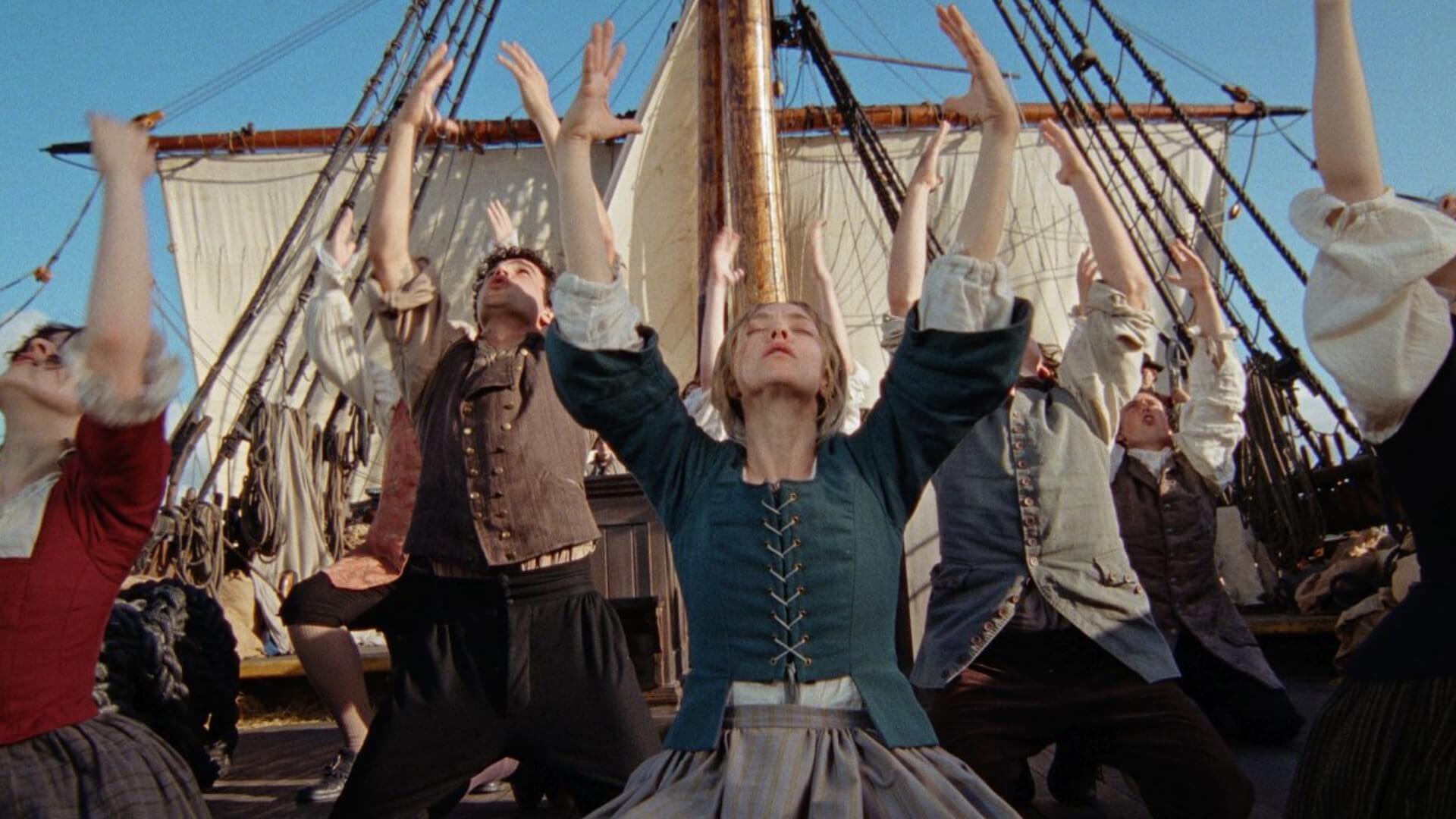
The Testament Of Ann Lee is built around a series of musical numbers, beginning with an image of dancers in 18th-century period dress lined up in geometric formations. They jerk their bodies to a ghostly melody written by composer Daniel Blumberg, “The Woman Clothed By The Sun,” that urges listeners to “make a faithful record of Mother Ann Lee.” The film is divided into chapters, which are referred to as “songs.”
The movie sings its feelings—mainly religious ecstasy, but also grief and love—in big production numbers and in a capella single-voice hymns, all expressing moments of dramatic significance in the life of Shaker leader Ann Lee (Amanda Seyfried). Born in 1736, Lee led the Christian sect originally known as the “Shaking Quakers” from England to America, establishing an egalitarian community that still exists today, albeit in greatly reduced numbers. (The end credits note that two Shakers still keep the faith, although a third joined shortly after the film’s completion.)
The first half of the film is structured like a musical, following that enigmatic overture with songs that establish Ann’s world (the wordless “Hero Prayer One”) and define the film’s conflict between believers and non-believers in Mother Ann’s gospel (“I Never Did Believe”). It even includes reprises; when Ann is arrested for blasphemy, Seyfried sings a few bars of the previous number as the door of her jail cell closes behind her. This leads to a classic “I Want” song, “Hunger & Thirst,” as Ann has a vision that reinforces her belief in celibacy, and in herself as the second coming of Christ.
This is the catalyst for the film’s grand adventure, spurred by a rhythmic number, “All Is Summer,” aboard the ship that transports Ann and her followers—and a few hundred skeptics, who nearly throw the Shakers overboard—to the New World. The musical structure breaks down in the film’s second half, as the kineticism of dance is replaced by the decisive movements of work and violence, respectively, as Ann’s dream of utopia is realized and then threatened in turn.
Still, in the first half alone, there’s more than enough evidence to declare The Testament Of Ann Lee a movie musical. Still, many are hesitant to embrace the label. The New Yorker refers to the movie as a “pseudo-musical,” and The Evening Standard as “a musical (of sorts).” Variety‘s review takes care to qualify its assertion by assuring readers that there are “no jazz hands” in the film, one of multiple reviews that take a “yes, but” approach.
Even Fastvold has admitted that she “resist[ed]” the idea that her film was a musical “from the beginning of the writing process,” until co-writer (and Fastvold’s life partner) Brady Corbet told her “you just have to accept it. So I did.” Even then, “when we finished the film and we were starting to show it to people, I kept asking, ‘Do you think it’s a musical? Have I made a musical?,'” Fastvold said at a recent Q&A.
This ambiguity is actually a testament to the artistry of composer Blumberg and choreographer Celia Rowlson-Hall, whose approaches are just unconventional enough to set The Testament Of Ann Lee apart from its peers. As otherwise repressed (and, remember, totally celibate) 18th-century people, worship was the Shakers’ only outlet for emotional and creative expression. And, while the effect is relatively subtle, the lyrics of the songs and the movements of the choreography match the plot at specific moments in the film.
Beginning from a library of hundreds of Shaker hymns, Blumberg and Fastvold narrowed the number used in the film down to 12. Blumberg describes highlighting Shaker hymns specifically for their lyrical content; in an interview with Paste he says that “Hunger & Thirst” was chosen for this reason, and revealed at a press conference that “All Is Summer” had “lyrics [that] were related to traveling,” perfect for the scene where the Shakers are worshipping aboard the ship to America. From there, Blumberg built these hymns out into lush, achingly beautiful arrangements, supported by a chorus of voices that included Fastvold and her daughter.
And for the profoundly sorrowful “Beautiful Treasure,” Rowlson-Hall told The A.V. Club in an interview that the song’s choreography expresses Ann’s emotional journey. “When she was on the ground, I had her trace her finger around her body, before she held her leg like a baby, cradling it to get herself up,” she said. “When she holds her leg and cradles it, is she cradling a baby that’s about to come into her life, or is she cradling the baby that she just lost? Or is she now realizing she’s cradling her foot, and she’s actually lost [the baby]?” All of these events happen simultaneously with Seyfried’s movements, in sequences Fastvold weaves into her dance.
“It was never really dance for dance’s sake. I was always telling a story,” Rowlson-Hall adds. “I always approach dance as narrative, so that you, as an audience member, can take in just as concrete of a story and emotion [through a movement] as you could through dialogue.” The underlying tragedy of Ann birthing, and then losing, four children is expressed through these movements, and the audience understands in turn how this experience affected her life and beliefs going forward. She’s not turning to the camera and singing, “I’m sad that my babies died,” but the point is still made.
The same could be said of the human sculptures Rowlson-Hall molds out of the worshippers who surround Ann. These express not only their ecstatic fervor, but also something important about these characters and their communal values. And while, as Fastvold puts it, “improvisational music will automatically make [a scene] feel modern,” what we see in the film is true to historical accounts, in which the Shakers would “dance and sing and vocalize for days” and “kick their shoes off and take their shirts off and dance and roll on the floor.” It’s all intentional expression, and it’s all in the service of conveying something essential about these characters and their radical beliefs—just like in a musical.
Fastvold’s hesitation to embrace the musical genre is understandable. Musicals are earnest, often painfully so for those who don’t have a theater kid deep inside their souls just waiting to belt out a number. But self-consciousness and ironic detachment aren’t Fastvold’s issue: Her and Corbet’s immersive, collaborative filmmaking style relies on a similarly earnest engagement from game cast and crew, who come together into a unit that Fastvold describes in terms that are part family, part theater troupe. The bigger obstacle is a lack of precedent.
In 21st-century American film culture, musicals are typically big-budget studio affairs based on pre-existing IP, whether that be a Broadway musical or a beloved classic film. (Sometimes, as with the Wicked movies, they’re a bit of both.) Most of these are aimed at families, and even the originals are designed to appeal to as wide an audience as possible. Independently produced on a budget of around $10 million, aimed at adults, and telling the story of an obscure figure from American history, The Testament Of Ann Lee turns all of these conventions upside down.
Fastvold’s film does have musical contemporaries—Annette, The End, Please Baby Please—but they’re few enough to count on one hand. All of these are eccentric, big-swing movies, visionary works that compel some and repel others. The same is true of this film, as it was of Ann Lee herself. And so, as Fastvold herself has said, this is the only way this production could have been. To properly tell the story of Ann Lee, you have to lose yourself in the dance.


 Keep scrolling for more great stories.