I signed up for pee wee football in 2007 because I wanted to wear the jersey to school on Fridays. I saw the high schoolers doing it, tucking the orange mesh behind their big cowboy buckles, and I liked the way their muscles poked out of those taut arm sleeves. It’s too bad I was thick as a tick and had awful knees. I mean, I was washed up in grade school, with legs crooked like a wishbone. It took two rounds of metal plates and deck screws to straighten them out and even then I was still slow. My favorite player was D’Qwell Jackson so of course I wanted to play linebacker, but they stuck me at nose tackle. I wasn’t supposed to spend 90-degree days getting my clock cleaned by 10-year-olds on a practice field covered in boy puke. But I liked the idea of doing a macho thing, because most of my friends liked doing macho things. David liked doing macho things but his dad never let him go out for football, even though he was tougher than all of us combined. At lunch he’d squish apples with his bare hands and we’d holler again.
David lived behind me, sort of. The house next to mine was my grandparents’, and behind their house was a pond. And behind that pond were three houses, one of them being David’s dad’s. At some point he just showed up at our front door and asked my mom if I could come out and play. So we did, and I took him to see the motorcycle windshield in the woods behind my swingset. He dared me to smack it with an aluminum bat as hard as I could, and to this day, my ears are still ringing. But I liked going to David’s place because his dad let him have pocket knives, let him ride his bike all over. He had Freddy vs. Jason on DVD and convinced me that there were all these special features with “lots of boobs” on it. I swear to God he was the only 11-year-old in Ohio who slept on a waterbed. In our eight or nine years together he taught me a mess of stuff, like how to find porn on my PlayStation Portable and fashion a Tropicana juice bottle into a functioning bong. We put on a “concert” for my parents, performing Cat Stevens’ “Moonshadow.” David played guitar, I sang. It was nice.
A few years later David got his license before the rest of us. He’d barrel into my driveway in his red pickup truck with the stereo always blasting Pearl Jam’s cover of “Last Kiss.” I’d hop into the passenger’s seat and we’d spend an hour, sometimes two, crossing backroads for no good reason other than boredom. I had a curfew and David didn’t. He never did. So after he’d drop me off he’d go right back out, picking up someone else to pal around with who could stay out later than me. To a lot of people, he was the class-clown whacko whose single dad let him do anything he wanted. But David’s dad was a mean cuss. I saw David not as the guy who talked himself into a dozen in-school suspensions, but as a curious person with no outlet to wander. Nobody really knew him, though. He was trying to be a few people at once. I mean, we all were. He was conventionally good-looking with a chronic buzzcut, well-cut jawline, and a closet full of white T-shirts. Next to him I was this pale, overweight ghost with gelled hair that looked like that of a troll doll. He was a rock star to me, and there were times when he’d let me into his world and make me feel like I was the most important person in everyone else’s.
One day I was on David’s mind, or maybe I was just the only person in his phone that picked up, and he asked me to come over for a campout. I showed up and there he was, cooking hot dogs on a bonfire he’d made himself. He seemed sad and he didn’t want to go into his house, but I didn’t ask why. “If you gotta piss, do it over there,” he said, pointing at a treeline I’m pretty sure was lined with a fence of poison ivy. So I held it in. “Where’s the tent?” I asked while jumping up and down on the trampoline an empty-nester down the road gave him after her kids moved out. “You’re looking at it,” he responded. I found out quickly that he’d been sleeping on that trampoline for a week, under summer stars he assured me looked best from his backyard, not mine 1,000 feet away. And he was right: they looked really good while we were stupidly laying on that trampoline at 3 a.m., mere hours before Independence Day.
The fire was dying down, so David and I screamed and screamed for no good reason other than to piss off our no-armed neighbor, Bertha. And together in the blackness we huddled real close under a blanket thinner than a towel. We laughed at the “faggot shit” we saw on Facebook and talked about where our lives were going. He was finally gonna join the football team. I was embarrassed about flunking out of Algebra II. That was just life then. And it was just life when David put his phone between our heads after a cocktail of Chief Keef and Roy Orbison ended. Maybe that would have been a good time to let him know about the HRT I was undergoing, but my parents forbade me from discussing it with family, let alone a 16-year-old blabbermouth. David’s algorithm sent our minds elsewhere anyhow. This coasting, teardrop guitar cut in until a voice picked up: “Candy says, I’ve come to hate my body and all that it requires in this world.” I’d never heard anything like it. Neither had David. It was a beautiful, sobering blur. It’s too bad David forgot about it by morning.
But I never forgot. I really didn’t. And I didn’t know anything about the Velvet Underground. They were just a band that said something about hating bodies when I hated my body more than ever, and they sounded good doing it. I met the Velvets properly that winter, when I queued their first tape on a long weekend. I heard fingers tapping on a celeste and a bass note vibrating, then a lyric about restlessness hushed into me by Lou Reed—a boy from Freeport who got his start writing doo-wah-ditties for Pickwick bands like the Hi-Lifes and the Hollywoods. He and his good mate John Cale made that album and 30,000 bands apparently started because of it. Then they made a record blown-out and textured with hippie disjunction. The mix was so subterranean that not even its most accessible track—the delicate, disquieting “Here She Comes Now”—could break past all the weirdo obstacles. God, the Velvets just seemed so fucking alive when I was 17 years old. Their transgressions didn’t radicalize me—they stabilized me, all because “Candy Says” yanked the stars beneath the tree canopy in David’s backyard and I was the only one that noticed. I gave a shit about the banana before anyone else I knew. In a high school video production class, we had to make a short film and I convinced Steven and Wes to rip off the Andy Warhol Screen Tests. Even now, in my deep twenties, the only person in my immediate life who cares about the Velvets lives on a different coast.
Two weeks after White Light/White Heat came out, the Velvet Underground recorded “Stephanie Says” at A&R Studios. It was the beginning of the Velvets’ real pop stuff, and I always liked the pop stuff—the eponymous, Loaded hullabaloo after Reed took the piss out of Cale and sacked him from the band. I’m talking about sentimental tunefulness that did more for my rock and roll than any of those fussy “Heroin” or “Femme Fatale” noises (although the Paris ‘72 performance of “Heroin” is a quixotic beauty). I’m talking about elaborate populist music made by anti-populist, non-elaborate people—songs as gorgeous as they are nasty, ripped from the maws of four musicians that fucking hated each other’s guts. I used to listen to “Stephanie Says” with the volume up in my bedroom. I kept the windows cracked open an inch. Some of those nights a few-dozen gunshots would ring louder than the song. It was always David pointing an assault rifle at the woods, firing at God-knows-what while his dad held an audience around him. I hadn’t talked to him in a year, maybe two by that point. I was a month away from starting college and I don’t know what he was a month away from doing.
I think, when we’re young, queerness writes checks that our brains can’t cash, but our souls always can. Our souls speak thousands of languages, and mine spoke Lou Reed’s. He sang about queers before most people sang about queers. He worked at a gay bar in Baldwin and wrote songs about trans women; he penned ambiguous stories about the AIDS crisis, gender dysphoria, and gay attitudes outside of the Village. Of course, I didn’t know that when I was 15. But I felt those things, of course: I fantasized about chasing boys and wearing girl clothes before I actually did chase boys or wear girl clothes. And when I learned the meaning of “Candy Says” and its Tenth of Always beginnings in college, I let the epiphany surge through my body like an electric current. One day “Walk on the Wild Side,” “Candy Says,” and “Halloween Parade” were just songs. The next day, they were poems about Factory superstars Candy Darling and Holly Woodlawn. The day after that, they were street-level maps for me to follow.
But Lou Reed traveled by portals, not roads. He went from fucked-up garage doo-wop to big-brained, off-Broadway drama sweeps. I like listening to Lou Reed because he was a Renaissance man trapped in a glam rocker’s shiny, shiny leather. The ghostly lullabies impregnating Transformer, his short stories about city decay on New York, the cynical snot of Sally Can’t Dance, the dirty punk opera powering Street Hassle, the smelly, anti-CBGB wasteland of Rock and Roll Heart, the strung-out sorrow that plagues Berlin’s gothic—there’s a piece of me in one or all of those, depending on the day. Hell, depending on the hour. But I come back to the elegiac, sensitive Coney Island Baby more than anything else. I can live without the murder-crazed “Kicks” or the muscular symphony powering “She’s My Best Friend.” And “Charley’s Girl,” charming as it may so often be, sounds like “Sweet Jane” getting pummeled by “Walk On the Wild Side”’s lethargy. Bob Kulick dolls up “Crazy Feeling” with a cursive slide guitar, and the methamphetamine catches up with Reed on “A Gift.”
When I say I return to Coney Island Baby more than anything else, I am talking about its title track—a romantic, syrupy, funny tribute to Lou Reed’s childhood and his then-girlfriend, Rachel Humphreys. In a review of Coney Island Baby, somebody wrote: “‘Coney Island Baby’ is an epic story-ballad, and a real good one at that.” I thought to myself, “Is this guy fucking mental?” I read another review of the record that omitted the song altogether. I couldn’t get past the neglect—the author’s decision to minimize “Coney Island Baby,” a beautiful song written about a beautiful trans woman that a very significant rock musician loved once, into something that makes Christgau’s description of the album (“cheapjack ennui”) sound handsome.
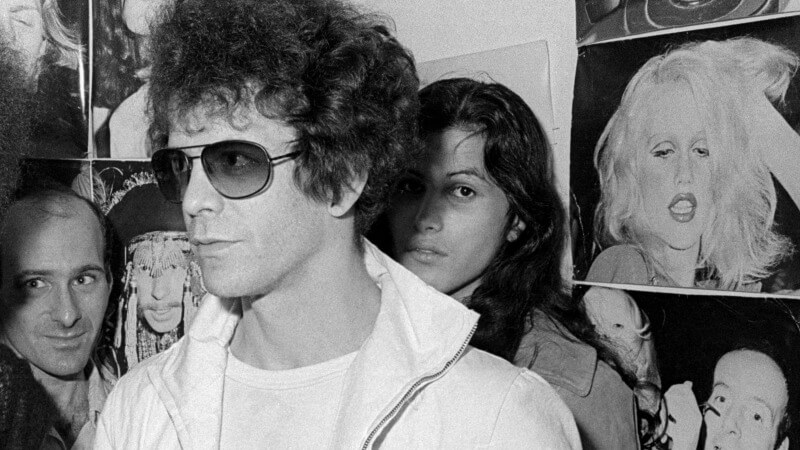
Ed McCormak compared Humphreys’ looks to Cher’s, “only prettier.” And if I’m to take anything from Lou Reed’s street prose literally, it’s that Humphreys was a woman worth loving and dreaming about. In “Coney Island Baby,” she is the serenader and the serenaded—her arched eyebrows, dark and falling hair, Jersey accent, and long, wonderful fingers run aglow in Reed’s fascinating midnight hour, in his peculiar and constant shine of hating everything in this world but her. Since meeting David 17 years ago but more now than ever, I have craved the fate of being wanted. I have craved anyone—even somebody as cruel and egotistical as Lou Reed—saying, “I swear, I’d give the whole thing up for you,” to me and only me. Music is all of my life and that photo of Reed curled beneath Humphreys’ arm—or even the photo of Reed and Humphreys standing behind a three-layer mocha cake somebody baked for their three-year anniversary party (which many believed was actually a wedding ceremony)—was evidence of a rock star I liked loving someone I doted on in secret.
But the closer I got to coming out, the more stories I read about Lou Reed and his longtime “constant companion” Humphreys, the tall and thin and extraordinary Mexican-American hairstylist he met at Club 82 a year after Transformer came out. They traveled everywhere together, from Alice Cooper’s house parties to Eastern Europe, and he showered her with diamonds and titles. Humphreys became Reed’s road manager, backup singer, management liaison, muse, and, according to Reed’s guitarist Jeff Ross, a “guidance system and caregiver.” When Humphreys couldn’t accompany Reed to Australia because she didn’t have a visa, they laid in bed with phones pressed against their ears, falling asleep to the sounds of each other’s breathing. Reed even canceled his New Zealand tour in 1975 so he could get home to Humphreys sooner. They shared two dachshunds, the Baron and the Duke, and she would occasionally crash with him at his loft on 53 Christopher Street, right above the Stonewall Inn.
I also read about how awfully Reed treated Humphreys—how she wanted gender-affirming bottom surgery, he forbade it, and she nearly killed herself over his rejections. How he called the albums he made during their relationship a “bullshit […] dyed-hair faggot junkie trip.” I am sometimes resentful of the fictions I’d written around Reed and Humphreys, having bought into their photographed love without looking beyond what was captured. Humphreys inspired Reed’s two best solo albums—Coney Island Baby and Street Hassle—and then, after their breakup in the late 1970s, she was erased from his identity forever. Her existence was discarded, tossed in the bin with their so-called faggot past once Reed no longer had use for her in his art.
I liked “Coney Island Baby” first because it gave me hope that someone would—or could—love my trans body like Lou Reed may have loved Rachel Humphreys’ trans body. And then I hated “Coney Island Baby” because none of that was real anymore. The truth behind the song probably kept me in the closet for an extra year or two. But, having plied myself with enough courage to do so, I came out to a partner in the bed I shared with her. She misgendered me a day later, and again the day after that. My transness was ignored because I was no longer useful. I wanted Lou and Rachel to have an ending that I could also have and, for a few confused, ridiculous years, I damn near convinced myself that they really did get one. In the dog days of embarrassing heterosexual misguidance, a man with power and cultural sway caring about a trans woman arrived to me like an apparition or a cautionary tale or a miracle. But I was not just a closeted queer living the delusion of being merely a straight ally then, but a closeted queer actively playing to the hand of heterosexual relationship dynamics. Was that a consequence of my own repressed gender dysphoria, or a disproportionate patriarchal power that I subconsciously exploited? I don’t know, but the mask I’d placed over Lou and Rachel’s relationship slowly slipped and then eventually fell down all the way.
Maybe I wanted to come out a long time ago, to David on his trampoline, and have it end up okay. But that didn’t happen. It couldn’t have. I didn’t have the words, and eventually David became a nuisance—a neighbor that shot up the silent parts of summer nights. Eventually he stopped texting, stopped coming around the house. Reed eventually got rid of Humphreys too. He wrote “Street Hassle” about her and didn’t so much as mention her name publicly again. Maybe Humphreys crept into songs on New York, but that didn’t prevent her from dying alone at Saint Clare’s Hospital in Hell’s Kitchen, possibly from AIDS, although no one can say for certain. Now she’s buried in an unmarked grave on Hart Island. But women never really fade, and I think about her more than I ever think about Lou Reed. “Coney Island Baby” is good again because I’m not just playing the part.
Memories are whatever we want them to be. We can stretch new truths around them or manipulate their meanings, but they’ll never actually be true, you know? All I’ve got are these photographs of Reed and Humphreys. I have their song and what radical, fleeting, possibly false love exists within it. I’m sitting in my parents’ house, listening to all seven superb minutes of “Coney Island Baby,” looking at David’s backyard. It’s quiet, nearly blacked out. I haven’t seen him in seven, maybe eight years, when I ran into him and his newborn daughter at a Target and we exchanged brief life updates. Mom says he’s living on the other side of the county now, working locally. I’ve been thinking a lot about him and how I spent the end of my sculptable teenage years obsessed not with a history where a cis, transamorous man loved a person that society (or, in this specific case, also Lester Bangs) could so easily deem disposable, but with a history where a rock star could love a trans person so much that he made perfect, impossible art about them—that he’d tell the whole fucking world about how much he loved them. But Lou Reed moved on from that faggy bullshit just like everyone else and here I still am, gathering my transness in prose and trying to not mistake any of it for grief.
Matt Mitchell is the editor of Paste. They live in Los Angeles.


 Keep scrolling for more great stories.