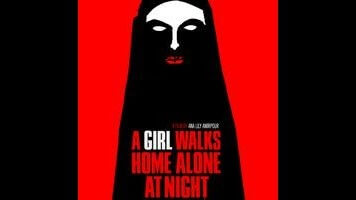
The thing is, writer-director Ana Lily Amirpour has a real knack for ripping pop looks and influences and collaging them in ways that are goofy and genuinely fun to think about. The Girl is a feminine other who eats men and scares boys, but she’s also a hip artist stand-in whose lair is decorated with cut-up magazines and posters; she gets around on a skateboard, her cloak flapping like a bat’s wings in the nighttime breeze. The setting is seedy Bad City (actually Taft, California); populated by junkies and hookers and ringed by oil derricks and corpse-packed ravines, it is both an Iran that isn’t and a sort of purgatory. One character looks exactly like Die Antwoord frontman Ninja, another is styled after James Dean—and so on and so forth.
Everything is arranged in matching sets: different kinds of addiction, from blood to heroin; different kinds of feminity and masculinity; different kinds of vampirism, from the literal kind to the sort practiced by the local smack dealer, who swoops into decrepit apartments, ready to suck addicts’ savings dry; even different versions of Bad City, which resembles an industrial wasteland in some scenes and a quiet immigrant suburb in others.
Sometimes, these bits and pieces click in interesting ways, as in the sequence where The Girl takes home a handsome landscaper (Arash Marandi) in a Dracula get-up, whom she spots stumbling home from a party, whacked out of his mind. In this scene, all of the movie’s references and aesthetic conceits—stark black-and-white, slow motion, synth-heavy indie rock, bleary anamorphic widescreen—converge into something that’s genuinely moving, as The Girl appears to lean in for bite, but instead ends up resting her head on the landscaper’s chest. Behind them is a wall-sized collage, which could easily be a metaphor for the film itself. Unfortunately, it’s just one scene, and after it’s done, a viewer can’t help but think of the movie as a strikingly pasted backdrop badly in need of a meaningful foreground.


 Keep scrolling for more great stories.