The Lestat we meet in season one of Interview With The Vampire is already a performer: An accomplished pianist, a commedia dell’arte harlequin, an opera connoisseur whose perfectionism leads him to murder a subpar tenor. For fans of the Vampire Chronicles novels, these moments offered a tantalizing tease of how the show would adapt The Vampire Lestat, where he embarks on a career as a rock star. For composer Daniel Hart, who penned a more traditional score for the first two seasons, this creative pivot presented a fascinating new challenge.
“The most important thing we needed to discover was the sound of the music that Lestat wanted to make, because that was going to drive us throughout the entire season,” Hart tells The A.V. Club. “It was going to comment on things that were happening in episodes, plot points, and it was going to delve through Lestat’s past, especially lyrically, since Lestat was going to be the one writing the lyrics.”
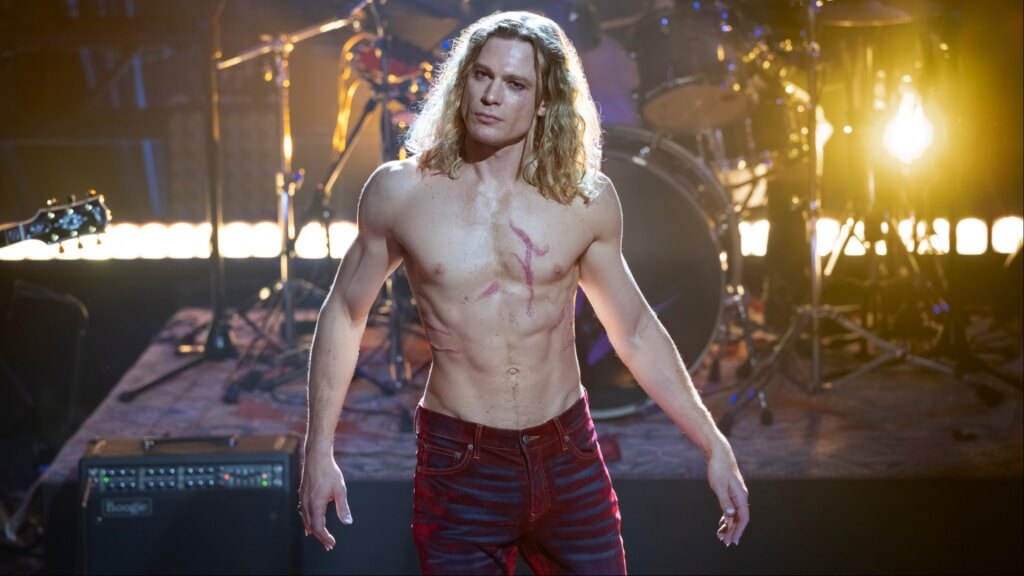
Actor Sam Reid prepared extensively for this point in Lestat’s journey, working with a vocal trainer and learning to play piano. That all culminated in a live concert in New York ahead of the season premiere, performed in-character as an act of promotional kayfabe. Lestat’s North American tour then provides the framing device for this season, traveling with an entourage including Daniel Molloy (Eric Bogosian), who is filming a documentary about Lestat’s rise to fame.
Known for his collaborations with director David Lowery on films like The Green Knight and Mother Mary (another project about a fictional pop star, this time with songs by Charli XCX and Jack Antonoff), Hart has also toured and recorded with artists including St. Vincent and Broken Social Scene. When the time came to start work on The Vampire Lestat, those experiences were “pretty much the first thing that we discussed at the writer’s room table.” The writing team demanded juicy anecdotes, but Hart had to talk them down: “Touring is very grueling. It’s just a job, and yeah, there’s some partying, people do crazy stuff and do lots of drugs, but that wasn’t me. It was a job for me.”
His pragmatic outlook did not translate to Lestat’s story, which definitely leans more toward the sex and drugs side of things. Swapping one unreliable narrator for another, season three sees Lestat use music as a chaotic, exhibitionist form of self-expression. His songs function as a companion piece to Daniel Molloy’s in-universe book Interview With The Vampire, which explores the life and undeath of Lestat’s ex-lover Louis. By striking back in such a public way and revealing his identity to the mortal world, Lestat has violated a cardinal law of vampire culture—although some humans still seem to think his undead shtick is just a gimmick.
“I can only draw on my own experience when I’m writing music,” says Hart. “I try to write music that’s very personal, so I tried to adapt the things about music that are important to me, and overlay it on the things about music that are important to Lestat.”
Lestat’s choice of genre is appropriately anachronistic for a guy whose influences span three centuries. Daniel Hart and showrunner Rolin Jones have cited numerous references including David Bowie, INXS, Kurt Cobain, and Chappell Roan, but above all, The Vampire Lestat’s sound is straightforward rock. This season’s credits song, “All Fall Down,” resembles a cross between T. Rex and a lost track from The Rocky Horror Picture Show.
“We talked about it a lot in the writer’s room,” says Hart. “Rolin asked me if I thought rock and roll was dead, and I said I think it’s not dead, but headed for a deep sleep, maybe.”
The original Vampire Lestat novel came out in 1985, and in theory, the show could’ve updated it with a more modern style of music. But Hart argues that rock felt “right on target” for their version of Lestat, who embraces the rockstar lifestyle complete with groupies, drug binges, and a VH1-style film crew documenting his spiraling mental health. Lestat isn’t a millennial artist trying to emulate Iggy Pop’s self-aggrandizing stage presence. He’s “like a 60- or 70-year-old who maybe listened to Woodstock albums when they came out.”
The Vampire Lestat follows a lineage of rockstar films like Hedwig And The Angry Inch and Velvet Goldmine. Not traditional musicals, but stories about music, where the songs reflect the personality of their fictional protagonist. “Much of my time in the writers’ room was spent thinking about Lestat’s past,” explains Hart. “How that might affect him musically, and what kind of music he might have enjoyed the most.” That ranged from classical composers Lestat might have encountered in his youth (“a lot of Mozart and Bach”), to 20th-century names like Igor Stravinsky and Florence Price, to more direct reference points like Bowie.
“I’ve never been as involved in anything as I’ve been involved in this,” says Hart, who co-wrote an episode this season. “I was in the writers’ room essentially from day one, and spent the entire length of the writers’ room either working on scripts or working on songs, or both at the same time, and the two informed each other quite a bit. I would sit at the writers’ room table with all the other writers, and we would talk about an episode and how it related to a specific part of the book. Every once in a while inspiration would strike, and I would just get up and leave and go back to my little corner where all the music instruments were, and work on music for a little while.”
Taking cues from the novel, Lestat’s guitar rock sound is partly a matter of circumstance. We see him working on music in the season-two finale, but his rock career only takes off a couple of years later, after he hijacks a nearby garage band and recruits them for his Vampire Lestat tour. “They’re good, but they’re not as good as Lestat is,” Hart explains. “He raises them up to another level with his musicianship and his personality.”
It’s a conflicted dynamic. Lestat’s band are important characters this season, played by multi-hyphenate actor-musicians including Schitt’s Creek star Noah Reid and Man Man songwriter Ryan Kattner, who collaborated with Hart on some of Lestat’s music. Performing in Lestat’s shadow, these characters have mixed feelings about their newfound success. Their new frontman has given them the fame they craved, but it’s a devil’s bargain, leaving them beholden to the whims of a megalomaniac overlord.
“We knew that at least one of the songs needed to have come from the band,” notes Hart. “Like it would have been their song first that Lestat then hijacked, which also feeds into some of the tensions between him and the band members.” Playing into the group’s garage band roots, Hart found it “a lot of fun to make a shittier version of a song that I’d already written.”
One of the most compelling elements of Interview With The Vampire is the way it invites us to analyze the biases of its narrators. All of the main characters are performers, attempting to retell their own stories through theater, music, or journalism. So when Lestat takes the stage, there’s a lot going on beneath the surface of Sam Reid’s vampiric charisma, encouraging fans to dig deeper.
“My favorite lyrics are ones that are open to interpretation,” says Hart. “I would love for people to listen to Lestat songs and find things that relate to their own life in those lyrics. Some fans of the show have reached out to me on social media to say, like, does this lyric mean this? Is this lyric talking about this? And most of the time it hits on one of the multiple intentions that I had in writing those lyrics.”
Likewise, Hart could imagine Lestat smirking while writing some of those more ambiguous lines. “Lestat would really enjoy being allegorical and engaging in double entendre, or even triple entendre.” In Lestat’s debut single “Long Face,” he refers to a relationship as a “Boléro”—an old-fashioned term that harks back to his classical roots—but otherwise sticks to a horny glam rock vibe, including a phallic brag about his “long fangs,” and a cascading finale of orgasmic “oh yeahs.” Mirroring the comedic side of Sam Reid’s performance, Hart never loses track of the fact that Lestat is a pretty ridiculous person. His music may be a window into his traumatic past (for instance, with the intensity of “Your Biggest Fan”), but in some cases it’s also wildly over-the-top.
Under normal circumstances, Hart finds lyrics to be “the most challenging part” of his songwriting process. “Conversely, writing for a vampire who thinks of himself as a clown sometimes, and is pretty silly sometimes, and melodramatic, and extremely clever, and witty, and petty, and angry, was extremely easy.” Getting into Lestat’s head was a freeing experience, allowing him to get “more heart on the sleeve than I might ever do from my own music.”
There’s a self-aware humor to Hart’s approach, overlapping with the complicated question of whether Lestat’s music career is actually a success. Viewers may begin this season expecting to be wowed by Lestat’s genius, but within the show’s narrative, he’s more of a trashy B-list celebrity, filling mid-sized venues and receiving more attention from conspiracy theorists than critics. In an early episode, Daniel Molloy openly makes fun of his songwriting, suggesting that lyrics like “Oh yeah we’re coming, oh yeah we’re coming” are not exactly a convincing showcase for Lestat’s inner turmoil. Sometimes, Hart’s goal was to write songs that provoke this kind of criticism; an exercise he enjoyed a great deal.
Later, this self-mocking tone extended into the show’s promotional materials, where Hart and Rolin Jones co-wrote quotes in Lestat’s voice. Hart says it was “extremely satisfying” to make fun of himself as Lestat—for instance when Lestat derides “Butterscotch Bitch” in an AMC press release as “the song that feels the most like Daniel Hart, as it’s the song he wrote on a toilet in between vegan burritos.”
Like many of Lestat’s songs, “Butterscotch Bitch” is full of in-your-face sexuality. Lyrics like “Gimme your hips and I’ll open you wide” play alongside self-critical lines where he characterizes himself as “a showgirl in the shower, a puking princess on your bathroom floor.” After two seasons where we only see Lestat through other people’s eyes, he’s finally getting to introduce himself on his own terms—and it’s interesting to see how much of his identity is wrapped up in sex appeal.
After season two, Sam Reid described Lestat as “a hypersexualized person, not necessarily by his own design.” Abusive relationships and sexual trauma are central themes throughout the show, and it feels telling that Lestat processes his side of the story in such a radically different way from Louis. We see a few quiet moments of private Kurt Cobain-like angst, but for the most part he’s an attention-seeking stereotype of rockstar sexuality, moaning and thrusting his way through songs about toxic relationships and self-destruction.
Despite Lestat’s repeated claims that he’s an inhuman monster, Hart highlights his music as “one of the things that connects into humanity” this season. “It is a very human thing to want to create in this way, and that music was a way for him to discover himself, for him to think about his past.” Unlike the controlled environment of Louis’ interview with Daniel Molloy, Lestat’s therapeutic process requires an audience—preferably an adoring one who will buy his records and scream his name at the stage, providing evidence that his trauma has tangible worth to other people.


 Keep scrolling for more great stories.