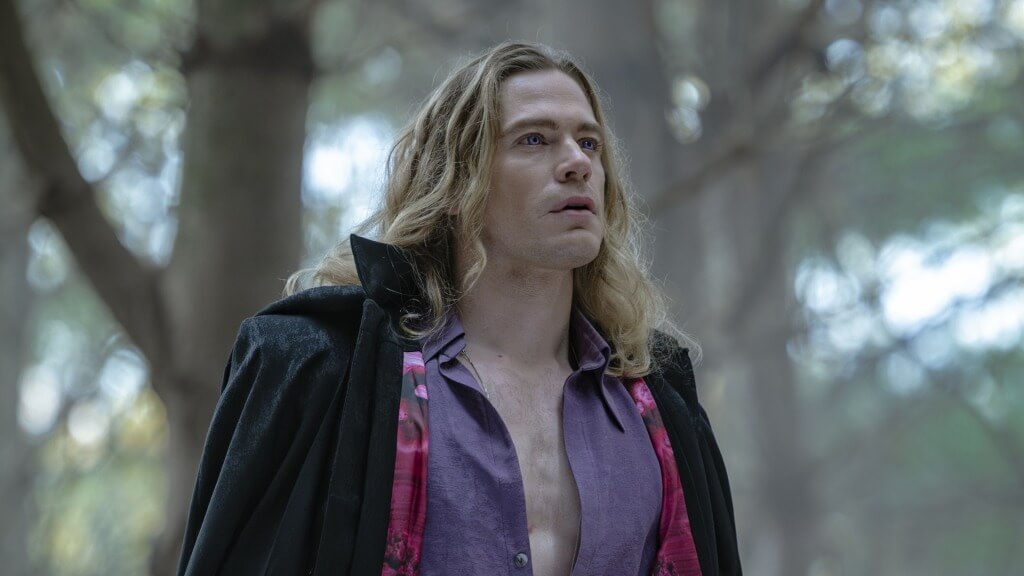
AMC’s Interview With The Vampire wholeheartedly embraces rockstar Lestat‘s (Sam Reid) campiness, churning out an edgy third season that aptly rebranded to The Vampire Lestat. But under layers of his glam-rock aesthetics and boundless snark, Lestat carries centuries’ worth of pain that he expertly avoids—and TVL gradually unearths it all in last night’s finale.
In “Failures,” not only does Lestat confront his long-buried emotional wounds (courtesy of an imaginary, messed-up dinner party) and come out on the other side, but the episode also digs into how there’s no love lost between exes Louis (Jacob Anderson) and Armand (Assad Zaman). The latter vamp, as it turns out, also holds onto unbridled anger, which he releases by forcing Louis (or Louis’ decapitated head, rather) to make amends.
Speaking with The A.V. Club, series creator and showrunner Rolin Jones said it was always his goal for Lestat and Louis to look deep within themselves in season three—it’s about time. In our post-finale interview, Jones also discussed how—despite its lack of Akasha (Sheila Atim)—”Failures” sets up Interview With The Vampire‘s future, why it was important to pivot to outright comedy in The Vampire Lestat, and how self-love is the theme of the show.
This interview has been edited for clarity and length.
The A.V. Club: What was the intent behind making the finale all about Louis and Lestat’s respective trials, so to speak, and how it serves to end the story you set out to tell with The Vampire Lestat?
Rolin Jones: Oh, we were going for self-love and contrition, which are always the end places for these particular characters, but also so hard for them to get to. There’s so much self-loathing in season three for Lestat. There’s so much enduring, too, and this near-death experience in which the worst of the worst of what he thinks of himself is on display, and still he fights through it. When Paul emerges out of this, we thought it was a symbolic act of self-love, where you’re just wrestling yourself to the ground and saying, “It’s okay, you’re doing the best you can.” And to think that of all people who could’ve shown up in that moment, it could have been Louis, but Lestat picked the person that Louis loved the most, his brother, to be the messenger. I don’t know, I think it’s lovely.
On the other side, Louis’ journey here comes right after the séance. So he’s now looking at himself and wondering, “Man, did I have my head up my ass?” It’s obviously taken to a very extreme situation. Armand is putting him through a very weird type of body horror. So for Louis, he’s thinking in this moment that he really wants to save Regina over everything, but he’s also going deeper and thinking, “Maybe I owe this to Armand. I owe some accountability for why we are here.” Another part of what we were thinking is, we know the horror fans probably think we’re horror-lite, so we thought, let’s just go for it.
AVC: Yeah, I appreciated Lestat’s realization being as simple as the fact that if he failed, then it means he at least tried.
RJ: There’s just such important data there for all of our lives. It’s not the most original statement in the world, especially for a guy who is as chaotic as Lestat, whose narration is an armor and whose referential humor is a distraction. Simple, declarative sentences by Lestat are a real achievement. That sentiment is the follow-up. Once everybody sees the finale, and on a second rewatch, hopefully they’ll see how far he’s come from album one to album 55 of The Failures. Maybe it’s an overcorrection on his part, but if you notice, he starts the season by saying that maybe he has something to do with the catastrophe, and by the end, he says that it’s all his fault.
AVC: Speaking of the catastrophe, we don’t see the actual concert that led to it just yet. Why did you save it for the future as opposed to trying to fit it into season three, or possibly doing an eighth episode?
RJ: You’re always juggling budget as you’re doing these things, and at some point you just go down the line and say, ‘I don’t know if I can pull off a 50,000 people concert this season.’ So it’s better knowing you’re betting on yourself and you’re hoping that you’re writing a real part one. It’s not even the concert. There’s so much that happened off-screen this year, and I would encourage fans to remember the structure of Queen Of The Damned, and how many of those chapters are strict points of view. My guess is, anybody who thinks The Vampire Lestat the book is incomplete right now, we’re halfway there. There’s a lot of stuff that happened off-screen that will probably be revisited.
AVC: Does that apply to Sheila Atim’s Akasha as well, in terms of how she doesn’t appear in the flesh after her introduction in episode five?
RJ: Season three is all about an examination of Lestat, and part of that examination is to get to the part where the blood of Akasha has become an excuse, and he has to realize he’s had enough time to master it. It’s this idea of “What is my responsibility with how the world turned out,” and he’s doing CliffsNotes for some people, and also going after himself. We’ve been talking about Akasha and this idea of doing The Great Conversion for three seasons now. So we wanted you guys to get a taste of what energy is coming in next. There are suggestions in the first scene itself about this whole new kind of power that is coming in, and it’s embodied in Akasha. Hopefully, if there’s a fourth season, I’m pretty sure it’s going to be called Queen Of The Damned. It puts her right at the top of what’s coming up.
AVC: Armand finally lets out his darker side after going on an “apology tour.” It makes me want to revisit Interview With The Vampire with this development. How did saving this reveal for the finale affect the plotting of season three overall?
RJ: It is an apology tour to a certain extent, but this reveal is one of the things we’ve been sitting on for the longest time. If you think about it, Armand is in every scene in season three. If you consider Regina, he’s been everywhere because he’s been lurking. His body wasn’t, as in the actor wasn’t, and he’s a terrific actor, so I get wanting more Assad [Zaman], but Armand is everywhere, even with Alex and with Regina. He’s lurking like a little gremlin all over the place. By the end with Louis, there is a level of contrition about what he is owed. Now, has he gone to a certain extreme? Yes. Are there probably other ways of getting past these things? Sure. But I think his apologies to everyone in season three were sincere. He got the exact result that he wanted from all of them. Daniel’s by his side, and, well, Lestat is making fun of him still. And now here’s Louis, who is the most prideful out of all of them, right? So it’s really moving to have the scene where Louis apologizes and talks about Armand’s history.
The hardest part about doing Armand’s backstory is that it’s fucking hard to shoot in Venice, man. It’s a pain in the ass to shoot. It’s not an easy place. But you
don’t want to tell the same story every single season either. So sometimes there’s going to be a season where somebody’s definitely on their darker side, and that may be what’s coming up. All I know is the last we see them, they’re all sitting in the auction house; they’re not at each other’s throats, and Lestat is not there. We end with Louis and Lestat in a very loving place, but he is still calling him Mr. Du Lac in The Failures. It points to the fact that there’s a bunch of shit coming up that, if we’re fortunate enough, we’ll get to cover in season four, but not even that—there’s at least a season five already percolating.
AVC: What was the process like in the writers’ room to handle season three’s overall comedic tonal shift? Did it feel like a creative challenge?
RJ: I’ve always thought of Lestat in terms of Falstaff, a tragic clown, and so if he was going to lead the show, that was always going to be part of it. It was just intrinsically easier. Louis is a little more introverted and a little more existential. For Lestat, he has to confront and get through some of the stock shit before getting to the real stuff, which probably made people look at the initial episodes and ask, ‘What is this glossy ass shit that they’re doing?’ I hope people will go back and look at episodes one and two, and the quiet moments and tiny breaks that Lestat has in the midst of all the salesmanship. You probably can’t experience this whole thing until there’s, God willing, more [seasons].
We have a fun, gangly group of writers, but we also have turnovers season to season. It’s not because a writer didn’t do well. Half the time, people have taken other jobs, too. This year, I lost three writers who were fucking great: Shane Munson, Coline Abert, and A. Zel Williams. I had to bring in two singer-songwriters this year, which fits for this season. But I also look at seasons one and two, and I laugh my ass off all the time. This season, the comedy is just a lot more front and center, although a lot less in the last couple of episodes.
AVC: Since the song and lyrics amplify the story being told, do you have a favorite that lends well to it?
RJ: The one that has meant the most for me is probably “The Loneliness.” I will tell you this. There is a song; you have to look on the sheet that’s in a little frame in episode five. Well, there are a couple of songs on there, but one is a favorite of mine that Daniel Hart wrote. And if there’s a season four, then people will hear it.
Saloni Gajjar is The A.V. Club‘s TV critic.


 Keep scrolling for more great stories.