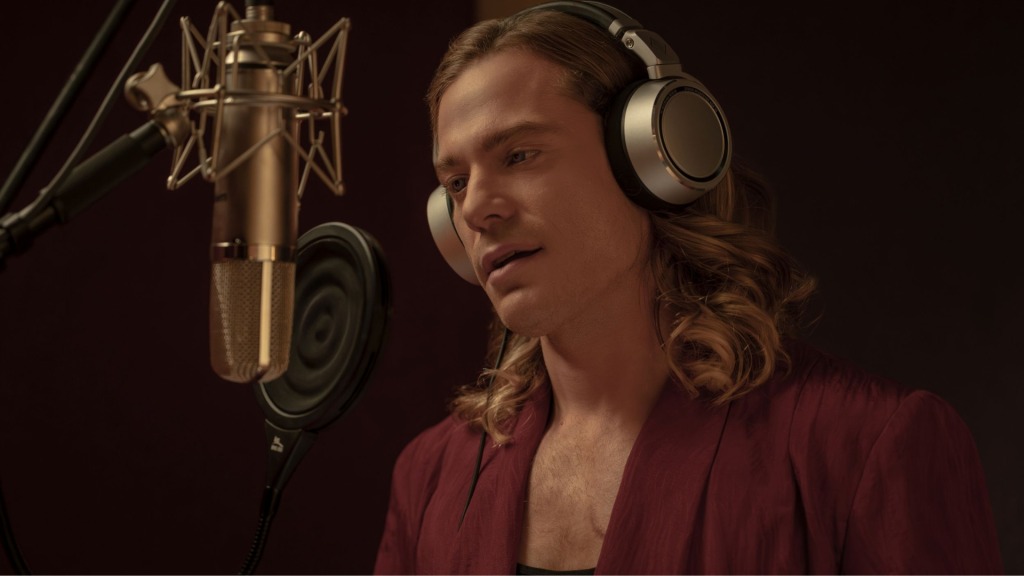
The Vampire Lestat is peculiar compared to the first two seasons of Interview With The Vampire because they trained us for gothic horror through the lens of Louis de Pointe du Lac and how he was narrating his life story in a private, luxurious penthouse to a journalist who was willing to listen, investigate, and research. It was a methodical way to get his version of the events out, with no one but the Vampire Armand sitting by his side. (Although, thanks to this week’s episode, we have more insight into why Armand arranged to be in Daniel Molloy’s presence again.) But Lestat de Lioncourt’s version of events is different. He wants to get his story out not through a well-composed memoir, but through his maniacal, loud, spontaneous, and yet somehow moving songs. But why is music his go-to—and seems to have been for quite a while?
In “New York,” we learn what compelled Lestat to keep trying to perfect the piano over the years and why he barged into Satan’s Night Out rehearsals to take over their band. Writing and performing on the stage with a wild audience dancing to his tunes isn’t just an outlet for him to express himself and channel feelings he doesn’t know how to process. As it turns out, music is also a way to subconsciously bond with the very first immortal. This episode has a few flashbacks (would’ve loved some more!) to how Lestat and Queen Akasha were introduced and the decades he spent taking care of her alone, the one whose blood spawned other vampires. And we now know what Lestat meant when he kept saying “I have the blood of Akasha in me” as a reason for his lackadaisical attitude about death.
It’s not a surprise, but the biggest takeaway from these flashbacks is the fact that Lestat cannot stand solitude. Loneliness (also the title of one of the show’s original tracks) is his mind’s enemy. He buried himself for nearly a century after being abandoned by his mother—alive but not living. It wasn’t until he was rescued by the vampire Marius (Christopher Heyerdahl)—who turned Armand and was presumed dead—that Lestat found a purpose again. Suddenly, Marius put Lestat in charge of taking care of Akasha (Sheila Atim) and her lover, Enkil. The two vamps had practically turned to stone because of their age, even though they were the most powerful beings, and Marius encouraged Lestat to play the violin and other instruments to try and connect with music lover Akasha.
“New York” leaves Akasha and Enkil as mostly a mystery for now, despite Atim’s fabulous and creepy performance at the end of the hour. What it clears up is that in all the time Lestat spent caring for them as they lay motionless on a slab, he lost his senses. It adds valuable context to his downward spiral in the present-day, considering he’s still recovering from the time he spent alone after the Paris trial. While looking after Akasha, he put on a performance for no one in particular, with name tags for Armand, Gabriella, and friends he knew in Paris watching him “show and pony” his way through life. Still, Akasha had a fondness for Lestat, speaking to him more often than she did Marius, despite her “no voices” command. Eventually, she arose, and the two drank from each other’s necks, rendering them more powerful than they were before. So is Lestat gung-ho about making music to somehow awaken Akasha? Is that who Gabriella is working for, with the agenda to “make more” vamps, which she’s passed on to The Vampire Lestat and new employee Sam Barcley?
Lestat’s time in isolation is likely why it’s now easy for Gabriella to convince him to make music that attracts others like them. So much so that he agrees to rerecord his entire album, cut “Long Face” from the tracklist, and let the instruments do the talking (“as metaphors,” he says). The goal now isn’t to release a rock album that they’re proud of as a band, but to drop an album that only vampires can hear and be influenced by. Larry immediately quits because he doesn’t agree, nor is he up to the task, and he knows Lestat doesn’t like him. The other members—T.C., Salamander, and, surprisingly, Alex—volunteer to turn. They’d rather be immortals than quit the band or Lestat, even though Lestat doesn’t want to turn them. “Let me save you from myself,” he tells them quite heartbreakingly, before Lestat, Gabriella, and Sam pounce anyway.
I enjoyed this part of the book; I like the concept of music being a specific language for vampires to connect with each other. If Interview With The Vampire was about Louis communicating his complexities to the world with his words, then why can’t The Vampire Lestat be about how Lestat utilizes sound (and lyrics!) to do it? As a treat, Lestat presents his thoughts in the most delirious ways possible. What’s not to enjoy about it, especially if it’s balanced by how his innermost thoughts are so highbrow in nature? Some of the things he worries about most and even asks Akasha about include trying to figure out why creatures like him exist: “Am I evil? Is my evil sanctioned by nature? Where is God?” I appreciate a show that slowly but surely unravels how both of its lead characters—the two who are meant to be—have so much depth.
Speaking of Louis, his loneliness becomes too apparent in “New York.” It’s curious that he hasn’t developed any truly meaningful relationships post-Lestat and post-Claudia. Yes, he was close to Armand and maybe to Daniel at one point, but those relationships were out of necessity and not affinity. He even confesses to keeping Lemuel at a distance. So, of course, he agrees to pay Claudia’s doppelganger, Regina, a large sum of money to role-play. Who else was relieved that Louis told Regina to stop faking that Southern accent? It makes the whole thing less creepy by 1%. After spending time with Regina, Louis realizes just how far he has gone while craving genuine company.
Thankfully, Louis reaches out to Lestat for help. Lestat, pissed at his ex for not even bothering to check in on him after he was shot, still shows up and even meets Regina at the same diner. Once again, both Sam Reid and Jacob Anderson sell their characters’ anguish, which is always at its peak when it comes to Claudia. Anderson wears Louis’ remorse on his face when Louis and Regina are on the boat earlier in the episode, and when he tearfully asks Lestat to talk to Regina and find out, “Is it her?” In the diner scene, I urge you to focus on Reid’s expressions when Lestat has only a few seconds to actually deal with how much Regina looks like Claudia.
After speaking with Regina, telling her to stay away from Louis, he tells him something similar (“Don’t see this person again and next time someone tries to murder me, pick up the phone”). If we know anything about Louis, it’s that he is not going to heed Lestat’s surprisingly sound advice. Then again, it’s not like Lestat has much ground to stand on when it comes to sanity. With only two episodes left in this season, The Vampire Lestat has a bunch of questions to answer and narratives to wrap up. And yet, all I find myself wanting is more time spent with Loustat together, so let’s hope the show delivers on that front.
Stray observations:
- • “We are making an album about my life, which has been a three-century trainwreck.”
- • What is Armand up to? After declaring feelings for Daniel that he’s buried for decades, he pops up at the end of “New York” to manipulate Larry into killing himself by jumping in front of a train. Why? He had already left the band and Lestat by then. Shouldn’t Armand be trying to save his AA mentee/Larry’s brother instead?
- • It should be noted that in the books, Lestat searches for Marius for a long time all over the world before he buries himself in the ground. And when the two meet, Marius spends time educating Lestat about their existence and about Akasha. Like it’s been doing all season long, the show unfortunately rushes through these developments.
- • So, the world assumes that Lestat has died after he was shot. The real Lestat has paid off Jarda, Christine, and even Daniel to shut up and get lost while the band records. Still, Daniel persists with his documentary, and is now recording “man on the street” videos to ask people why they like the band’s music.
- • Sorry to shove Daniel’s arc in “New York” down here, but I find myself still hoping for more when it comes to him and Armand. The latter pops in this week not just to kill off Larry, but also to tell Daniel he’s loved and stalked him for the past 52 years. Daniel, confused about his own feelings, doesn’t buy it entirely. But clearly, there is more story here, and I hope The Vampire Lestat finds the time to tell it, particularly for the Devil’s Minion fan club.
- • Don’t ever say Lestat isn’t committed to his music. To deliver the pitch-perfect falsetto note, he rushes out in the sun several times, hoping his physical pain will manifest in the song itself.
- • Lestat writes a beautiful ballad, titled “Stained Glass,” dedicated to Claudia, after his encounter with Regina. It’s the song that he hopes will get through to the rest of the vampires.
- • My favorite detail in this episode is that Lestat has saved Louis’ number on his phone as Thomas Pitty He’s A Whore.
Saloni Gajjar is The A.V. Club‘s TV critic.


 Keep scrolling for more great stories.