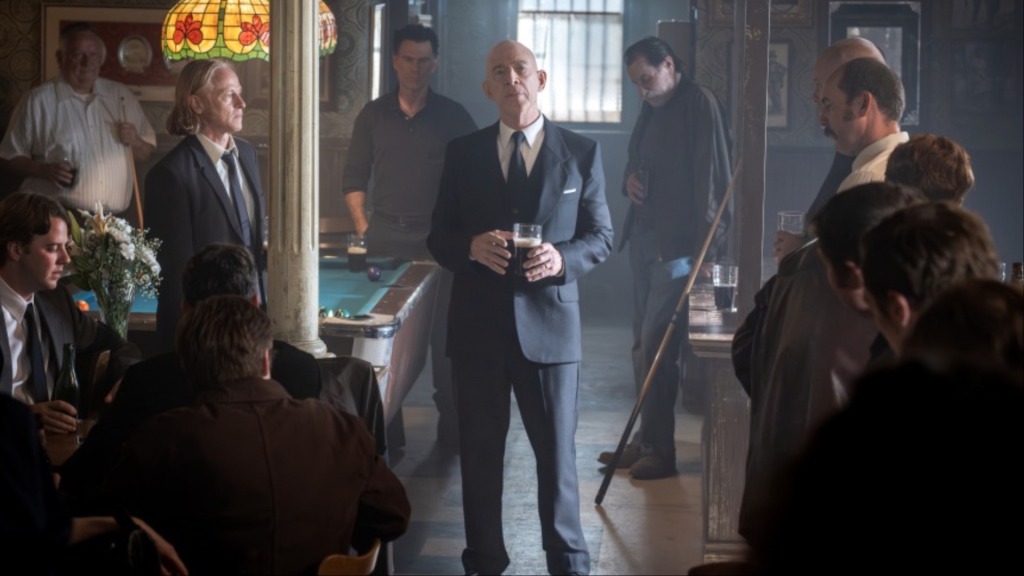
The Westies are led by fictional crime boss Eamon Sweeney (J.K. Simmons), who seems to be a rough stand-in for the real Mickey Spillane, an old-school gentleman gangster whose heartfelt speeches about Irish history and community pride tend to take place at funerals or wakes where he’s responsible for the body count. His control is bolstered by inside info from corrupt cop and old friend Glenn Keenan (Titus Welliver) and his favorite protege, Jimmy Roarke (Tom Brittney), a quick thinker and perhaps the only character whose default settings are not immediately violent ones. But as Eamon begins to make a predictable series of questionable sacrifices in the name of the Javits project, Jimmy must face that age-old gangster cliché: painfully divided loyalties. Torn between the man who gave him his start and the younger Westies who look to him as a leader, Jimmy gives the show its most consistently compelling emotional arc, a moral crisis that touches on everything from how to handle the Italians to the gang’s role in the city’s budding cocaine trade.
The Westies’ unflinching violence, intricate betrayals, and dash of local politics suggests a desire to be something like an American version of Peaky Blinders. It doesn’t reach those lofty heights, largely because too many members of its sprawling cast ultimately feel interchangeable, and the show struggles to truly convey the stakes of the rivalry between the Irish and Italian mobs. While various characters repeatedly invoke the importance of the Javits construction to justify all manner of heinous deeds, viewers are given relatively little context about what such a massive project means for the city’s West Side and the poor and marginalized people who live there. Aside from some specific aesthetic choices, repeated references to The Troubles in Belfast, a banging soundtrack, and the fact that everyone smokes constantly, this is a period drama that’s not terribly interested in the period in which it takes place. But, hey, the sets are fun.
Simmons gleefully chews through every available piece of scenery as a man willing to sacrifice anything in the name of his own power and profit. But it’s Brittney—best known for his performance as one of the Hot Vicars on the underrated PBS mystery series Grantchester—who is The Westies’ secret weapon. His Jimmy is the show’s moral compass and emotional heart. A gangster who is happy to commit murder or dismember a body if the situation requires, he still has an ethical line he’s not willing to cross, often when it comes to betraying those he cares most about. Brittney deftly conveys the impossible weight of many of the seemingly impossible choices Jimmy is repeatedly asked to make and is the closest thing this show has to someone you’ll feel okay about rooting for.
Unfortunately, most of The Westies’ supporting characters aren’t drawn with anything approaching a similar degree of nuance. Stanley Morgan is entertainingly chaotic as Jimmy’s BFF Mickey Flanagan, but you’ll struggle to recall the names of the rest of the Irish crew, who are all fairly flat and unmemorable. And while it’s unlikely anyone really expects an ’80s New York mob saga to be a bastion of feminism, The Westies’ almost total lack of named women onscreen is a bit jarring. To her credit, Sarah Bolger is fantastic as Jimmy’s girlfriend Brigid, and manages to infuse her vengeance-fueled IRA activities with some fairly devastating emotion. But her subplot has little to do with the season’s larger story and generally feels as though it’s happening on a completely different show. Pity poor Allan Leech, seen here playing the latest in a series of history’s dumbest revolutionary agitators.
Still, The Westies somehow manages to be a decent enough distraction. Its relentless action keeps things moving relatively briskly—barely a scene goes by in which someone isn’t being punched, kidnapped, killed, shot at, or brutally tortured—and its cast displays a worthy commitment to the material that the show’s larger story doesn’t always deserve. But its superficial exploration of a tumultuous time period means it won’t linger in viewers’ minds once the final credits roll.


 Keep scrolling for more great stories.