2025 has delivered no shortage of varied, messy, and compelling anime about queerness. There’s No Freaking Way I’ll be Your Lover! Unless… brought a mixture of fluffy fun and disaster lesbian hijinks as its protagonist was dragged kicking and screaming out of the closet by a lineup of suitors. Rock is a Lady’s Modesty reveled in musical foreplay, as sweaty guitar solos became extremely thinly veiled metaphors for carnal desire.
Other shows featured prominent subplots about fighting back against oppressive norms, like Sanda and its critiques of a natalism-obsessed society where same-sex romance is even more stigmatized than in our world, and Kowloon Generic Romance featured characters who battled to regain their true (often non-conforming) identities. Perhaps most convincing of all, The Summer Hikaru Died eviscerated emotions like a buzzsaw, portraying the nightmarish experience of growing up queer in a small town (with side helpings of an Eldritch blob creature boyfriend).
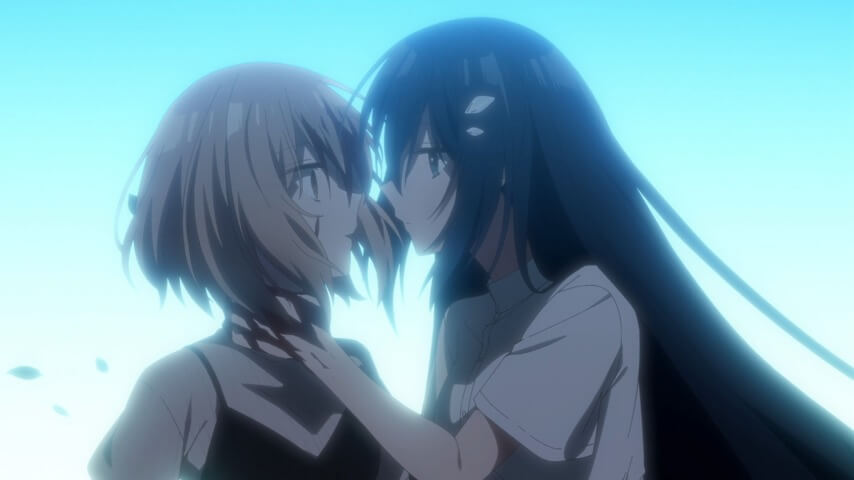
It’s in this decidedly uncomfortable, horror-tinged portrayal of queerness that one of this season’s most interesting shows resides. As its name would suggest, This Monster Wants To Eat Me is, in fact, about a girl and a monster that wants to eat her. Hinako is a high school student who passes her days drowning in an ocean of grief, until one day, she meets a mermaid, Shiori. But while this mermaid looks like a teen on the outside—with Hinako commenting on her beautiful blue eyes and regal presence—her true form is decidedly more unnerving: an aquatic yokai with sharp fangs and hooked claws used to eviscerate human flesh.
Shiori makes no attempt to hide her true nature; after saving Hinako from a rival creature, she reveals that she saved the girl so that she can one day devour her “delicious meat.” She likens it to fattening livestock. While this situation would be enough to send most running for the hills, there’s an even grimmer twist: Hinako has been struggling with isolation, depression, and suicidal ideation ever since her family died in a boating accident. Her death wish is what attracts these circling yokai in the first place, and she’s relieved that she will soon be able to “join her family,” as she puts it. From here, the two carry on with this off-putting situationship until future revelations complicate matters, eventually subverting this premise.
It goes without saying that the situation is far from wholesome: there’s messy romance, and then there’s this setup that flies past toxic yuri into a homicidal, Ted Bundy fangirl-adjacent hellscape. Up front, it calls to mind other stories that draw parallels between queerness and acts that actually deserve to be taboo (like cannibalism): Guadagnino groupies will remember the director’s 2022 film Bones And All, which could be somewhat uncharitably interpreted as a tortured metaphor for being gay in the ‘80s (when the movie takes place), while Julia Ducournau’s Raw touches more indirectly on similar subject matter with stomach-churning glee. Both of these pictures have the protagonist commit deeply difficult-to-watch acts to place the audience in the shoes of the prejudiced uncle at the Christmas party: they push the viewer into a mode of discomfort that essentially mimics what those with internalized or externalized homophobia may feel towards queer media, encouraging the viewer to confront and grapple with these feelings.
At first, This Monster Wants To Eat Me does something similar, even if the roles are reversed, with Hinako’s suicidal ideation and desire to be eaten invoking unease. This starting place is unpleasant in its own way as it’s the kind of setup that could risk glorifying suicide if handled thoughtlessly. Thankfully, though, there’s a bit of misdirection involved, and while the series never forgoes its carnage-slicked path, it eventually becomes clear that it’s more about looking past veneers—in this case, that of a grimacing, scaled, former mass murdering amphibious humanoid—to see what’s underneath. Basically, it alludes to taboo, evoking the discomfort some feel towards queer media, before peeling back the layers to show a more heartfelt (albeit still extremely messy) relationship underneath, asserting that these initial reservations are unfounded.
However, even if elements of its premise are fake-outs, the buckets of blood are the real deal. Hinako and Shiori are routinely covered in yokai gore, as the latter tears these endlessly attacking creatures to ribbons for the sake of the former—how romantic! More fundamentally, even if these two’s relationship isn’t quite as rancid as it initially seems, the smell of death still lingers in the air. But strangely enough, this copper scent is oddly refreshing. It is wonderful that there’s been much more queer media in recent years that avoid the trap of the gays being buried over and over again; the Heartstopper of the world, with their largely positive, buoyant presentations undoubtedly need to exist. At the same time, it’s a sign that a storytelling space is healthy when it can show things that are unhealthy.
In a 1969 paper, academic Cedric C. Clark described four states of minority media representation on television: non-recognition (when a particular group isn’t depicted at all), ridicule (where the group is shown but in a derogatory fashion), regulation (where the group is portrayed in more positive roles, but within social convention in positions that affirm existing power structures), and respect (where the group is shown with the full range of human complexities, as good guys, bad guys, and every shade of moral gray in between). In other words, the ability to portray minorities as complex characters, potentially in uncomfortable situations, is a sign of a healthier TV landscape than one where large groups of people are pigeonholed into sanitized roles.
Moreover, while the affirmational elements of shows like Heartstopper are important, especially for younger viewers battling through the living hell known as high school, there’s something cathartic about a messy, nightmare series that affirms the inevitability of certain uphill battles and unpleasant situations. That’s most probably true for many viewers in Japan, who live in a country where gay marriage still isn’t legal despite widespread support, and for many in the United States, where minority rights are threatened to a terrifying degree. In short, things are bad, and for some, it’s cathartic when media addresses that reality instead of pretending that everything is fine.


 Keep scrolling for more great stories.