With Together Again, Jesse Hassenger looks at actors and directors who have worked together on at least three films, analyzing the nature of their collaborations.
Editor’s note: This essay includes full spoilers for Bugonia as well as other Yorgos Lanthimos movies.
Certain types of roles are seen as easier pathways to Academy Award nominations. Playing real people, whether celebrated or more obscure, is a big leg up. Alcoholics in various forms remain popular. Among women, wives in crisis come up a lot. In this field, aliens are less of a go-to. Yes, Jeff Bridges was nominated for Starman, but the prevalence of visual effects, a view of science fiction as less serious than realistic drama, and the lack of easy comparison standards for how a human actor might play an alien has meant that there’s not much awards market for such otherworldly characters.
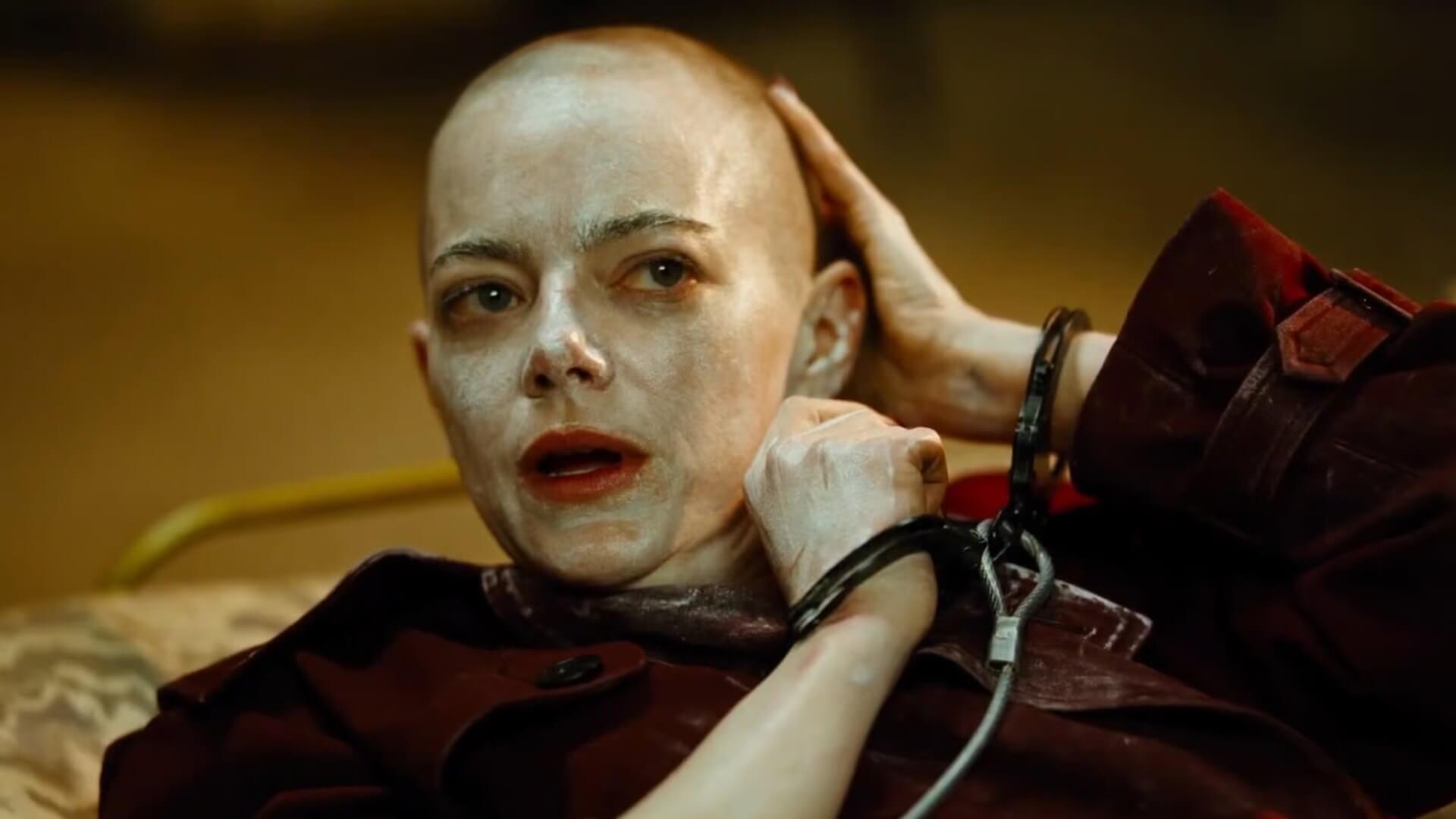
But then, very little else about Bugonia screams Academy Awards, either; it nonetheless emerged from this year’s nominations with four, including one for Emma Stone, playing a high-powered CEO who also…well, suffice to say that the more you learn about Michelle Fuller, a pharmaceutical executive kidnapped by a pair of troubled, conspiracy-addled men, the less Oscar-friendly she (and the movie) will seem. Even so, Stone’s nomination was not seen as a particular surprise. After all, her record with filmmaker Yorgos Lanthimos has been pretty strong: Bugonia is their fourth feature together, and three of those four movies have netted her Oscar nominations (as well as Best Picture nods for the movies themselves). Lanthimos films also represent the majority of Stone’s prodigious five acting nominations overall, and he’s yet to score a Best Picture nomination without her.
Films endure or don’t based on their own merits and the many flukes of history, which may include awards as part of some complex, unknowable calculus, one just as likely to include supposed snubs as actual nominations or wins as part of a broader narrative. The degree to which the Stone/Lanthimos combination has proven particularly irresistible to Academy voters is notable. Though the awards body has diversified over the past decade, it’s strange to consider that Stone has helped sell Lanthimos to them in a way that even star-friendly and sometimes-awarded figures like Wes Anderson, David Fincher, or Steven Soderbergh haven’t consistently managed.
At first, it seemed more like Lanthimos was helping to repackage Stone than the other way around. Both of Stone’s nominations before The Favourite came from another awards standby: Hollywood movies about Hollywood, though admittedly Birdman and La La Landoffer distinct points of view and wildly different characters for Stone to inhabit. Good as Stone is in these movies—and if anything, her open-hearted mix of classic-romance vivacity and aching vulnerability in La La Land has been undervalued over time, swept up into the generalization that the Oscars like to award female ingenues but prefer men to accumulate some middle-aged gravitas—their Hollywood stories also tip her scales away from the more sui generis aspect of her persona.
When she first turned heads in Superbad, Stone established her appeal with a mix of girl-next-door guilelessness (this was her first movie!) and child-actor poise (she had bopped around low-attention gigs on TV, variously credited as Emily Stone or even, for one guest shot, Riley Stone). That continued as Stone performed the then-standard dance between high school, college, and twentysomething roles over the next decade: She obviously had comic chops, but she could use them to play convincingly gawky, too, even selling whoppers like her character being socially invisible at the outset of Easy A.
Adulthood, though, was a shakier sell than precocity, never more so than in Gangster Squad, her second of three collaborations with Ryan Gosling. She looks the part of an Old Hollywood dame, but can’t quite get the part out of the quotation marks that surround everyone in the movie. Compare that misadventure with her peer Jennifer Lawrence, who came up around the same time; she had so much credibility that David O. Russell could repeatedly cast her beyond her age range and only receive further Oscar attention. While Lawrence was playing troubled housewives in her early twenties, even Stone’s grittiest role, the recovering addict in Birdman, was predicated on her being someone’s college-aged daughter.
This is why the Stone-Lanthimos partnership doesn’t feel like a simple case of an Oscar-darling actress helping to legitimize a mischievous scamp-provocateur in the eyes of Hollywood. Lanthimos’s Greek film Dogtooth, a bleak drama discomfiting (and darkly funny) enough to qualify as horror-adjacent, was nominated for the 2010 Best Foreign Language Film Oscar. His alternate-world parable of love and loneliness The Lobster received a Best Original Screenplay nomination a few years later. Both of these movies seem too out-there for awards attention, and yet there they were. (The Killing Of A Secret Deer suggests some kind of line, even for the English-language work that now makes up the majority of his filmography.) The disturbing premise of Dogtooth, where a couple’s adult children are kept in a state of highly controlled, sheltered, and perverse childhood, could almost read as a parody of the type of forever-ingenue roles that actresses like Stone are pressed to play well into their twenties, sometimes even thirties.
Stone convincingly embodied other adults before playing Abigail Hill, the usurping cousin of Sarah Churchill (Rachel Weisz), secret lover of Queen Anne (Olivia Colman) in 18th-century England, for Yorgos Lanthimos in The Favourite. But costume drama, even with a bawdy black-comic streak, was not seen as her forte. As it turns out, though, Stone wears costumes well: As Abigail rises in status from scullery maid to replacement for Sarah, she looks increasingly resplendent in her own presumed security, until she’s wielding her body not just to pleasure Queen Anne, but to half-crush one of Anne’s beloved pet rabbits beneath her heel. Much has been made of how Lanthimos uses fish-eye lenses in many scenes of The Favourite, but just as crucial is the camera’s positioning at a low angle, so the characters constantly look like a combination of towering, distorted, and lonely in the elaborately art-directed frames.
This is on a spectrum with Lanthimos’ other visual strategies, like how the camera frequently faux-misframes the characters in Dogtooth, letting them extend past its field of vision, making them look particularly overgrown and ill-fitting in these constricted, constructed kidult roles. But what’s actually seen in the frame represents a major departure from Stone’s earlier girl-next-door vibes, where even her iconic looks in La La Land were simple and straightforward: that yellow dress, that green dress, that orange dress. The pageantry of both The Favourite and Poor Things looks more superficially ready for the Oscars, and the Academy followed suit. (As did her most mainstream post-Lanthimos film, the gorgeously designed if underthought Cruella.) For Stone specifically, however, these Lanthimos films offer an appropriately weird hybrid. The go-for-broke physical presence she has as Abigail and especially Bella Baxter, the dead woman revived and reborn through mad science in Poor Things, sometimes plays like a cross between the high-spirited dancing of La La Land and the forays into grotesquerie found in her frequent Saturday Night Live hosting gigs.
That might sound reductive, but SNL looms large in Stone’s personal and professional life: She’s hosted five times, she gleefully played Gilda Radner’s Roseanne Roseannadanna on the show’s 40th anniversary special, and she’s married to SNL segment director Dave McCary. The early segments of Poor Things revel in ribald slapstick, with Bella peeing and smashing and stabbing before she graduates to verbal bluntness. As easy as it is to admire the toddling physicality of Bella’s early days, and as much work as it probably represented for Stone, it’s also shtick—albeit high-minded shtick accompanied by a carnality that, even given the disturbing couplings of Dogtooth, feels like a Stone-accelerated development in Lanthimos’ filmography.
So much of his style in those earlier films, particularly Lobster and Sacred Deer, comes from their deadpan stillness and strange dialogue, where the characters talk with a hushed, banal formality like, well, aliens disguised as humans, rendering their relationships particularly remote and unsexy. It’s no wonder, then, that the alien-among-us paranoia of Save The Green Planet! appealed to Lanthimos, who remade that Korean film as Bugonia. The idea of imprecisely sourced foreignness is intrinsic to Lanthimos’ reputation in the U.S., with unspoken (and probably ethnocentric) questions of: What’s this guy’s deal? Is he some kind of weirdo pervert running a theater of cruelty, or is he just European? As much as his awards success feels like a foothold from a more international-skewing Academy membership, it’s also markedly increased as he’s moved into English-language productions.
Oddly, Bugonia sometimes feels like a galactic expansion of Stone’s most memorable segment in the Lanthimos triptych Kinds Of Kindness. In the middle section of that film, Stone plays Liz, a woman who returns after being presumed lost and likely dead at sea, greeted by a husband (Plemons) who simply refuses to believe it’s her. Convinced she’s an imposter, he demands increasingly gruesome acts of devotion, and she complies, nonetheless failing to win his acceptance. As in Bugonia, there seems to be nothing Stone can do to convince Plemons that she’s on the level—and like Bugonia, albeit more obtusely, the story ends with the suggestion that Plemons was right all along. After Liz dies while performing one of her husband’s impossible, mutilating gestures, another, identical Liz appears at his doorstep and embraces him. Somehow this feels more like a sick joke than the species-annihilating finale of Bugonia, where Michelle eventually reveals that she is, in fact, an alien put on Earth to observe the planet before deciding that human life is not worth saving.
There’s an undeniable boldness and brashness in repeatedly using Emma Stone, a sparkling movie-star presence, as a tool of fantastical deception. It’s a clever trick, rooting audience sympathy in the idea that Stone must be who she says she is while exploiting the idea that we’re prone to “believe” movie stars even as they explicitly play pretend for a living. “You got a real human response out of me there, which is impressive, given your cellular composition and all,” the Plemons character from Bugonia tells Michelle early in his kidnapping. He could be describing the inherent fakeness of any acting. (Is Lanthimos being cheeky when he gives one of Stone’s other Kinds Of Kindness characters the actress’ birth name of Emily?) In Bugonia, Stone is, if you accept her character’s protestations, pretending to be a pretty loathsome CEO; Michelle is kind of delightful as she rattles off a “generous” new corporate policy for just long enough to make it clear that no, employees aren’t particularly encouraged to leave slightly earlier, no matter what she thinks she’s saying.
Does making Michelle, a perfect avatar of corporate speak, an actual alien turn Stone’s performance into more of a parlor trick and/or let real CEOs off the hook? I’m honestly not sure. If Lanthimos could be accused of observing many of his characters from beneath glass, then surely there’s room to at least wonder whether he’s doing that with the actors expressly hired to do his bidding. Certainly there are ideas and images in his work that, over time, start to seem less like pure provocations and more like personal kinks. The matter-of-fact yet childlike sexuality of Dogtooth, for example, gives way to a tendency to use sex as a punchline—and a good one, as in one memorable shock-laugh in Kinds Of Kindness. Still, it’s easy enough to wonder whether he’s passing off his desire to see attractive actors simulate group sex as a dark-comic examination of human foibles.
Yet Bella Baxter, calculated as some may find her textbook-feminist story arc, certainly doesn’t seem like a plaything for her director, despite all those sex scenes. (They may be the only sex scenes of his recent career that escape the dichotomy of either having a laugh or getting off on having a laugh.) Bella represents, among other things, a Frankensteinian synthesis of Stone’s early-career arcs (comedy to drama; perpetual and age-mismatched teenager to legitimate adults) as well as the director’s observations about the wobbly transition from childhood to adulthood. Somehow, this riff on a famous horror story is his only movie that ends with an unambiguous sense of contentment.
Stone’s recent Lanthimos movies contain little explosions of exuberance—the dance from Kinds Of Kindness, her private “Good Luck Babe!” singalong in Bugonia—that could easily pass for moments from the broad comedies she mostly avoids these days. (Maybe that’s why she’s stayed close to SNL even after multiple Oscar wins; it’s her most sustained post-Lanthimos outlet for comedy.) But these moments pop in part because she submits so thoroughly to the mood of the film at hand, something that carried over so thoroughly to the rigors of Ari Aster’s Eddington that she intentionally recedes from the movie as she acts in it. The quality of Lanthimos and Stone’s work together hasn’t flagged over the past eight years, and the idea that it was these movies, of all things, that have made Stone an Oscar darling is both gratifying and hilarious. But their collaboration still leaves more room for Stone to grow up within her favorite director’s wide-angle frame.


 Keep scrolling for more great stories.