Over the last year or so, the Umamusume series has gone from ultra-niche to only moderately niche, the kind of thing terminally online individuals might have come across in passing thanks to Northernlion or any number of other popular streamers. Previously only available in Japan, the game Umamusume: Pretty Derby came out worldwide last July, and it’s essentially a management and racing sim where you play as a trainer for anime horse girls (that is, anime girls with horselike features called umamusume) who are based on real-life Japanese race horses. It kicked off an online fervor that began as ironic before quickly becoming anything but, sucking droves into a fever dream of endless Bakushins. If it sounds like it’s for weirdos, that’s because it is, but it turns out those weirdos have a point.
The deeper you dig, the more absurd it gets, because beyond the popular game, there are also multiple television shows: the mainline Pretty Derby series, which has run for three seasons, and the spin-off, Cinderella Gray, a lethally self-serious sports drama that emerges like a charging steed. Before CygamesPictures worked on the latter, they handled Umamusume: Pretty Derby – Beginning Of A New Era, a film where hand-drawn animation captures pure speed in flashes of prismatic light and blurred motion. After a long wait since its initial 2024 debut in Japan, it’s finally releasing stateside this week (likely due to the series unexpectedly breaching containment). While most of the movie’s initial charm comes from how it handles such a bonkers premise with utter earnestness—dramatizing the real-world 2001 Japanese Classic Races through horse girls—it isn’t long until skepticism transforms into a sports fan’s passionate cheers.
As for the main umamusume of this story, her name is Jungle Pocket (again, the characters are based on real-life race horses, so their names are ridiculous), and she’s a student at Tracen Academy, the premier destination for up-and-coming sprinters. Her fate was sealed the moment she saw an upperclassman tear up the race track, demolishing her competition in front of a packed audience before taking a regal bow. From this point on, Pocket wants to be the best.
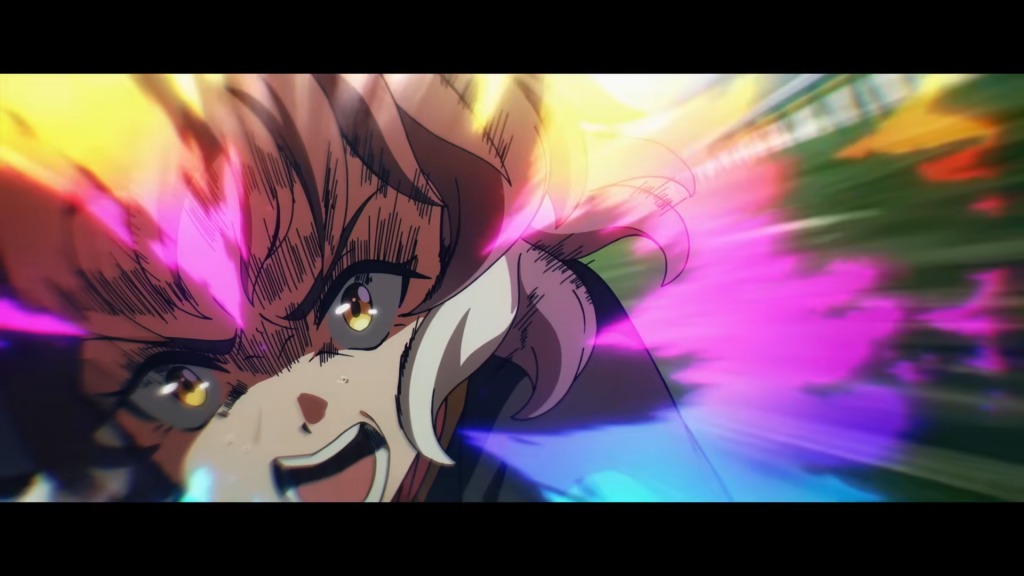
This straightforward motivation is set up quickly, but the film sucks us into its slipstream with racing scenes that are so intense they make it feel like a loss means being sent straight to the glue factory. Helmed by veteran animator Ken Yamamoto (who is credited for direction, storyboarding, animation direction, and key animation), CygamesPictures captures the power behind these racers’ every step. Hooved boots press into mud as final sprints come alive with the explosive force of an orbital missile strike. These characters may literally just be running in a circle around a track, but the aesthetic framing borrows from the visual language of battle shounen anime to get across the hot-blooded drama: at one point, Pocket’s main adversary, a scientist horse girl in a lab coat, Agnes Tachyon, runs so fast that it’s portrayed like she’s breaking spacetime, assaulting the viewer with a 2001: A Spacy Odyssey styled rush of colors. Bodies contort in impossibly long shapes to capture a sense of momentum and weighty impact frames capture the unnatural force of every stride.
Thankfully, there are visual highlights off the race track as well, and Yamamoto’s direction builds towards the kind of human (er, horse girl) drama that builds investment. At one point, a dominant competitor announces their early retirement on TV like they’re a Bond villain as the color grading flickers to a horror movie red and the soundtrack takes a sinister turn: fans are devastated that she’s gone, and her opponents are dismayed they’ll never get a chance for revenge. At the other end, moments of slapstick comedy turn these characters into expressive, exasperated blobs that may as well be from an old-school comic strip, selling these sudden tone shifts.
The atmospheric direction throughout is particularly important for capturing Pocket’s headspace, a surprising development that shows just how much is bouncing around in her brain. She begins as a typical headstrong athlete, overconfident in her own skills and sure of her eventual success, until she runs into the previously mentioned monster, Agnes Tachyon, a perfect foil who, despite her incredible skill, seems to only care about these races for much colder, more scientific reasons.
It sets up what seems like a typical back-and-forth rivalry, only for events to take an unexpected turn, destroying Pocket’s self-confidence as she’s consumed by imposter syndrome and the pressure to achieve outward success. The abrupt switch from sports antics to psychodrama is another bizarre touch conveyed through skilled execution. Her doubts are visualized in anxious body tics and shadowy embodiments of self-loathing, while voice actor Yuri Fujimoto captures this range in guttural cries of victory and jagged inner monologues. There’s suddenly less Rocky Balboa going on and more Shinji Ikari. Even the nominal “villain,” Tachycon, goes through a similar emotional journey as she attempts to rationalize her misfortune.
Despite the unexpected suffering, the film is still ultimately about chasing a pure idea: running very, very fast. Through its obsessively realized animation, it gets at its characters’ similarly obsessive drives. For Tachyon, this is about understanding what lies at the limits of umamusume ability, while Pocket is driven by the desire to become an unambiguous champion. These ambitions come across in final spurts that see them transcend their surroundings, running past not only their competitors but everything else, too.
However, while the film makes time for its central characters even with its general need for speed, the rest of the cast gets left in the dust. Among the long list of side-characters, only Pocket’s trainer and mentor get much of a spotlight beyond broad strokes, leaving the extended cast feeling like easter eggs for the game. Moreover, there’s a sort of fuzziness to the stakes, which is partially a function of how horse racing works: while some races are far more prestigious than others, like the Japanese Derby, there isn’t really a final championship or tournament to overcome, like you’d find in traditional sports stories. The film works as a standalone, but this somewhat confusing competitive situation will probably be worse for those who haven’t watched the existing anime or played the game.
Even with some strange plotting, it says a lot about Umamusume: Pretty Derby – Beginning Of A New Era that most of these extraneous details and background concerns are drowned out in the heat of the moment. Eventually, even the baseline absurdity of anthromorphized horse girls fades, as the story tackles a different type of ridiculousness grounded in the real world: Why do these kinds of athletes care so much? It’s a question less directly answered by the film than felt in the desperate way characters move while approaching the finish line, their motions squashing and stretching as they shatter barriers at impossible speeds. At once melodramatic, jaw-dropping, and oddly inspiring, Beginning Of A New Era captures the irrational passion of sports in all its hooved glory.


 Keep scrolling for more great stories.