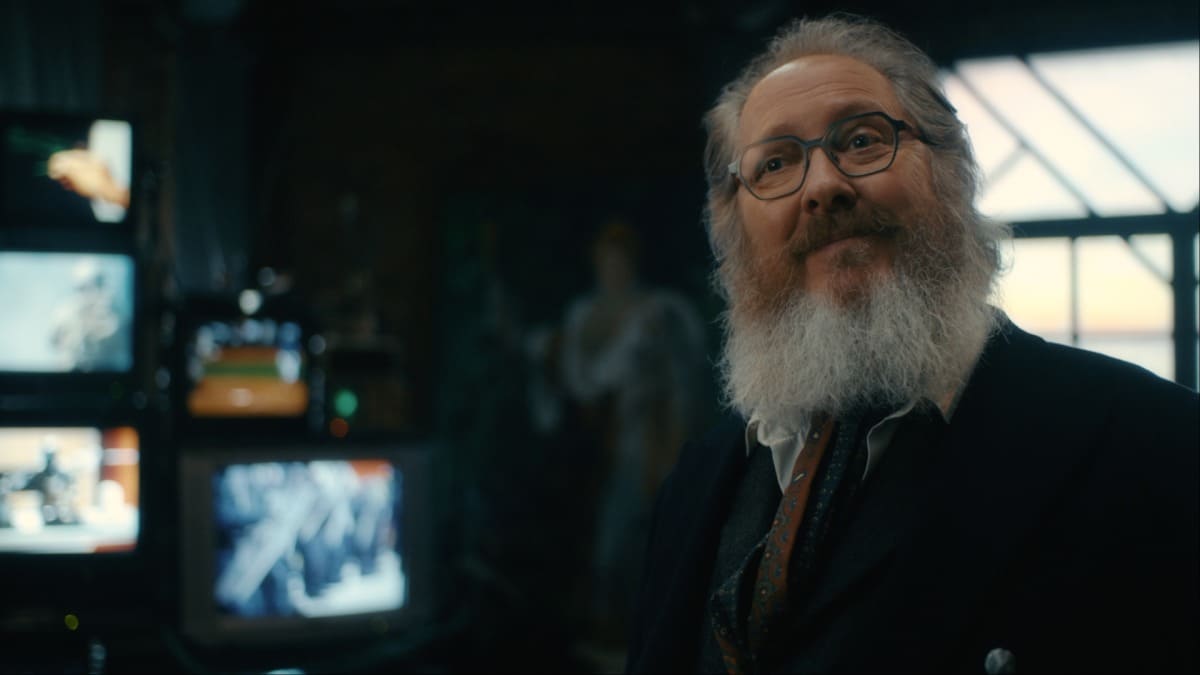
Though Vision is still dealing with the grave injuries he suffered while saving Thomas—who he still refuses to acknowledge as his son—from Paladin, “Reboot” takes a moment to step aside and introduce a new narrative thread. It’s one that threatens to throw the “funny friends in a house” sitcom-adjacent hijinks of VisionQuest into even more disarray: the so-called “Butcherbird” serial killer, who got her name from the way she leaves wing-like markings around her victims. Ultron learns about Butcherbird from a news broadcast on his pile of televisions, and he seems worryingly curious about this “busy little bird.”
And there’s a good reason for that, because we then see Butcherbird in action as she disables a man’s fancy security system and then shrugs off a couple of shotgun blasts before we see the scary, robot eyes she has beneath her hood. All of the Tony Stark AIs we know about in the MCU are accounted for in Vision’s mind-mansion, which means we’re dealing with a new challenger here.
While that’s going on, Vision finishes healing up from his injuries in the car that Thomas stole for him, which involves dumping sulfuric acid into his wound. In the mind-mansion, this medical emergency is depicted as a house fire, with D.U.M.-E. heroically stepping in with a fire extinguisher, presumably as a cute nod to his overzealous extinguisher usage in Iron Man. At the same time, Paladin patches up his own injuries and chats with his handler about some of his previous adventures. One apparently involved a werewolf (if this is a reference to something specific other than Werewolf By Night, I don’t know what it is), and the other ended with Paladin getting a billy club to the face. “If you can’t stand the heat, stay out of Hell’s Kitchen,” he says. Paladin first appeared in the comics in a ’70s Daredevil issue, so it’s nice to see ol’ Hornhead get a nod here.
With the crisis seemingly averted, Thomas tries to talk to Vision and finally get some answers about whether or not Vis is his father, but it doesn’t go well. Vis insists that it’s impossible for him to be anyone’s father and that anything that may or may not have happened is entirely because of what Wanda did and not because of him. Remember that this is technically a wholly new Vision built from the remains of the original guy, and that the Vision who served as Billy and Tommy’s father in the WandaVision reality was a fake guy created by Wanda’s magic, so he is correct in saying that he can’t be the boy’s father — a fact that he presents with all the tact of, well, a computer.
This dynamic between Vis and Thomas is really good, and it helped to assuage most of my concerns about Thomas being able to carry the emotional weight of a show that is otherwise all robots. Ruaridh Mollica is really good at playing a guy who’s putting on a brave face even though he’s perpetually one breath away from a breakdown, and the decision to have Vision insist that he feels absolutely nothing for this boy who clearly needs him so bad really distinguishes this Vision from the “real” one or the WandaVision one.
The not-father and not-son eventually find a hotel they can hide out in, where Vis catches Thomas watching Small Wonder and notes that, hey, Wanda also used to like watching old TV! (An important note for the nature/nurture debate: TV taste is genetic.) This also prompts Vis to explain WandaVision to Thomas, though he leaves out the whole thing with Evan Peters’ meta-casting. He also mentions, of course, that there’s no way he could be Thomas’ father; the boy doesn’t take this well, and he storms off. Ultron questions Vis’ dedication to brutal honesty and calls him a “wanker,” so Vis shows Ultron a bunch of simulations where he took a different approach with Thomas, all of which also end with him storming out. Ultron, unimpressed, asks Vision if he wants to “rent a porno”—a great moment.
But as good as that was, VisionQuest nearly spoils it with a subsequent scene where Thomas gets mad at a malfunctioning vending machine and yells about being surrounded by “broken machines” that won’t give him what he wants. You see, because he wants to know about his connection to Vision, but Vision won’t give it to him, and also he wants a snack that the vending machine won’t give him! And a synthezoid and a vending machine are both kind of robots! (It’s a good thing the rest of the episode is solid, so this doesn’t bring it down too much.)
In his frustration, Thomas accidentally activates his super-speed and phases his fist into the vending machine, breaking it. Trying to calm him down, Vision bonds with Thomas about boxing and they somehow land on the subject of death. Vis isn’t afraid of death, since he’s done it before, but—as indicated by Thomas’ haunted reaction to a sign for the hotel’s pool—he suspects that Thomas is. Thomas then shares his own backstory, talking about how some kids were holding him underwater at a local pool and he felt like he was about to die, but then “something else tried to fill the space.” That’s when his double-memories started and when his powers activated, with him panicking so much that his super-vibrations super-heated the pool.
It then turns out that Vision’s core needs a reboot before he explodes and kills everyone, and his only idea for how to pull that off is for both he and Thomas to get in the hotel pool, let himself shut down, and then have Thomas use his power—“the very essence of speed”—to jumpstart his core. It works, but the reboot also sends out a signal that attracts the attention of the Butcherbird.
She’s been spending the episode messing with Paladin, who mistakenly tracked her down to the apartment from the beginning of the episode because he thought she was Vision. She’s able to scan his mind somehow, allowing her to see that Paladin’s father was abusive and that he was murdered by the real Paladin, who then raised our Paladin to take his place in the legacy of Paladin assassins when he got older. It turns out that everyone in this show has some kind of issue with their father and/or son! It’s a little heavy-handed, but whatever. Familial strife is one of the few connective themes in this trilogy of shows, though WandaVision and Agatha All Along were more about mothers and sons.
Meanwhile, the mind-mansion gang has also been talking about death, with F.R.I.D.A.Y. revealing to E.D.I.T.H. that both of them, like J.A.R.V.I.S., were modeled after real people that Tony Stark knew at some point. E.D.I.T.H. decides to honor J.A.R.V.I.S. with a funeral, hoping that someone did the same for the real Edith when she died, which sets up what could be the show’s best scene so far. The AIs gather around to mourn J.A.R.V.I.S., and, after a moment of silence, D.U.M.-E. steps forward and recites John Keats’ “On Death,” followed by U. joining him, taking a breath, and then simply saying, “Yeah.”
VisionQuest has been generally less jokey than the previous two shows, but this is such a solid gag, and keeping both D.U.M.-E. and U. silent for nearly three whole episodes before doing a “dumb guy says something very eloquent” joke displays not only an impressive level of patience but also confidence. This isn’t overplayed Marvel quipping, this is an actual structured joke! There was a setup and a punchline!
Unfortunately for our mind-mansion friends, the funeral is then immediately interrupted by Butcherbird, who managed to make a connection to Vision’s mind while he was offline. This kicks off the week’s second episode, “Malware,” with E.D.I.T.H. performing an exorcism of Butcherbird’s code by reciting from a “programming bible” and immediately donning a priest outfit. She even says “Control-Alt-Delete thee from this place,” which is a cute computer joke, but not as cute as one that comes later.
The AIs discuss what’s up with Butcherbird, with Ultron explaining that she’s a synthezoid serial killer. Vis thinks there must be some way to get through to her and convince her to stop killing, but Ultron is just pleased that someone is flying the flag for robots. Either way, they decide to hack into police (and later Interpol) records to figure out who her next victim will be.
Unfortunately, Interpol has AI security bots, depicted as detectives in a simulated police station, and they force Vis and Ultron to pass various security checks—including a CAPTCHA that involves picking which photos include fire hydrants. Vis solves the puzzle easily, but Ultron gets hung up on deciding what is and is not a fire hydrant, and he continues arguing even after finding out the right answer. Cute computer joke! Because, you see, Vis thinks like a human but Ultron thinks like a machine, so he can’t pass the CAPTCHA!
With access to the records, the gang finds out that all of the victims worked for an AI research company that was later sold to none other than Stark Industries, and that everyone on the team has been murdered except for two: One died years ago, so that’s definitely not related, but the other, a woman named Katarina Wells, is about to host a big gala event about AI on what happens to be Remembrance Day for the victims of Ultron’s attack on Sokovia (see: Avengers: Age Of Ultron).
Vis and Thomas enlist the help of his friend Lisa, who is refreshingly on board with all of this (it is truly a blessing that the show wastes no time questioning whether or not she should know what’s going on), and there’s an interesting moment at the AI gala where Thomas and Lisa have a little argument and Vis explains that Wanda once told him that there’s a difference between saying sorry and being sorry. Thomas astutely notes that Vision says she told this to him, and not to the old him, suggesting that they’re not as dissimilar as Vis thinks.
Unfortunately, Vision then lets it slip that he has five AIs arguing in his head, not four (as he previously had said), and it doesn’t take Thomas long to figure out that the fifth one is Ultron—which rightfully horrifies him. (Imagine finding out that your buddy Thor is still friends with his evil brother who tried to destroy New York!) Then, Butcherbird attacks and reveals herself to be modeled after Josephine Carrington, the unrelated AI researcher who died (wait, what?!). Katarina tries to explain that she was just trying to create the kind of world that Josephine had envisioned with her AI research, to which Butcherbird/Josephine responds: “Peace in our time…”
Ultron, listening in within Vision’s head, repeats the line and manages to stop his eyes from literally turning heart-shaped, since “Peace in our time” was his catchphrase when he was trying to wipe out humanity. Vis tries to save Katarina from Josphine and immediately gets his metal butt kicked, so Ultron—without a single ulterior motive!—offers to take the proverbial wheel (depicted as a literal wheel) and help Vision win the fight. Vision agrees, because he’s stupid, so Ultron takes over, locks the other AIs in the house, and then kills Katarina himself. Josephine is mad, because she needed some kind of information from Katarina, but Ultron (his voice coming out of Vision’s body) flirts with her before she runs away. Ultron-As-Vision then puts his arm around Thomas and the two walk off together.
The episode ends by lingering on one of the exhibits at the AI gala: a tribute to J.I.M., the first synthezoid, and one who felt emotions so strongly that it overloaded his circuits so bad that he caught on fire. The image then flips to the portrait of the burning man from Vision’s mind-mansion.
Stray observations
- • Though he hasn’t been properly introduced yet, it stands to reason that J.I.M. is meant to be Jim Hammond, the Golden Age Human Torch from the comics. Unlike Johnny Storm of the Fantastic Four, this Human Torch was a robot who fought alongside Captain America and Namor in World War II. There was an Easter egg referencing him in Captain America: The First Avenger, but it remains to be seen if VisionQuest will directly acknowledge that.
- • “You see, Thomas, both Disney and Fox claimed ownership over the Scarlet Witch and Quicksilver, since they’re both mutants and Avengers, and Evan Peters played Quicksilver in the Fox movies while Aaron Taylor-Jones played him in the Marvel movies. So Peters’ role in WandaVision was both a fan-service gag and a wink to the eventual reveal that he’s not the real Pietro.” Vision could’ve said something like that.
- • In Agatha All Along, the original William was dead in a car crash before Billy Maximoff took over his body, but it sounds like Thomas wasn’t fully dead when Tommy Maximoff’s spirit (or whatever) tried to do the same, which might explain why Billy had no memories of his body’s old life but Thomas does.
- • I didn’t love the sequence where F.R.I.D.A.Y. talks about Tony Stark’s death. She was never anything resembling a character before this, she was just a voice. Am I supposed to feel bad for the Captain America shield? Does it miss Steve Rogers? Nobody has more of an emotional attachment to robots than I do, but this just feels so hollow.
- • F.R.I.D.A.Y. was based on Howard Stark’s assistant (his “Girl Friday”), J.A.R.V.I.S. was based on the Stark family’s butler (which we already knew), and it turns out that E.D.I.T.H. was based on Stark Industry’s hotshot test pilot. Rather than a heroic and exciting death, though, it was her husband who died in a plane crash, leaving her to live a long, sad life without him.
- • E.D.I.T.H. asks Ultron why he looks the way he does if he’s not based on a real person, which seems like it could be setting up some kind of future reveal about Ultron’s own origins. Could be fun!
- • Semi-related: I don’t know if a single one of these acronym names actually stands for anything and I’m afraid to ask.
- • Josephine Carrington’s robot form is obviously modeled after Jocasta, a robot built by Ultron in the comics to be his bride. It doesn’t work out between them, and he later joins a polycule with space robots called the Phalanx.
- • When Ultron leaves with Thomas, he instructs his grandson to call him “Pop Pop.” We know Vision had imprisoned Ultron in the top floor of his mind-mansion, so that means… Vision has Pop Pop in the attic!
“Reboot”: A-
“Malware”: B


 Keep scrolling for more great stories.