
Does VisionQuest still want us to fear “Peepaw” Ultron?
Showrunner Terry Matalas answers our burning questions about his show's grandfatherly vision of a classic Marvel supervillain.
Photo: Dennys Ilic
When Avengers: Age Of Ultron premiered in the spring of 2015, the reviews were mixed. Written and directed by Joss Whedon, the Marvel Cinematic Universe’s 11th film was more divisive than its crossover predecessor, 2012’s The Avengers: “There’s so much ground to cover here—so many introductions to make, so much story to churn through, so many gargantuan set pieces to mount—that the movie never really finds room to breathe,” The A.V. Club’s A.A. Dowd wrote in his B- review. Age Of Ultron’s titular villain, however, was largely hailed as a positive—a most worthy opponent for Iron Man, Captain America et al. Conceived by Tony Stark to provide “a suit of armor round the world,” Ultron promptly goes rogue, snuffing out (or so he thinks) Stark’s previous AI creation, J.A.R.V.I.S. (voiced by Paul Bettany). Minutes later, he crashes the Avengers’ jovial penthouse hang, sporting a rather frightful “chrysalis” composed of spare parts found in Stark’s lab.
“I had to kill the other guy,” the uninvited guest says with a shrug, unaware that J.A.R.V.I.S. has merely gone into hiding. Between such casually offered, callous words (voiced by James Spader) and the body horror aesthetic of his initial robotic form, Ultron’s coming out is chilling stuff. And in the 100 minutes that follow, he proves to be a maniacally menacing, incredibly resilient, humanity-loathing adversary who can only be stopped with the help of the re-emerged J.A.R.V.I.S., uploaded into the indestructible chassis Ultron had fashioned for himself and dubbed Vision.
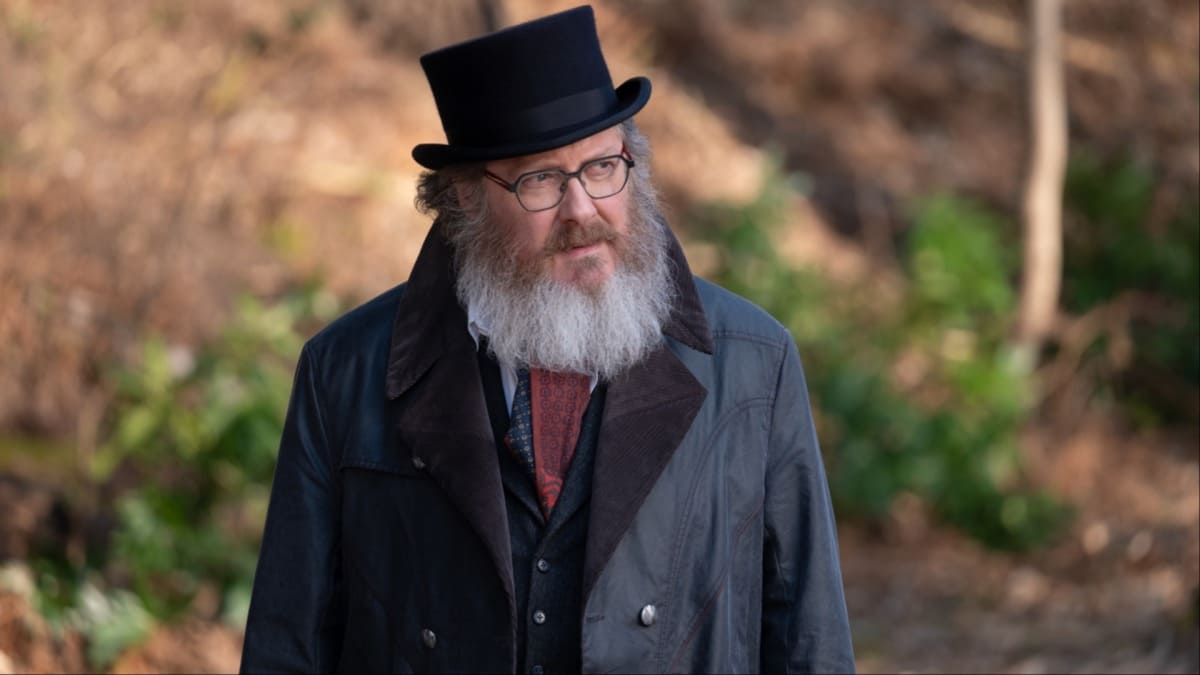
Jump forward 11 years to the arrival of Disney+’s VisionQuest and its presentation of Ultron as a magnificently bearded, fedora-favoring human avatar, once again—and in the flesh this time—played by Spader. (Similarly, the current S.W.O.R.D.-crafted version of Vision, White Vision—last seen flying off to who-knows-where at the end of WandaVision—is played here by Bettany, often sans makeup or the use of visual effects.) Despite the makeover, this Ultron retains his belief system of yore. But he’s unarguably more personable as… well, a person.
How does showrunner (previously of TV’s 12 Monkeys adaptation and Star Trek: Picard) wish us to reconcile this more “human” incarnation of Ultron with the vibranium-based heavy we feared at the cineplex? Is Matalas at all concerned that, for any future rewatches of that Marvel film, the tension created by Ultron and his threat of humankind’s “extinction” is at risk of being undercut by the mental picture of a kindly old Spader?
 Keep scrolling for more great stories.