C

Whalefall sees a scuba diver swallowed whole by his daddy issues

Austin Abrams gets gobbled up by a whale, but the constant flashbacks to family drama undermines the gross survival story.

Whalefall sees a scuba diver swallowed whole by his daddy issues

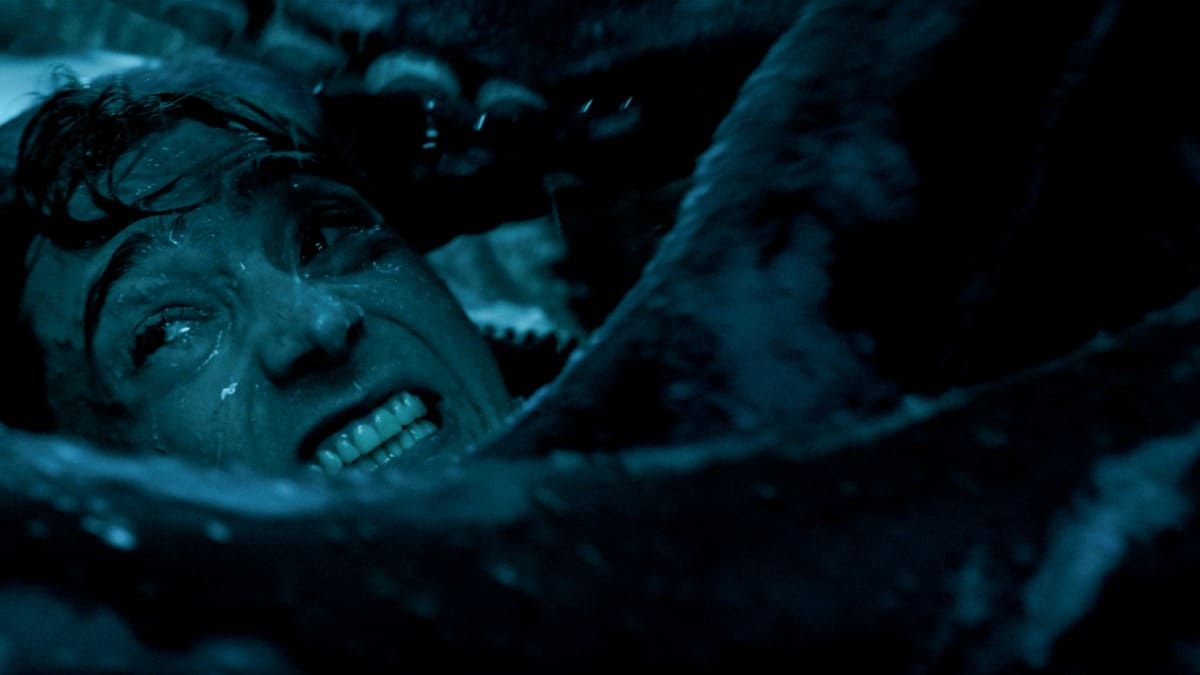
Whatever else there is to say about Whalefall, a movie where a scuba diver is gobbled up whole by a sperm whale off the California coast, it’s got more sphincters than any movie you’ll see in theaters this year. And certainly more that are essential to the plot! That’s as silly a statement as this film’s premise—which is that a young man must come to terms with his father’s death while inside the belly of a whale—and as silly as much of the film itself, especially when it’s leaning into its family drama. Yet, when Whalefall sticks to its sticky guns, simply digesting a neoprene-clad failson inside an acidic escape room, it’s so strange and bold it’s hard not to respect it.

Director Brian Duffield is no stranger to ambitious, restrained genre fare. His last film, the alien invasion thriller No One Will Save You, was another one-man show, with only a few spoken words throughout the entire film. During the best parts of Whalefall, where Jay Gardiner (Austin Abrams) feels his way through oversized organs using trial and error, there’s a similarity in vision. Jay can’t really speak, at least intelligibly, because he’s got a regulator in his mouth the whole time, delivering him a dwindling supply of oxygen. That means Abrams and Duffield lead us through the guts with mime and evocative framing, explaining the layout and threat of this squishy space visually. It’s just one struggling man, tossed and turned inside a washing machine made of meat. But that quiet elegance (nasty as it may be) doesn’t last, because Whalefall isn’t just a survival story.

It’s also a literary drama, adapted by original author Daniel Kraus and Duffield into a mutant sea monster, one that’s half gross-out B-movie and half flashback-heavy emotional flotsam. Jay may spend most of the movie covered in ooey gooey bits, but those don’t hold a whale-blubber candle to the film’s ooeir gooier bits. This is faithful to the source, which alternates first-person chapters between Jay’s gripping present and overwrought past, now with a dumber and heavier hand befitting a studio film. The only reason Jay went diving, see, is to find the bones of his cruel father, who sunk himself to the bottom of the sea rather than allow cancer to gnaw away at him.

In life, Mitt (Josh Brolin, done up like a nautical Danny Trejo) was a pushy sea dog. His hippie talk was encrusted with a thick coat of masculine brine and his driving purpose seemed to be browbeating his scrawny landlubber son at every opportunity. After he finally drove Jay off for good, his sickness took a turn. Jay never saw him again, much to the chagrin of his overbearing sisters (Jane Levy, Emily Rudd), who didn’t have to put up with the same paternal expectations, and to the sad understanding of his mother (Elisabeth Shue). But the rest of Jay’s family may as well not be in Whalefall at all, because the asinine dramatic dialogue is so bad you’re thankful the hero has something in his mouth for most of the movie.

It’s not inherently bad that you can’t understand half of what Jay mumbles to himself. (It is bad that you can understand the other half, limp throwaway laugh lines and spoken-aloud revelations, so well that the difference is jarring.) When Whalefall feints at being a Martian-like survival story where Jay must make do with his diving equipment and whatever sea junk he shares this digestive tract with, it shows mad glimmers of brilliance. There’s simplicity inside the whale: One chamber is blueish, another redder and filled with yellow bile. The Anatomy Of A Whalefall is easy to understand. Ribbed mucosa walls contract, crunching and munching Jay like Play-Doh in a fist. His only goal is to get out, and he’s only got a few options. This pursuit gets complicated from without and within, whale and man both weathering plenty over the film’s drawn-out 106 minutes. Seeing this play out is enjoyably odd—Abrams clinging to a giant tongue, screaming his heart out, is a highlight—even when it becomes visually muddled in moments of intense action, which is where Jay suffers his more visceral and upsetting injuries.

But even that novelty has its limits. As Jay’s plight overstays its welcome and his practical problems give way to emotional reckonings, it’s hard to stay with Whalefall. It’s inherently ludicrous to try to find closure inside a fleshy fetish nightmare, regardless of whether a helpful jellyfish’s bioluminescence allows it to be a well-lit fleshy fetish nightmare. That the film pursues this so cloyingly, with composer Joseph Trapanese apparently paid by the swelling crescendo, bogs down its early thrills like an overweighted dive belt. It doesn’t matter how effectively Whalefall captures the eerie vastness of the abyss, or the imposing scale of its central beast, when, at every opportunity, it prioritizes the hokiest, most familiar daddy issues. This doesn’t ground Whalefall‘s ridiculous premise, but sinks it.

Director: Brian Duffield
Writer: Brian Duffield, Daniel Kraus
Starring: Austin Abrams, Josh Brolin, Elisabeth Shue
Release Date: October 16, 2026

 
Join the discussion...
Keep scrolling for more great stories.