Actually it’s Sorkin who’s wrong. Zuckerberg is an asshole. His tenure as CEO of Meta (née Facebook) has been marked with criminally reckless passivity, power grabs in a crowded social media marketplace, and alt-right sycophancy. In Reckoning, Zuckerberg is painted as intimidating, asocial, but unwavering on his faulty principles—and Sorkin still believes principles are a thing that define “great men.” Plenty of great drama has reduced a complex subject to a lone tragic failure, but Sorkin’s psychological reductiveness flattens what used to be his most compelling film character.
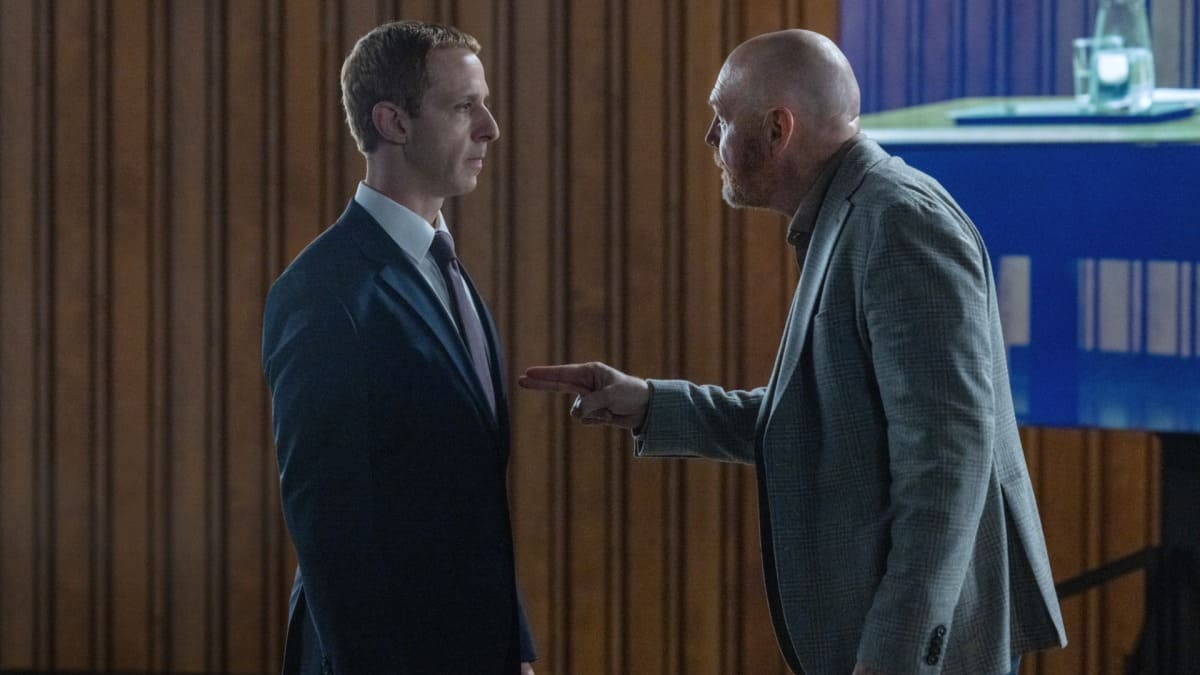
Because Zuckerberg is a supporting character to the investigations of Frances and journalist Jeff Horwitz (Jeremy Allen White), Sorkin tries to make a splashy dramatic impact with every Zuckerberg scene—most of which take place on a soundstage where he rehearses for the hearing, surrounded by lackeys and interrupted by worrying updates about the impending bombshell articles. Only crisis PR exec Raya (Wunmi Mosaku) and ex-investor Charlie (Bill Burr) are allowed to call Mark out, and only Charlie—upset by Facebook boosting political disinformation—seems to get a reaction out of him.
You don’t need to know that Raya and Charlie are fictionalized characters, their flimsy dichotomy as agents of Zuckerberg’s conscience makes it impossible to imagine their life outside of their repetitive conversations in the theater-like set. Raya wants Mark to be genial, thoughtful, and not break into a condescending rant; Charlie wants Mark to admit that he can’t claim to be a “crossing guard” when he’s simultaneously depending on manipulative and dishonest content to boost his algorithm.
Sorkin stresses Zuckerberg’s fatal flaw with faux-Shakespearean gravitas—Zuckerberg hates censorship so much, he’ll harm his users before he filters what they interact with. Any “inflammatory” material (Reckoning only mentions fascists and Nazi content in terms like “extremist” and “partisan,” a writing choice that softens the dangers of residing in Zuckerberg’s town square) is allowed to spread until it explodes into the January 6th Capitol riot, which takes place the same day that Zuckerberg prepares for his hearing. Now Zuckerberg can be somber and tragic, reluctantly agreeing to ban President Trump, who’s posting through the insurrection.
If Zuckerberg’s stubbornness is his fatal flaw, then his position of anti-censorship could be seen as virtuous—perhaps it once was, before he slid down a more angry, self-centered path. To watch it backfire is satisfying, but in Sorkin’s eyes, also a bit tragic. “Great men” have ambition, ideas of substance, and the conviction to see them through—their self-mythologizing can be appealing, and to those blinkered admirers, it’s easy to pay less attention to the details of their bad behavior and reckless choices. In The Social Reckoning’s defense, when we glimpse Mark from Frances’ perspective, he’s an icy, domineering boss who shuts down anyone who threatens Facebook’s engagement. But this alternative perspective just makes the cloistered soundstage scenes feel even more artificial; a way of Sorkin cornering a man he thought would be better.
In those scenes, it’s easy to see Burr’s fuck-you swagger and deduce that he’s the only actor unaffected by the smarmy affect that’s endemic to being one of Sorkin’s dramatic mouthpieces. In reality, Charlie is the clearest Sorkin self-insert character in the film: someone who once believed Zuckerberg was a visionary, and now needs to question—with unmatched verbal poise—why he turned his back on the cornerstone of Sorkin’s belief system. Look no further than Charlie’s most severe rebuke of Facebook’s moderation policy: His admonishment that the platform received money for political ads that it knew contained lies feels weirdly tepid for a performance as frank and no-bullshit as Burr’s.
But it’s still what troubles Sorkin most—a betrayal of truth, progress, and altruistic genius within institutional politics. Frances’ whistleblower journey is where The Social Reckoning’s limited tension lives, and Zuckerberg’s scenes are a siloed, limp excuse for authorial accusation. Sorkin wants an explanation for someone he admired betraying democracy, even if he compromises a clear-eyed and compelling character in the process. Reckoning’s Zuckerberg is not in conversation with the real Zuckerberg in 2021, but with the side of Zuckerberg that Sorkin idealized when he wrote The Social Network.
This is why Zuckerberg’s tragic arc and mannered, theatrical portrayal fall flat—they’re designed purely for those who subscribe to Sorkin’s limited perspective, who share his view of the faults with tech giants. In Sorkin’s telling, Zuckerberg’s stubbornness (which a genius is permitted, in the abstract) blinded him from a greater wisdom and obscured his vision of the extreme polarization of his users’ politics. In being true to himself and refusing to compromise, Reckoning posits, the executive fell out of step with reality and polluted his own inspired invention, which makes him a target for another admired Sorkin device: speaking truth to power. Rather than making Reckoning his mea culpa for lionizing the Facebook wunderkid, Sorkin stymies his follow-up’s power by saying that Zuckerberg’s fatal flaw—his distorted dedication to freedom of speech—let us all down. It’s a dramatic swing and a miss, all built on a catastrophic failure to read the room.


 Keep scrolling for more great stories.