Since Martin McDonagh broke out with In Bruges in 2008, the director-screenwriter has straddled the line between dark comedy and bleak drama, often landing in an emotionally raw yet amusing place between the two. He’s especially homed in on the dynamic of tenuous male friendships, which drove movies like In Bruges, The Banshees Of Inisherin, and his new film, Wild Horse Nine. “I like exploring male relationships or the sensitivity that male relationships can have,” McDonagh tells The A.V. Club. “It’s not the typical buddy-movie kind. It allows you to go to places, especially in this one, which is a fun film in lots of ways and an entertaining one. It allows you to also go to some sadder, more reflective moments.”
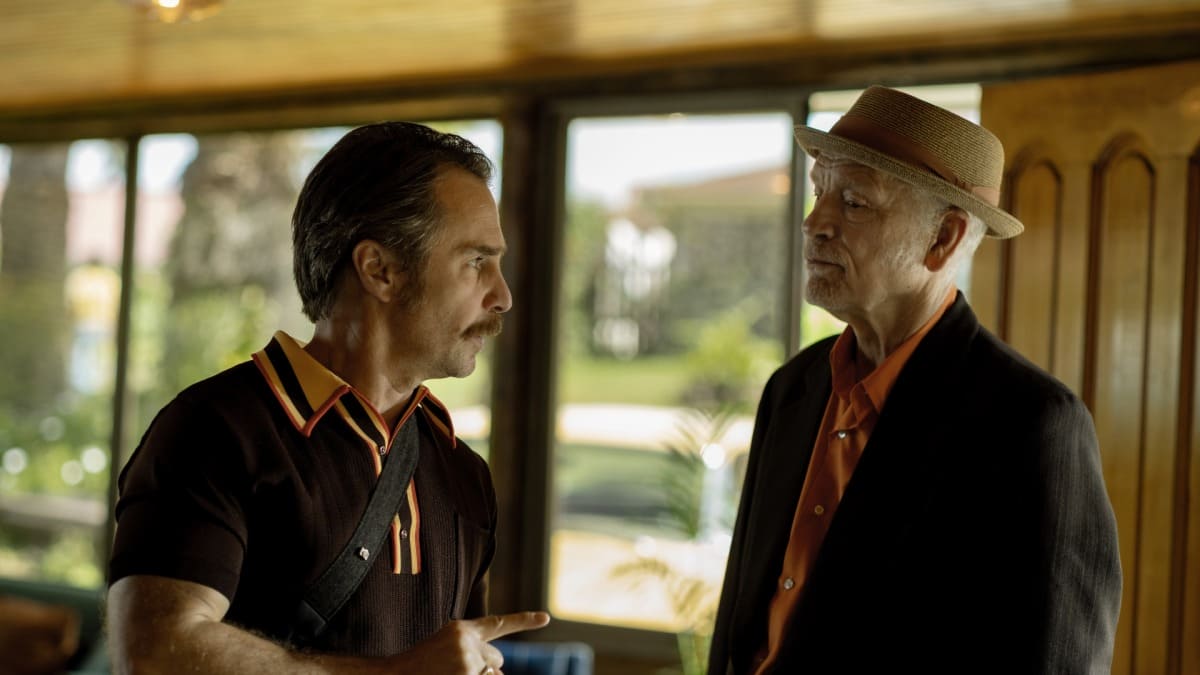
Wild Horse Nine takes place in Chile in 1973, where a CIA-agent odd couple is about to depart for Easter Island under the cover of a little sightseeing ahead of destabilizing that country’s new leftist government. Of course, since this is a McDonagh movie, there’s a bit more complexity to the men’s histories and their tortured friendship, which seems to be made only from bickering. As the film goes on, the men’s relationship comes into better focus, especially in light of Chris’ (John Malkovich) terminal illness and Lee’s (Sam Rockwell) extracurricular assignment.
While McDonagh and Sam Rockwell previously worked together on movies like Seven Psychopaths and Three Billboards Outside Ebbing, Missouri, Malkovich was someone the filmmaker always admired. “I loved him for 20, 30, 40 years,” McDonagh says. “He’s always good in everything he does, doesn’t get enough lead roles. To know that you’re in safe hands with his danger and his comedy, but also his sensitivity, for this character to work, the actor had to have all of those facets, and it was a no-brainer really to go to John.” It’s Malkovich who brings an unpredictable energy to McDonagh’s black-comedy blend. To get the right cadence of the script, the star explains that the director worked extra with his main actors. “Martin’s a great writer of dialogue and all of us rehearsed like crazy,” Malkovich says. “The entire shoot, we were rehearsing.”
Rockwell, no stranger to McDonagh’s combative barrage of dialogue, found an excellent match with his co-star, comparing the dynamic to His Girl Friday. “We’re kind of like an old married couple,” Rockwell says of their characters’ relationship. The pair worked to get just the right timing in order to get that screwball comedy cadence: “We just ran the lines over and over again. We come from the theater, and they ran lines every weekend. We just ran it like a play.”
As for playing off his scene partner, Malkovich used Rockwell’s character like a launchpad for his own character’s eccentricities and tangential comments. “The last couple of times I saw the movie—and I think this is really accurate—Sam is like a trainer at Sea World who feeds the sharks in his way, which can make them jump way up out of the water to get the fish or do it quite delicately,” joked Malkovich. “[My character] can kind of go any number of ways.”
In order to perfect the speed with which the cast delivered his script, McDonagh gathered the main players for rehearsal ahead of the shoot. “That was just basically getting together with John and Sam, Mariana [di Girolamo], Ailín [Salas] and Parker [Posey], just to talk through the script, read it through,” he says. “My thing about rehearsals is that we get on the same page as each other. All the questions can be asked way before filming starts, but also we start to become a little team, a little repertory company, and there’s an ease of everyone being with each other.”
Posey was also taken by McDonagh’s screwball-inflected script and the small team’s theatrical rehearsals before taking their show to set. “It’s important that the lines are learned and that you’re not thinking about them so you can tune into the other person and have it come to life at varying temperatures,” she says. “I remember when we were rehearsing at The Public Theater, we got to hear the whole screenplay read out loud. There was a part when John was—I forget what he was talking about in the movie—but Martin was like, ‘Can you go back and just add a little more heat to that part?’ And he did. When John Malkovich gets angry and passionate, there’s nothing better. I don’t know what it is about him, but it’s just really exciting.”
Posey, who steals a scene during a phone exchange with her character’s husband, Lee, says that she doesn’t have a set approach to developing her performances. “If I can dress it a certain way and see it a certain way, it helps me be grounded and to deliver at the right pitch that I think the director wants,” she says. “That’s kind of the fun of it. I think with hair, I think with shoes, I think with costume. I think of the tone of the movie. This is very much realism and everyone pops in this. There’s only eight characters in the movie, so nothing is falling below a pitch.”
With its rapidfire cadence and political edge, McDonagh’s film drew inspiration from some classic movie greats. “Maybe it’s my background in theater that allows that, but I love juicy dialogue that goes on for pages and pages,” he says. “I was just thinking about Preston Sturges earlier, but Billy Wilder was another great who would have all that sparkling repartee. There’s something joyful about allowing a couple of amazing actors to speak for two pages in a row.”
Another canonical film inspired one of Wild Horse Nine’s final moments, a brief scene with Tom Waits as Chris’ distant brother. “We actually filmed that on John Ford Point in Monument Valley,” McDonagh says. “It’s one of the most famous shots in film history, really, that shot through the doorway from The Searchers. You couldn’t go there and not have some kind of nod of the head towards John Ford.”
That throwback feeling to a different era of cinema has stuck with Posey since she first finished the script. “It’s like a time capsule from the ’70s, [like] Midnight Cowboy. There’s a buddy movie, there’s a Western kind of feel to it. There’s an Americana to it that Martin gets [from] his love of Westerns and his point of view,” she says. “This movie really enjoys being a movie.”


 Keep scrolling for more great stories.