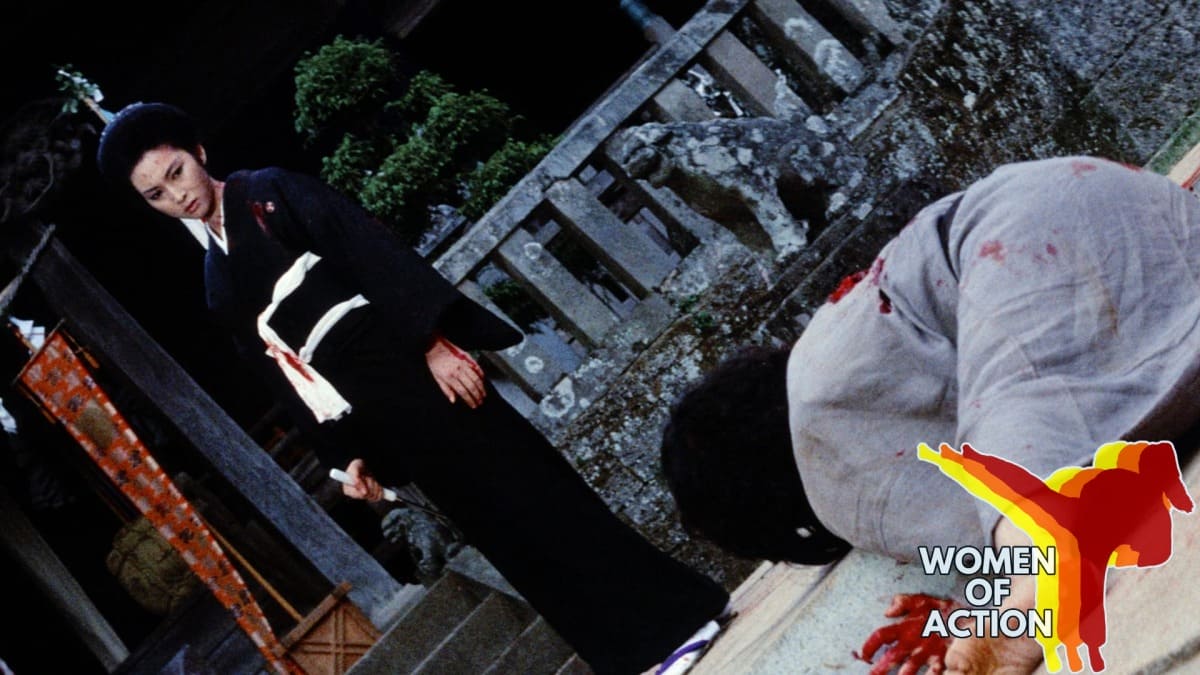
The next scene jumps 20 years into the future, where a now-grown Yuki (Meiko Kaji) wanders a snowy street at night, carrying a purple oil-paper umbrella to protect her elegant hair and makeup from the flurries. When a gang leader and his cronies demand she step aside to let them pass, Yuki somersaults over their drawn weapons and chops off their arms with a sword concealed inside the handle of her umbrella. Lipstick-red blood spurts from their jugular veins as she slices and dices her way to the leader. As she stabs him through the chest, he begs her to tell her why she came for him. “Revenge,” she says. “For the powerless people you made suffer.”
It’s a sequence that would feel right at home in the kind of rape-and-revenge films that filled exploitation cinema across the globe during the 1970s, including Kaji’s own Female Prisoner Scorpion series. Except, the revenge in Lady Snowblood is much more emotionally abstracted. In Kill Bill, Tarantino gives some of the essence of Yuki’s story to Lucy Liu’s O-Ren Ishii. Only, O-Ren actively witnessed the yakuza murder her parents when she was nine years old, which gives her a much more personal drive to avenge them. Yuki, however, never even knew her mom, who died of childbirth complications shortly after imbuing her daughter with her dark mission. That means Yuki’s vengeance is less of a lived vendetta than a family inheritance she’s honorbound to continue. “She bears the weight of karma,” Kaji herself sings in the film’s theme song, “The Flower Of Carnage.”
The weight of family legacy is something we take for granted when it comes to male action heroes like Superman, Luke Skywalker, or Chris Pine’s Captain Kirk, who all exist in the shadow of fathers they never knew. But it’s much, much rarer to see a mother positioned in that same kind of morally complex legacy role—mostly because it’s rare to see mothers positioned as morally complex characters at all. In some ways, Sayo’s demands for Yuki’s upbringing protect her daughter from the patriarchal hardships of the world. When Yuki is threatened with gang rape from a crazed group of villagers, she has the martial arts skills to fight them off. Yet Yuki’s entire life has also been devoted to wiping away her humanity in order to become a living weapon, as we see in harrowing flashbacks to her childhood training sessions with a brutal instructor. “Her mother’s vendetta and grief weighed on her slight shoulders,” the film’s narrator explains. “But young Yuki bit her lip and endured it all.”
It’s a metaphorical encapsulation of the way daughters are so often the only ones who truly see the full extent of what their mothers carry, even as so much of that burden gets unfairly passed down to them. Lady Snowblood was released over 50 years ago, yet could so easily fit into modern-day eldest daughter discourse. Yuki eventually gets a foil in another young woman named Kobue (Yoshiko Nakada), the daughter of one of the men on her kill list. Kobue has secretly turned to sex work to pay off her father’s gambling debts, concealing the truth by weaving baskets she pretends provide the family’s income even though she’s actually just throwing them into the sea—doubling her physical labor in order to keep up the emotional labor of cheerfully pretending everything is fine. In the world of Lady Snowblood, daughters are the ones who must both protect their ineffectual fathers and avenge their wronged mothers; duties that put Yuki and Kobue at odds even when their natural inclination would be towards friendship.
It’s a theme that fits with Fujita’s earlier work in the contemporary Stray Cat Rock youth rebellion films he made with Kaji. Fujita had never directed an action film before Lady Snowblood and instead specialized in capturing the stifled rage of a generation searching for their identity in postwar Japan. That background provides a touch of modernity to the historical setting of Lady Snowblood. Like a Western set in the twilight of the Old West, Fujita’s pseudo-samurai film takes place during Japan’s Meiji era, a time when the country moved from its long-held feudal isolationism to a swift embrace of European-style imperialism and industrialization. As screenwriter Norio Osada frames it, it was a shift that harmed the soul of the country—as peasants suffered and turned against one another while the rich partied with visiting Western dignitaries. (Ideas that are even more directly explored in the sequel, Lady Snowblood: Love Song Of Vengeance.)
It all adds an intense metaphorical depth to what could otherwise just be a pulpy, propulsive 96-minute thrill ride. Lady Snowblood is certainly memorable for scenes like the one where Yuki slices a woman in half or swings from a chandelier with a sword between her teeth. But there’s far more bubbling beneath its surface than just a classic revenge tale. The nonlinear structure gives the film a dreamlike quality at times, as Yuki strikes down her enemies and lets their bright red blood wash away in the sea. She could easily walk away from a 20-year-old revenge mission where so many of the players are dead or difficult to track down. Yet as Lady Snowblood sees it, burying generational trauma can be as poisonous as dredging it up.
Kaji’s mesmerizingly steely performance refuses to provide simple answers about whether Yuki’s vengeance is cathartic or hollow; whether Sayo’s mission for her daughter was right or wrong. The film is all the stronger for the ambiguity. While Sayo curses her child to the life of a demon, it’s Yuki’s love and grief for her mother that allows her to hold onto her human compassion—a quality that gives her the opportunity to be reborn, like a fresh sheet of snow coating the dirty ground. If there’s no cinematic subject more explored than being a son, Lady Snowblood is a striking reminder about the untapped well of being a daughter.
Next time: This column comes to a close with this author’s favorite action film of the last decade, Birds Of Prey (And The Fantabulous Emancipation Of One Harley Quinn).


 Keep scrolling for more great stories.