With Women Of Action, Caroline Siede digs into the history of women-driven action movies to explore what these stories say about gender and how depictions of female action heroes have evolved over time.
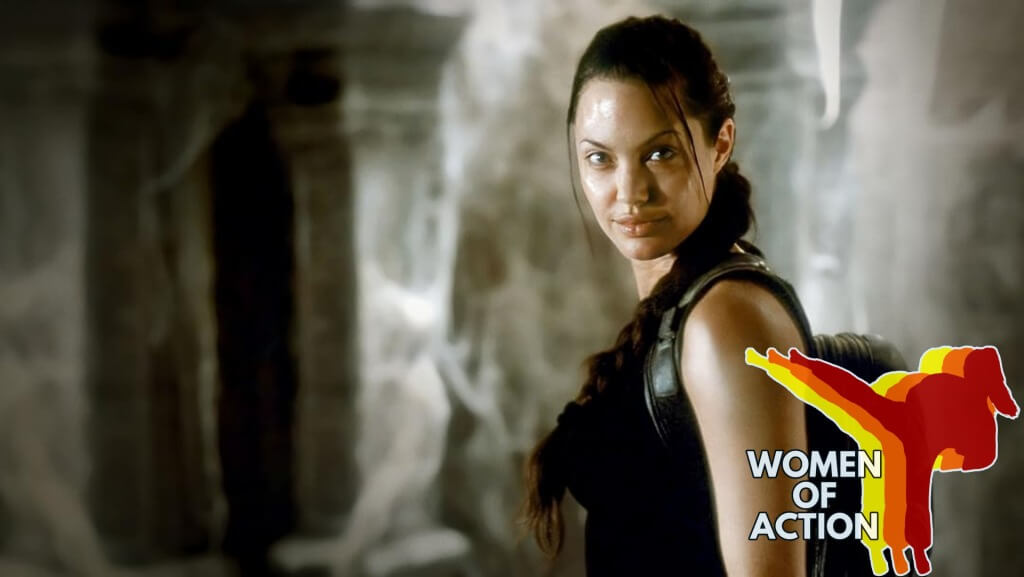
If you told the average 2001 cinemagoer that Lara Croft: Tomb Raider would one day be an example of a “wow, they don’t make ’em like they used to” movie, they probably would have laughed you out of the theater. Despite its sky-high box office, the film was received as the most basic of popcorn fare—a sexed-up summer blockbuster for video game fanboys that was scoffed at by critics, who could never be expected to take such a thing seriously. Twenty-five years later, however, what once felt basic now feels miraculous. There’s a shot of Angelina Jolie’s titular heroine throwing away a microwave dinner that’s more artfully framed than half of what you see in action cinema today.
While the history of female-led action movies is paved with obvious cultural game-changers, I’d argue Lara Croft: Tomb Raider is just as impactful—even if what it inspired was a wave of so-so early aughts movies like Resident Evil, Underworld, Æon Flux, and Ultraviolet. Still, along with Charlie’s Angels the year before, it brought women-led action films out of the more serious mode they had fallen into in the 1990s and back towards the stylish, campy tone of the 1970s. Tomb Raider remembered that women raiding tombs and kicking ass could be fun. It’s a sensibility the genre has never entirely lost since.
It also brought questions of sexualization back into the conversation in a major way after the earlier wave of 1970s “jiggle TV” had died down. Released in 1996, the Tomb Raider video game became a cultural sensation thanks to a buxom female heroine designed as a sex symbol for boys and an icon for girls. That colored how basically everyone received the film adaptation too. It wasn’t a question of if critics would talk about Jolie’s boobs, but how lewd they would get.
“Among the special effects, the stone monkeys rock, but you might be more distracted by the fact that Jolie’s breasts seem to balloon and deflate from scene to scene,” Rolling Stone observed. Meanwhile, the Newsday review opens, “All lips and legs, Angelina Jolie struts through Lara Croft: Tomb Raider the way Samuel L. Jackson swaggered through Shaft—as if nothing in the movie mattered but her own sex appeal.” It then goes on to note that “lusty cheers” erupted “each time a piece of her anatomy crossed the screen.”
It’ll drive you crazy to read interviews and profiles from this era, where Jolie is casually asked about her bust as if that’s a normal follow-up to a question about her stunt training regime. “C’mon, I’m not so flat chested to begin with,” she replies before sharing her own bra size in relation to Lara’s, as if she needs to provide concrete proof. “We still made it Lara Croft, but we didn’t go to any extremes… We did want to put in something for those hardcore game fans. Lara has those big breasts in the game. We didn’t want to make them as big as in the game, but at the same time we didn’t want to take away from her the things that are, you know, her trademarks.”
Perhaps it’s just because this movie broke the seal for a wave of even more sexed-up action flicks like Catwoman and Sucker Punch, but from a modern perspective, Tomb Raider actually doesn’t even feel egregiously filtered through the male gaze. Revisiting all the boob-focused press is a bit like looking back on the Pippa Middleton “buoyant bum” discourse from the 2011 royal wedding and wondering what the hell everyone was thinking at the time. This is what felt noteworthy in 2001?
Still, cracking how to adapt the video game heroine was no small task. The script went through a dozen different iterations and a truly absurd number of screenwriters throughout the late 1990s until Con Air director Simon West finally boarded the project and pulled the best elements of those previous drafts into one vaguely legible story that didn’t overthink the gender of its lead. As Jolie explained in 2002, “I read the first draft of Tomb Raider, and Lara Croft was always kicking somebody in the nuts, and they were always making a point that she was a girl, and there was always something about how stupid men are, and I hated that. I, along with the director, removed it all. That wasn’t the point.”
Though the action genre can be a powerful medium for processing everything from trauma and abuse to female solidarity and motherhood, what’s fun about Tomb Raider is that there’s absolutely no layer of metaphor at play. It’s a straightforward action flick that just happens to feature a female lead; one who’s sexy and sexual without exactly feeling objectified. West even makes sure to balance out a sensual scene of Lara showering by giving her rival treasure hunter Alex West (Daniel Craig, pre-Bond) the same stripped-down treatment later.
In fact, what stands out most when revisiting Tomb Raider is Jolie herself. She’s not just an action star, but a movie star. The way she laughs and winks is as captivating as the way she kicks ass. At the time, Jolie was known as a tattooed wild child and Billy Bob Thornton blood wearer who broke through in Hackers and Gia before taking home the Best Supporting Actress Oscar at 24 for her work in 1999’s Girl, Interrupted. The success of Tomb Raider transformed her into a full-on blockbuster leading lady. Even negative reviews tended to praise her performance as the only thing about the movie that works.
While the studio had considered bigger names like Catherine Zeta-Jones, Ashley Judd, and Jennifer Lopez, West thought that Jolie’s “dangerous” and “wicked” offscreen person would bring an intriguing energy to the character. “She lived quite an alternative lifestyle and didn’t hold back her words,” he told Entertainment Weekly in 2018. “She spoke her mind, and she had a notorious reputation. It was quite hard for me to get her through the approval process at the studio, because I wanted an actress who was going to bring something to the part… I wanted that mythology of Angelina Jolie to fuse with Lara Croft.” That included using Jolie’s real-life, semi-estranged father Jon Voight as Lara’s onscreen long-lost dad, a casting choice that Jolie herself pushed for.
That movie star quality is crucial to selling the pure action simplicity of Tomb Raider, which centers on a nonsensical plot about Lara trying to find a magical triangle ahead of a planetary alignment so that the Illuminati can’t use it to time travel. (Naturally.) Really, though, it’s Jolie’s cocky confidence that sells the movie and its action. It’s a tricky thing to give a character a sense of personality when they don’t have an arc or too many defining character traits. But Jolie projects a mixture of serenity and playfulness, whether she’s aiming double guns at a killer robot or casually bungee jumping around her mansion when a paramilitary operation invades in the movie’s best set piece.
While the prototypical female hero is forced into action out of necessity, Lara clearly enjoys what she does, which makes her story enjoyable to watch too. She’s a sort of James Bond/Indiana Jones hybrid with a touch of Princess Leia self-confidence—the type who can’t help but smile at her own cleverness when she thinks of loading a screwdriver into an air compressor to create a makeshift weapon. There’s virtually no attempt at backstory or context to anything that happens in the movie. Tomb Raider just drops you into its zippy world for 100 minutes and gets out as quickly as it can. The plot doesn’t matter. The point is to watch Lara zoom through the air on a motorcycle while shooting a machine gun or swordfight a giant monkey statue that’s come to life.
The tone is knowingly ridiculous but also wonderfully committed. (You can really feel the influence on the National Treasure franchise, in particular.) Baddie Iain Glen, tech whiz Noah Taylor, antiques expert Leslie Phillips, and butler Chris Barrie bring appropriate gravitas to Lara’s posh English world—although this is the kind of movie that makes you appreciate why the Bechdel Test became such a popular analytical tool. There’s barely even a female extra around, let alone another named female character. Still, when you think about how much could have gone wrong, it’s impressive the movie hits more than it misses. Lara’s more physically capable than your average hero but not quite so much that she feels like a superhero, which is a power level a lot of female-led action movies would embrace moving forward.
Behind the scenes, the film was a turning point in Jolie’s personal life as well. After the eye-opening experience of filming in war-torn Cambodia, she teamed up with the United Nations High Commissioner For Refugees and began a truly impressive lifelong devotion to humanitarian work. It also paved the way for her future action performances in everything from Mr. & Mrs. Smith to Wanted, Salt, and Eternals. Jolie isn’t necessarily thought of first and foremost as an action star, but it’s certainly a major through-line of her career.
As for Lara, Hollywood tried to recapture the magic in 2003’s Lara Croft: Tomb Raider—The Cradle Of Life and attempted to give the character a grounded, gritty redux starring Alicia Vikander in 2018. But there’s an energy to the first Jolie outing that’s never been matched. Sophie Turner will be the next to try on Ms. Croft’s holsters in an Amazon Prime series created by Phoebe Waller-Bridge. Perhaps the biggest lesson that upcoming show can learn is that sometimes it’s best not to overthink it.
Next time: Charlize Theron pioneered a new type of action heroine in Atomic Blonde


 Keep scrolling for more great stories.