The camera just won’t stop hopping around. Kyle Schwarber is absolutely knocking the cover off of the ball in the first round of the 2026 Major League Baseball Home Run Derby, and the Netflix production team appears determined to show his swings from every conceivable angle. From behind the pitcher’s screen, where ESPN tended to set up shop when it aired the tater-mashing prelude to the MLB All-Star Game. In a medium shot that cuts Schwarber off just below the waist and all but obscures the view of the ball as it approaches the plate or leaves his bat. From a ground-level angle that paints the Philadelphia Phillies slugger in a classically heroic light, looming over the lower-deck seats of his home ballpark. There’s a particular fondness for the last of those shots in Netflix’s inaugural broadcast of the Home Run Derby, and there’s an annoying tendency of lingering on the batters rather than cutting away to another camera that can show, you know, where the ball went. After one too many of these disappearing acts, a disturbing thought occurs to me: Netflix is going to screw up the World Cup.
The 2026 FIFA World Cup has been the undisputed event of the summer, and provided you’re making the correct choice of U.S. broadcasters, some of June and July’s best television, too. A Peacock subscription and/or digital antenna has been the gateway to Telemundo’s refreshingly unfussy presentation of the tournament: A comprehensive and legible view of the field, no commercials during the hydration breaks (the choice that launched a thousand “pausa de hidratacion” memes), and the strong likelihood of play-by-play announcer Andrés Cantor erupting in a “¡Goooooool!” at some crucial moment. In every respect, it’s a superior product to Fox Sports’ coverage of the same matches. This is the third time Fox has carried the World Cup in the United States, but its broadcasts still carry the desperate stink of a network trying to sell English-speaking Americans on a sport they long ago embraced. If a critical mass of soccer skeptics remains in this country, you’re sure as hell not going to win them over with a nightly aftershow hosted by James Corden.
But our national nightmare of Corden recapping highlights over some of the least-appetizing beers ever photographed may be short-lived. The U.S. TV rights for the next two World Cups are currently up for grabs, and while FIFA, as is its endlessly bribable wont, re-upped with Fox and Telemundo without taking bids from anyone else in 2015, such an outcome seems unlikely this time around. CNBC reports that soccer’s international governing body wants to assemble a bundle (how au courant) for the 2030 and 2034 tournaments—English- and Spanish-language rights in a single deal. That’s the type of arrangement they cut for the next two women’s World Cups, the first of which is set to play out next year on, sigh, Netflix. A quick glance at your queue in the past month would reveal how serious Netflix is about associating itself with association football: In June, it launched a whole slate of World Cup-adjacent content, including a movie that casts Diego Luna as the (fictionalized) guy who brought the 1986 cup to Mexico, two projects about two different Brazilian teams that won it all (one scripted, one a doc), and an unscripted series about this year’s Norwegian side that presaged the arrival of Erling Halland Mania in America.
Look, we give The Big Red N a lot of shit here at The A.V. Club: For its price hikes, for the declining quality of its original programming, for its apparent desire to devolve into YouTube (one of the other parties reportedly courting FIFA at the moment). But these are minor quibbles compared to all of the missteps Netflix has made in its expansion into live sports. It began in 2024, with a glitchy night of ringside rubbernecking courtesy of Jake Paul’s boxing match with a nearly 60-year-old Mike Tyson. It continued through MLB’s 2026 Opening Night, a cavalcade of plugs for the Netflix lineup during which the New York Yankees and San Francisco Giants also played a baseball game. The sideshow quality of its combat sports offerings, the mind-boggling production choices made in its first two baseball outings—none of this inspires much confidence in Netflix’s ability to handle the breadth and length of a World Cup.
There are a lot of moving parts to a live sports broadcast—that’s why the more seasoned players in the field love to fill downtime with shoutouts to all the camera operators in the stands, or the folks doing traffic control in the production truck. Netflix is attempting to spin up the kind of behind-the-scenes infrastructure that its competitors have built across decades, and its inability to, say, capture a history-making baseball moment as it happened—as it did when the Yankees’ José Caballero brought MLB into the Automated Ball-Strike era on Opening Night—demonstrates how much work it still needs to do to catch up. It’s little wonder that Netflix’s most successful sports efforts so far have been their Christmas Day NFL doubleheaders, co-produced in partnership with the old hands at CBS Sports.
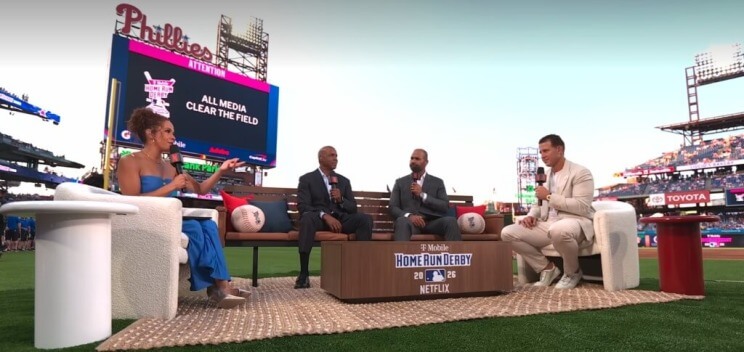
There were marked improvements between Opening Night and the Home Run Derby—the Netflix synergy was blessedly restricted to the barely audible player introductions handled by the cast of The Hawk—but weak links in the production chain kept hanging the on-air talent out to dry. Be it a teleprompter, the copy on said prompter, or the awkwardness of doing patter from an ad hoc “lounge” put together in foul territory, the otherwise polished hosts kept tripping over their words: Barry Bonds saying “rendendum” when the captions indicate he was being fed “repetition”; the laws of arithmetic defied as Elle Duncan recounted her colleague Albert Pujols’ 2005-07 hot streak at Philadelphia’s Citizens Bank Park—“You came to this ballpark eight times, and you deposited a ball out into the stands nine of them.” (An onscreen stat corrected the record: Pujols hit nine home runs in eight away games against the Phillies during that stretch.) The zeal for upward-glancing shots created an ironic juxtaposition during the pregame, with the camera capturing the giant scoreboard message “ATTENTION ALL MEDIA CLEAR THE FIELD” behind the members of the media who had yet to clear the field.
Screenshot: Netflix
Multiply that undertaking by multiple games per day, spread across several weeks, and any mention of the 2027 Women’s World Cup during the Home Run Derby sounded less like enticement and more like a threat. Next year’s tournament will be a dry run for the streaming giant’s facility with such an event; the question of whether people will put up with a paywall standing between them and a highly anticipated competition between some of the greatest athletes on the planet, meanwhile, may have already been answered by this past spring’s World Baseball Classic. In Japan, which hosted the 2026 WBC, Netflix was the only way to watch the games. The Japan Times described “fans gathered at restaurants and bars to share their Netflix feeds and watch together on smartphones and tablets”—the “personal, noncommercial use” language in the streamer’s terms of service keeping sports bars from putting the WBC up on their big screens. A month later, the Japanese government entered a plea to the tournament’s organizers at MLB. “It is extremely important for a wide range of people to have the opportunity to experience and watch sports,” education and sports minister Yohei Matsumoto said in a press conference, acknowledging that the country’s major television networks have traditionally made the WBC, the Olympics, and the World Cup available to watch free of charge.
Such a request has a lot of resonance here in July 2026. Between the various cultural phenomena of the World Cup—the delight of international fans encountering American fast food and convenience stores for the first time, the rise of Cape Verde, Haaland and his stuffed raccoon—and the end of the New York Knicks’ NBA championship drought, it’s been a uniquely joyous summer for sports in the United States. And a lot of that joy has been expressed and shared in public, without the barrier of a streaming subscription: The crowds congregating at soccer bars that more typically cater to early-rising Premier League fiends; game five of the NBA Finals streaming on public wi-fi kiosks amid back-and-forth between Mayor Zohran Mamdani and Knicks owner James Dolan over outdoor watch parties. Put aside concerns about lackluster, technical difficulty-prone broadcasts for a second—the loss of this kind of communal experience is the greatest risk of a Netflix World Cup. I’ve been watching the tournament since the first time the U.S. hosted it in 1994, and I can’t remember any edition that captured the world’s attention and imagination like this year’s. It’s the ultimate reminder that sports belong to everybody, not just the people who can afford to pay $8.99 a month to put a movie or show on in the background while they scroll through their phone.
Tomorrow, I’ll be having friends over to watch the final between Argentina and Spain. We could pull up the game on Peacock, but I’d rather pull it out of the air with my antenna. The opportunities to perform such a magic trick grow fewer and farther between these days. And provided the signal from Chicago-area Telemundo affiliate WSNS is coming in just fine, I can count on actually seeing the game, too, with no gimmicky camera angles, CGI-dandruff-dusted graphics packages, or sales pitches for Stranger Things spin-offs obscuring the view.


 Keep scrolling for more great stories.