Vincent Van Gogh was famous for his ability to get along with other people, making his time in Arles, France, where he forged a professional and personal relationship with Paul Gauguin the perfect theme for a cozy two-player card game.
Wait, I’m getting some feedback here in my right earpiece… apparently, that is not correct. It turns out The Yellow House, indeed based on Van Gogh’s time in Arles in 1888, is a rather cutthroat card-shedding game that takes its theme from a supposed conflict between the two men over the true nature of art. (The argument between the two men, which ended with Van Gogh mutilating his own ear, was probably about money.) The theme works here primarily because it makes the game visually appealing, but it’s mostly just painted on (pun intended) a straightforward game where each player tries to be the first to get rid of all of their cards in a round. It’s a best-of-five game, where you win by taking three rounds or by winning two rounds with the same color of card. Once you get the gist of how you play a card, it’s very simple to play.
The deck in The Yellow House comprises cards in four suits, each of which is supposed to represent one of the four elements required to create good art: skill, inspiration, passion, and money. The cards have no value; there are seven of each color, all equivalent. There are five wild support cards that you set aside at the start of each round, available to either player. Then there’s a cloth board in the middle showing rows with the numbers one through eight on them; at the beginning of each round, you put the four tokens matching the four suit colors into the first row, then deal 12 cards to each player.
The players then exchange two cards from their hands, while moving up the token(s) shown on those four cards by one spot per card exchanged. So if you gave your opponent two reds, and they gave you a purple and a green, you’d move red up two rows, purple up one, and green up one, leaving yellow where it is.
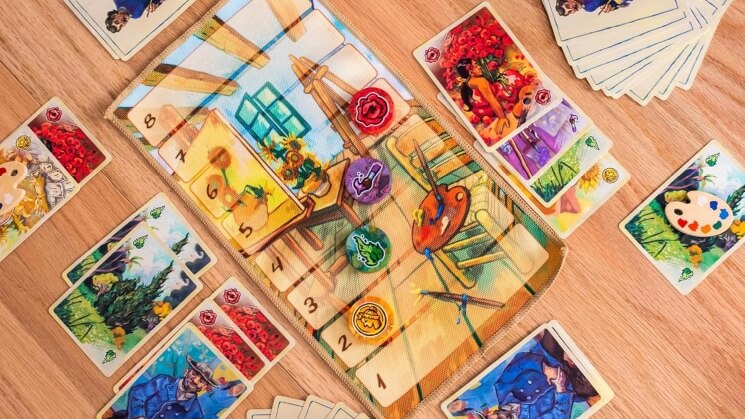
Then you begin playing “claims,” which are really tricks under another name. In each claim, the players can only play each color once, so the maximum number of plays in a trick is always four. The first player, which is the one who won the last trick or round, plays a single card from their hands. Each suit has a “strength” based on the row of its token at the time it’s played, so to beat the last card played in a claim, you must play a single card of a stronger suit, or strengthen another suit and then play one of its cards.
To strengthen a suit, you play one card for each row you’ll need its token to move, pushing it to one row above the suit you’re trying to beat. For example, if green is the current claim and it’s on three, and you want to play red and that’s on row one, you’d have to play three red cards to move your token to row four, and then you play another red card as your claim. You can also take one support card from the common supply to take the place of one suited card from your hand, with a limit of just one support card per claim and three per player per round.
The round ends immediately when one player goes out, regardless of whether the claim is completed. That player takes the last card they played and puts it under their palate token to signify that they won a round, and to track the color used, because you win the game if you win two rounds with the same color. This also means that the number of cards omitted from the deal decreases by one per round, so if you go to the fifth round, you’ll use all of the cards.
There is a good bit of thought required to play The Yellow House well, starting with the cards you pass to your opponent. It’s rare that you would choose to pass, or choose to use a support card when you have enough cards of that color in your hand, but it’s possible that you’d do so to preserve your ability to make a move in a later claim. That’s because it is very easy to end the round with one player going out with a series of one-card claims because the other player has just a few cards left and can’t strengthen those colors to play anything—a frustrating way to lose a round, but an inherent part of the game.
What works about The Yellow House is that it’s unlike most of the card-shedding games I’ve played before, with SCOUT still the champion for me. (If you don’t know what the term “card-shedding” means, think UNO or Go Fish.) I’m not sure about the long-term replay value because the play is so simple; it has a variant where using a support card gives you a bonus power based on the color of that claim, but the powers feel unbalanced and detract from the game. I also don’t love games where one player can’t make a move near endgame, even though The Yellow House is set up in such a way that you know in advance this is possible and should try to avoid boxing yourself in. It’s solid, although I prefer Jekyll vs. Hyde, another trick-taking game from the same designer, who goes by the mononym Geonil.


 Keep scrolling for more great stories.