AVC: Do you view this show as a way to also explore how ruinous the Targaryen rule has been on the citizens of Flea Bottom and probably everyone else in Westeros?
IP: There is no monarchy or even a democracy that has ever done well by the people who live in the slums. I’d say it looks pretty universally bleak at any point in history, no matter the ruling. So that was less an indictment of Targaryenism than it was of the class system.
AVC: Can you talk about using the Game Of Thrones music for Baelor’s big scene at the end of episode four after using it only once in the show to quite a comedic effect in the premiere?
IP: For that, I want to give credit where credit’s due. I’m about 85-percent sure that that came from my editor, Simon Brasse. We were looking for a piece of music to add there. We had tried a lot of stuff out; it was a great day. But then we heard this, and we knew it worked perfectly so we didn’t have to question it. We did do a lot of different musical edits of that to get it as we saw fit, but this scene still gives me goosebumps, and I’ve seen it about 10,000 times. The Game Of Thrones theme is used twice in the show, as you said. Once in the beginning when Dunk picks up Ser Arlan’s sword and he thinks, “I’m going to go off and do the hard thing. I’m going to go be a knight.” Then, as you know, that makes him very nervous. His body does not cooperate with him when he hears the call to greatness. He hears the hero theme in his head, but he’s not a hero yet, and ends up in an unheroic position. So when we bring the theme back, it’s in a moment that is fucking go time. It’s put up or shut up. Now is everything that he was thinking that he was going to have to do when he initially picked up that sword. So we thought we’d play it in earnest. I just want to add that a friend of mine has referred to that very first use of the theme as Chekhov’s diarrhea, which I just thought was very funny.
AVC: You were a writer for Better Things, which also nailed a balance between drama and comedy. Was working on that show, despite how very different it is, influential in how you viewed the specific tone of Seven Kingdoms?
IP: Oh, so deeply. It’s funny to say that, but no show I’ve worked on more has influenced A Knight Of The Seven Kingdoms than Better Things. That show felt like a big, warm hug from an old friend, and that was how we wanted to approach A Knight Of The Seven Kingdoms. There’s a lot of nostalgia here and a lot of love for Game Of Thrones. But we knew we couldn’t compete with the big boys on their scale, epicness, stakes and spectacle. Like Better Things, though, we could have miles and miles of heart, and so every decision about our storytelling came back to that and to having some fun. Nobody does that better than Pamela Adlon, or just showing people that they’re messy, and whether at their best or worst, they’re just trying to get on with their day. Is it harder to be a hedge knight or a single mother of three daughters? It’s not about that, but it’s the trying of it all and not stopping or giving up. Those are the admirable qualities of people.
AVC: Since the show’s heart is Dunk and Egg’s friendship, can you single out a moment that solidifies their relationship and feels particularly vital?
IP: I would say that after Egg comes back from training the horse and Dunk’s annoyed that he left and he didn’t say anything. At that moment, Dunk is figuring out how he is going to be a mentor. He knows what Ser Arlan would do at this moment and how he would react. Dunk initially does something like that as a knee-jerk reaction, but then he thinks about how it’s not really him. That was a very important moment for us to sow the seed of how he was going to be a teacher instead of telling Egg to figure it out for himself. There are two methods of child-rearing that certainly have been used both successfully and unsuccessfully throughout history, but it’s a personal choice. Egg is coming into his own squire-dom, and Dunk is coming into his own knight-ness, so to speak, so they have to both figure it out. Also, just because I fucking love it, I think one of my favorites is Dunk and Egg imitating each other. That wasn’t written in the script. We just asked them on the day of filming to do that, and that’s what Peter and Dexter turned out. It was just so wonderful, so that made it into the show.
AVC: The Game Of Thrones universe has a few great pairings. Do you have any favorites?
IP: I do love The Hound and Arya Stark; that was my favorite. Brienne and Podrick, too, and they probably feel the closest to our show. But there’s no comparison as such because there are not a lot of characters like Dunk who are low level, born in Flea Bottom, and then paired with someone like Egg. It is a lone wolf and cub story, but it’s a real flip of that, too. Egg knows a lot more than Dunk does about certain things, and we wanted to reflect that since it’s in the source material.
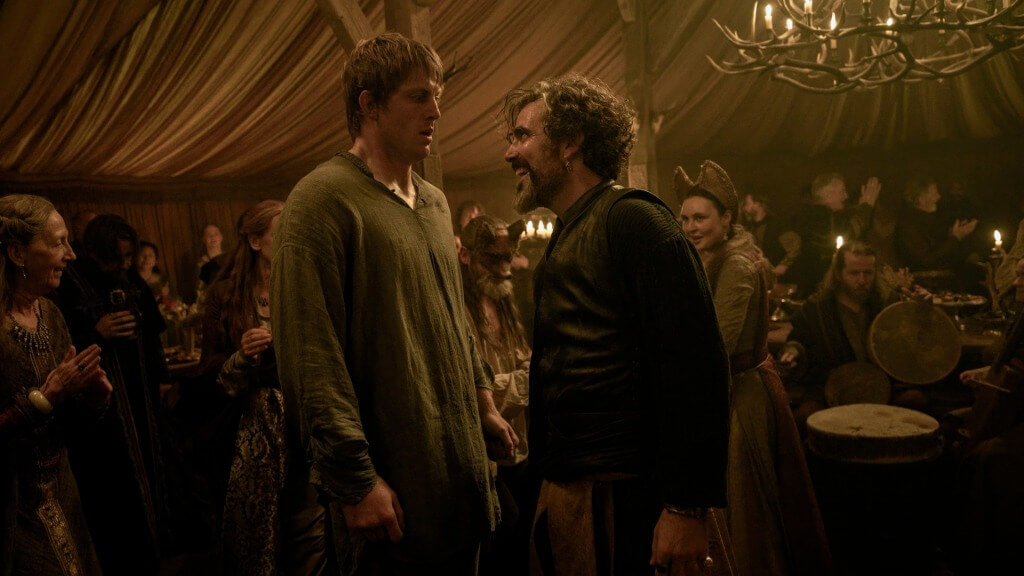
A Knight Of The Seven Kingdoms (Photo: Steffan Hill/HBO)
AVC: Another character you expand upon beyond the book is Lyonel Baratheon, who has quickly become a fan favorite. What was it like to figure out the details of his personality and collaborating with Daniel Ings to bring him to life?
IP: Danny Ings is a genius. When he came in to audition, I had seen a few people at that point for that role, and I was beginning to worry that I just hadn’t written this character very well because nobody was giving me what I was hoping for from these scenes. Danny sat down and read this thing like I had fucking scored it for him. So I just went, “Okay, this is easy” when it came to him. He brought all of himself to the role. It’s not fair for me to say that Lyonel was in any way fully formed on the pages of our scripts. If it wasn’t for Danny, we would have been in a lot of trouble. He should be a fucking superstar. He has such a natural charisma about him, and he’s obviously very fun and funny, but he also has a thing that great actors have, which is unpredictability without doing too much. It’s what I think Al Pacino and Jack Nicholson had, this ability to scare you in a moment where they were just smiling a second ago. It’s a lot rarer than people think, and Daniel has got it. He’s already doing great things, but I hope he gets to go and do even more huge things.
AVC: What’s it like to be in season two production while one is currently airing? Can you share anything about new characters, casting updates, or anything you’re excited for people to see?
IP: Of course. We’re now getting into The Sworn Sword, which is my favorite novella in many ways, with Rohanne Webber or the Red Widow, Ser Bennis, and Ser Eustace, who are these classic characters. I can’t say much but we have three absolutely brilliant actors coming in to do these roles. I’m excited. We are cutting some scenes together now, and the directors are seeing some of it, so it feels nice to see [season two] slowly come together. The show coming out at the same time as we work on it has been a blessing in many ways. It allows you to do what Dunk does by putting one foot in front of the other to focus on the work instead of just focusing on the response.
AVC: When you began your career with shows like the police drama Rogue, were you mainly envisioning a TV writing career? How do you think it led you to the Game Of Thrones franchise?
IP: Watching Game Of Thrones while I was still in school changed the whole course of my life. That and shows like Breaking Bad and Mad Men, which is a golden age of television for me. I went to school thinking I would make movies, and then I started to realize that all my favorite things were on TV. So this ended up being an easy choice. You don’t get to plot out your career as much as you’d hope, especially for your early career. Usually, you’re taking whatever job will get you to the next job. I’ve been so fortunate that that hasn’t really been the case, and I’ve got to work with fantastic people fairly early on. I would say the only real time I took time off to try and redirect my career was when I took about six months trying to get a comedy job because I had been staffed on a few drama shows up to that point. I always thought I was a comedy writer. I still can’t believe I ended up on Better Things, one of my favorite shows of all time. That was just an absolute dream. Then I went right back to drama, so it was nice to have those couples of years with Pamela and the other writers in that room. Of course, my career is still ongoing, and you can never take anything for granted. Like Dunk, I’m just taking one foot in front of the other.
AVC: You also created, wrote, and showran the Canadian series Four In The Morning, which was loosely based on your experiences. Are you the sort of writer who is able to bring yourself to various characters you write? Did that apply to Seven Kingdoms at all, despite this being an adaptation?
IP: Yeah, one of the reasons why I just love these novellas so much is that a lot of us see our own journeys represented in someone like Dunk, so I knew I could throw some of mine onto him, although I’m not sure how much that changed who he is since the story is already out there. But there were lots of little moments and little jokes here and there, and things that happened to you in your own life that you toss in. I think Dunk’s insecurity was an easy one, especially for people in the creative field and the idea of not being prepared for the job that you so desperately want. It’s daunting. It was very important for us to represent how certain people, at the beginning of this story, like Ashford’s squire, Plummer, and Steely Pate, who saw something in Dunk. Dunk probably would’ve turned around and continued home if Plummer didn’t stop him and say, “Okay, go and try to find someone to vouch for you.” Or with Steely and the armor—again, Dunk was about to leave when he was told, “Okay, give me what you have right now and pay me a little later.” I’ve certainly had a lot of people in my life at very critical junctures that I’m not sure I realized were critical at the time. But they gave me a little bit of help and a push in the right direction, or said the right thing at the right time. That aspect of insecurity is very underrepresented in movies and TV, that sort of luck that people have when they meet the right person who can send them where they need to go.
AVC: You were a writer on House Of The Dragon. Is that a drama you’ll go back to working on at any point?
IP: House Of The Dragon was my entry into this world. Ryan Condal is the reason I have my current job. In a lot of ways, he’s my Ser Arlan. I’m so grateful for him because he pulled me into Westeros and gave me these opportunities. His love for this world is infectious. But I think they’re already well on their way with the show. From what I’ve seen and heard of season three, it’s incredible stuff, and they’re already well on their way into season four. So that was a lot of fun for one season, but hopefully, I’ll get to stick with Dunk and Egg for as long as possible.
Saloni Gajjar is The A.V. Club‘s TV critic.


 Keep scrolling for more great stories.