A Scanner Darkly is the near-future Philip K. Dick film that always feels set in the present

20 years later, the navel-gazing of Richard Linklater's rotoscoped sci-fi is as fresh as ever.

A Scanner Darkly is the near-future Philip K. Dick film that always feels set in the present

The tension in Philip K. Dick’s sci-fi is that it is not very interested in the “science” part of the fiction. While his work is often set in a near or far future, or a world not-quite Earth, his writing always has a distinct sense of the present tense. His 1977 novel A Scanner Darkly is set in the 1990s, is not too different from the settings of his 1950s novels, and is still firmly written from the late-’70s perspective of post-hippie, post-Nixon paranoia. Read today, or watched as Richard Linklater’s 2006 film turns 20, and its indecipherable dystopia seems to directly reference the here and now. This anachronistic quality is critical to what makes his stories timeless—his flexible philosophical insight seems to predict whatever era it’s read in. It’s also what most adaptations miss.

Blade Runner‘s cyberpunk stylings set up a false assumption about what Dick’s novels are in the popular imagination, primarily by what it omits. Dick was influenced—as were many of his New Wave science fiction contemporaries—by the hard-boiled detectives of the ’30s, but he was really only interested in genre so far as it could work as a vessel for his philosophic and religious ponderings (while Androids‘ plot hinges the religion of “Mercerism,” Blade Runner throws it out entirely). Many adaptations of Dick’s work have focused too much on aesthetics, the mask he puts over his thematic ponderings. Ironically, though, the greatest adaptation of Dick’s work is one that is completely stylized: A Scanner Darkly.

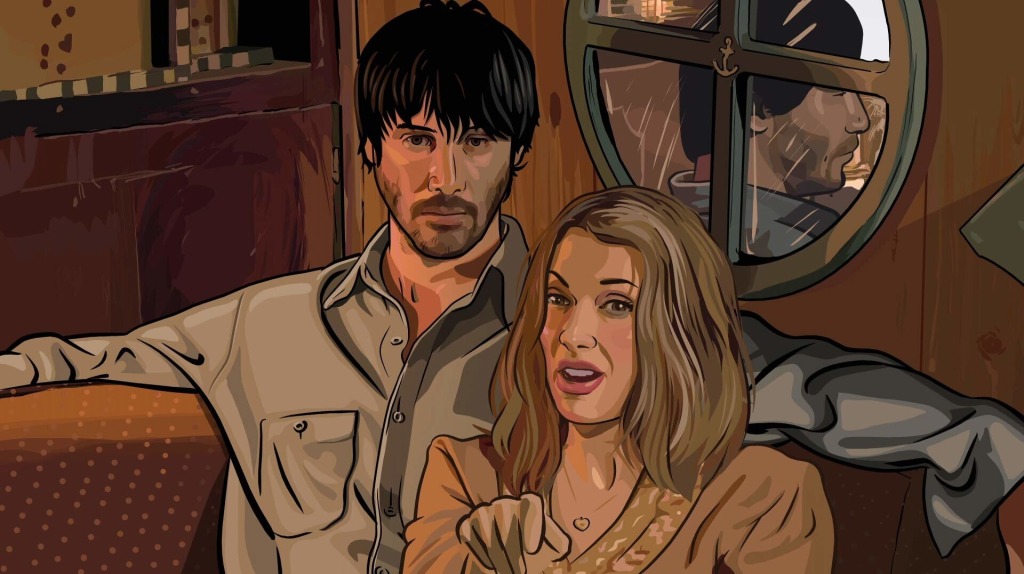
Coming at the tail end of what is simultaneously Linklater’s most Hollywood (for-hire jobs like School Of Rock and Bad News Bears) and most experimental era (the theatrical brilliance of Tape; his first rotoscoped film, the animated dreamscape Waking Life), A Scanner Darkly is Linklater is at the height of his directorial powers. But 20 years on, it stands as more than just an achievement in filmmaking—one that combines real-world staging and performances with the famously finicky work of animation—and acts as a prescient window into our world today. 

Linklater adapts A Scanner Darkly with incredible fidelity, following the narrative and digressions of Dick’s novel nearly beat-for-beat. The book and film follow Bob Arctor (Keanu Reeves), a Substance D addict whose house has become a home for fellow users James Barris (Robert Downey Jr.) and Ernie Luckman (Woody Harrelson). The twist is that Arctor is also an undercover policeman, “Fred,” who is tasked with surveilling Arctor and his crew. The increasing paranoia of the trio bleeds into Arctor’s—”Fred’s”—inner conflict, where he desperately attempts to stay moored to his own person while his identity floats away. 

Linklater stays close to Dick tonally as well. Linklater’s casual, hang-out humor becomes frantic when transposed from beer-drinking jocks onto fierce drug addicts. The material from Dick’s novel works perfectly with Linklater’s casting, in particular with Downey Jr.’s turn as Barris—one could even mistake Barris’ dialogue and inflections as originating from Downey Jr., rather than having been penned by Dick decades earlier. The sequences with Charles Freck (Rory Cochrane) feel less like Linklater and more purely Dickian, as Freck’s descent into drug-induced psychosis see him hallucinating being covered in bugs, before becoming trapped as an interdimensional creature reads out his sins for eternity.

Linklater ends his film the same way as Dick does his novel, with a note reading: “This has been a story about people who were punished entirely too much for what they did.” They go on to list names of those Dick lost: “To Gaylene…deceased…To Francy…permanent brain damage…To Nancy…permanent psychosis…and so forth.” Then, the final statement: “These were comrades whom I had; there are no better. They remain in my mind, and the enemy will never be forgiven. The ‘enemy’ was their mistake in playing. Let them all play again, in some other way, and let them be happy.” It’s a gut punch of a conclusion to a film and novel that, despite their humorous inflections, doesn’t let up from its cascading drugged-out paranoia. Out of the mental fog, suddenly the author and the work become sobering, pulling back to remember all the people who, as Dick writes, were punished “for want[ing] to keep having a good time forever.” 

While the novel is dedicated to Dick’s friends, it’s an even more personal creation. As he writes in the author’s note, “I myself, I am not a character in this novel; I am the novel.” When Freck offs himself with downers and a bottle of red, he lies down in his bed wearing a suit and sporting a copy of Ayn Rand’s Atlas Shrugged. One could imagine this as an end for Dick, a self-described religious anarchist and libertarian, a man who once ran in communist circles before turning on them. When Marxist academics like Frederic Jameson began to praise his writing, Dick reported them to the FBI, accusing them of being KGB agents. One could similarly imagine Dick as Barris—the know-it-all who doesn’t know anything and later tries to sell out Arctor to the cops—or as Arctor himself, the deep cover agent simultaneously living his life and investigating it from a distance.

This amalgamation of identities is visibly rendered through the “scramble suit” that “Fred” wears, which makes his face and body constantly shift. A Scanner Darkly‘s rotoscoped animation makes the scramble suit look like a net covered by constantly changing fractals of faces and clothes. On the outside of the scramble suit is everyone all at once, yet underneath it is the real man, hidden behind an ever-shifting veneer. The scramble suit is the novel and the film, an outward projection of many made-up faces that all serve to hide the author. 

Dick is interested in piercing this veneer, to which he ascribes a religious importance, the title itself being a reference to Corinthians: “For now we see through a glass, darkly; but then face to face: now I know in part; but then shall I know even as also I am known.” This poetic translation is as opaque as the glass we’re supposed to look through, and Dick translates this metaphor to new technology, having Arctor ponder, “What does a scanner see? Into the head? Down into the heart? Does it see into me? Into us? Clearly or darkly? I hope it sees clearly because I can’t any longer see into myself. I see only murk. I hope for everyone’s sake the scanners do better, because if the scanner sees only darkly the way I do, then I’m cursed and cursed again.”

Whatever mediating surface we use to see creation is imperfect. It shows an approximation without being the real thing, like trying to see through Fred’s scramble suit, or looking at live-action images outlined by Linklater’s rotoscoping. Behind the animation lies truth. This is all familiar to Linklater. Towards the end of Waking Life (Linklater’s first rotoscoped film), the director pontificates on Dick’s religious philosophy, saying that time is “just this continuous kind of daydream or distraction,” and that Dick “momentarily punctured through this illusion.” This is essential to understand why Dick’s works have so much staying power. Whether it’s the 1970s or 50 A.D., 2006 or 2026, the battle for truth persists. A Scanner Darkly works so well because it lends itself to mutability—drug slang and corrupt leaders can easily be updated from the ’70s to 2000s, all while telling the same story. 

But alongside this enlightenment, which comes from realizing that you’re working with narratives that humanity has cycled through for millennia, is the danger of developing a conspiratorial mindset. Dick himself found himself falling into that hole, in his work and his life, and this is partially reflected in Linklater’s film. One of the few additions Linklater made to A Scanner Darkly is a hard cut from Freck to Alex Jones standing on a street corner yelling into a megaphone: “Where does Substance D come from? Why can’t we stop it? The bigger this war gets the more freedoms we lose, the more Substance D is on our streets. Can’t you figure this out?” 

In 2006, this is clear allusion to the War On Drugs, which mounted many a conspiracy theory about the U.S. government’s involvement in the proliferation of drugs. When Linklater first met Jones and gave him a small role in Waking Life, mimicking the scene where a man spoke into car-mounted loudspeakers at the end of Slacker, Jones was just a local radio character in the Austin scene. By 2006, he had risen to national prominence as one of the first big “9/11 truthers.” In 2026, now that Jones has been completely disgraced and bankrupted, he continues to back the Trump administration and its phony fight of the “Deep State” despite its obvious corruption only becoming more transparent. 

Just as Bob Arctor and Philip K. Dick lost themselves to their own ideas, so too did Alex Jones, although the latter has to face the daily embarrassment of trying to sell this psychosis. Linklater finds that cinema is the perfect way to explore this conspiratorial bent, given that its reality always gets shaped by the whims of the filmmaker. In the case of rotoscoping, it is even more the case, with the director overlaying drawn images over those photographically captured. This form reinforces Dick’s veiled sci-fi world, one that kept its characters trapped.

In the nascent era of AI-generated images, this visual obfuscation of reality remains relevant. Not only does the fluidity of rotoscoping feel like a preface to the watery images of AI, but so does Dick’s conception of a veiled reality, whether it is something Biblically evil, or as earthly as drug companies selling both the poison and the cure. Now tech companies push for a world that only exists on our phones, while massive data centers continue to accelerate climate change in real life. Linklater’s adaptation of A Scanner Darkly works so well because, back in 2006, it adhered so closely to the source. Twenty years later, the real world has begun to look uncannily like a dystopia imagined by Philip K. Dick.

 
Join the discussion...
Keep scrolling for more great stories.