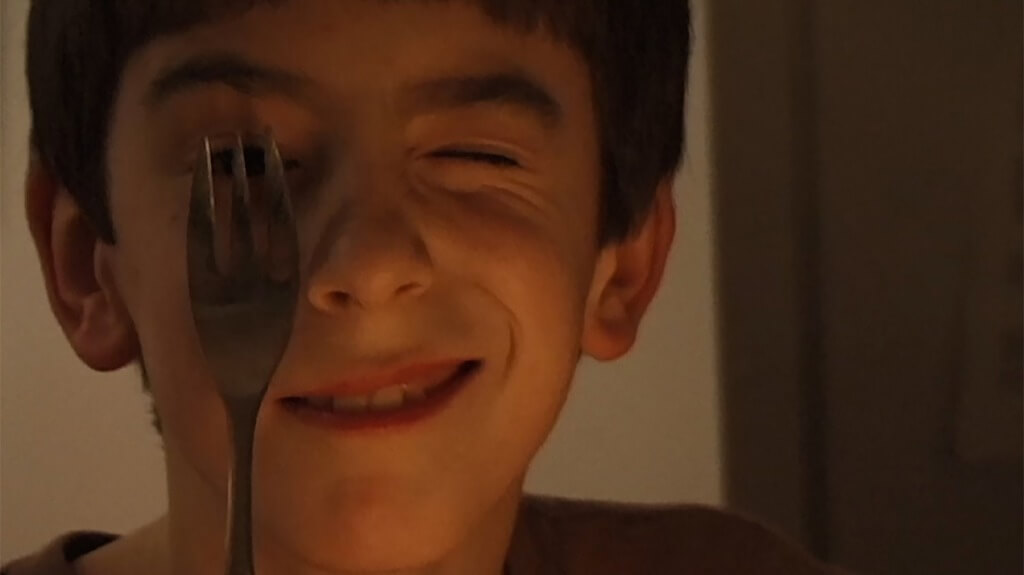
Despite the film’s somber subject, McElwee finds humor and levity in the banal. While his life is front-and-center in just about every one of his movies, McElwee cedes some ground to his son in Remake, featuring footage that Adrian shot when McElwee was signing a contract, of the Rockies when Adrian briefly called Colorado home, or some of the travel videos he shot when McElwee took him along to festivals. Adrian’s footage noticeably uses much more movement than his dad’s mostly stationary approach; he teases his dad that he should move the camera more. Adrian also tells the documentarian to leave nonfiction filmmaking behind to “make a real movie,” and shows some interest in becoming a filmmaker very different from his father.
Like Sherman’s March, which introduced the director’s unique personal narrative style, Remake is driven by his pensive narration as he revisits his movies and home videos. Adrian grows up and down in front of the camera, jumping in ages as McElwee’s memories meander through different stages of their lives, like jumping from the house-emptying time of the divorce back to happier times when the house was full of playtime and toys. More than in his previous films, McElwee is reckoning with the past, revisiting old friends like one of his dates from Sherman’s March, Wini, and his sharp-witted stalwart friend, Charleen, whose memories are fading faster than McElwee’s. With just the right observational moments, McElwee captures the gravity of our shared time together and how quickly it can run out.
Watching Remake can feel like rifling through a box of someone else’s home movies. The moments on tape can be adorable—babies cooing and kids playing make-believe games before graduating into teenagerdom, sullenly rolling their eyes before slinking off camera. At other times, when things get tough with scenes that would not normally be shared in public, it’s uncomfortable to watch such personal moments, like when McElwee tries in vain to talk to his son about drugs. It’s also confounding to watch McElwee stick to his instinct and keep filming when most everyone else in the world would have put the camera down. But for a director who processed so much of his life through the lens of a camera, Remake seems like the only way through such a heartbreaking ordeal. Once again, McElwee finds a throughline that’s both deeply personal to his experience and universal to just about anyone who has lost someone close.
There’s no separating sadness from the experience of watching Remake. It is a meditation on grief and the passage of time, forgetting neither. Wini tells McElwee that her time in Sherman’s March “is a kind of memory archive for me,” reactivating the sensations of her experience of living on the coast. She talks to McElwee about holding onto memories as one gets older, and Remake can be seen as McElwee’s attempt to hold onto Adrian. Even as McElwee wrestles with the age-old parenting question of “Could I have done things differently?” or worries that filming Adrian had a negative effect on him growing up, what comes through in Remake is a father’s love for a son he will never get to see pursue a future of his own. In revisiting some of his son’s ski footage, McElwee muses, “I was mesmerized by your shadow,” and that his sneeze “was the same sneeze you made when you were a little kid.” Thanks to the film, he can hold onto those memories just a little longer.
Director: Ross McElwee
Release Date: July 10, 2026


 Keep scrolling for more great stories.