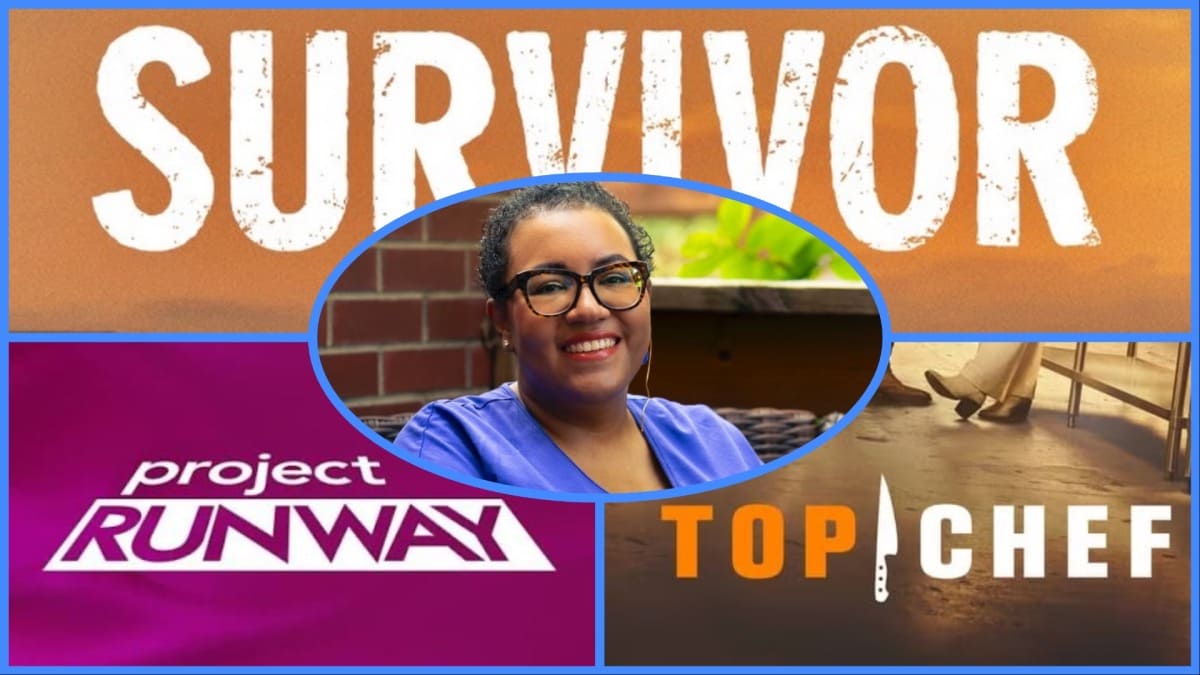
Center: Ali Barthwell (Photo courtesy of Full Complement Communications); Top: Survivor (Image: CBS); Bottom left: Project Runway (Image: Disney+); Bottom right: Top Chef (Image: Bravo)
Ali Barthwell may be an Emmy-winning writer for Last Week Tonightwith John Oliver, but she’s also a serious reality TV enthusiast. She’s been writing about the wider world of reality TV online for over a decade, particularly The Bachelor franchise, which she’s been recapping since 2015 at Vulture. (Fun fact: Barthwell is also an A.V. Club alum, writing about shows ranging from Game Of Thrones to Marvel’s Luke Cage.)Her new book,Reality TV For Snobs, aims to break down the sprawling (and surprisingly interconnected) landscape of reality TV into digestible chunks for those who find themselves a bit intimidated by all those Survivor seasons or The Real Housewives cities.
“It feels really satisfying to have done it,” Barthwell says. “This is the first time I’ve ever written a book, and a lot of my work has been much shorter form. Sort of the longest thing that I was doing was my Vulture recaps, and those eventually sort of ballooned into maybe 2,500 words, which is long for an online piece, but still in the grand scheme of a book, not very long. So having something that is completely my words, my thoughts, and then to have it be this length is really satisfying.”
More importantly, the book seeks to put reality TV as a genre into context—what does our obsession with it say about American consciousness and our current cultural moment? The A.V. Club sat down with Barthwell to chat about her book and get her take on the shows that have helped the reality TV genre become what it is today.
This interview has been edited for length and clarity.
The A.V. Club: Your book is called Reality TV For Snobs, and I’m a reality TV junkie, so I do not need convincing of its greatness. But what is it about this genre that makes some people think they’re above this kind of television?
Ali Barthwell: I think some of it is the memory of early reality TV. For a long time, the only thing that we saw on reality TV was a freak show or it was Cops. The only time we saw real people on TV was Cops, the news, and then this other weird thing over here. A lot of it was couched in there’s something wrong with the people that you’re watching. Something has gone wrong in their life that they’ve ended up on your television, not as an actor, and that’s bad.
I think that colors a lot of it. There really was that idea that this is fake, that it’s staged, that it is overly produced. It’s called “reality,” but it’s not really real. I think people really didn’t like that; they felt like they were being lied to or sold something that didn’t exist. And one of the points I try and make with the book is like, “You’re not watching something that’s real. You’re watching something that’s been edited, and there have been casting processes, and they’ve had to do sound, and the confessionals are filmed months after, but that doesn’t matter because what you actually end up watching is so entertaining and can spark so many conversations and connections with people that if you’re sort of in the year of our Lord 2026 still hung up, ‘Is the reality TV real?’ It’s like you’re sort of asking a question that I think is not going to get you where you want to go if this genre has any interest to you.”
AVC: The power of the edit is so interesting. How do you think, as viewers, we’re meant to suss out how we feel about what we’re seeing? Do people enjoy this more curated story, or do they feel misled by it?
AB: I think people would have a better time, in my opinion, if they sort of came to it saying, “I’m watching something edited; I’m watching something produced.” Now the amount that production has to do [these days] is probably a little less because people are signing up for these shows knowing the types of roles, the types of moments that get people noticed. So they’re able to stand out. They know how to make themselves stand out. They’re able to self-produce.
But I always joke when I talk about this stuff: “Is it real?” Who cares? You watch a lot of stuff on television that isn’t real, that is edited, that is produced, that is created by somebody. And so one of the goals that I had with the book is like, “Can we look at reality TV as a piece of storytelling rather than a reflection of our real lives?”
AVC: I would love to hear your take on what reality shows that are really popular right now say about our current moment. If we’re being honest, more people watch Love Island than watched Succession, which I think we can all agree is a prestige TV pinnacle. Do you think it says something about the cultural moment we’re in that this is what we’re watching?
AB: I think it’s a number of things. One, I think there’s an assumption that reality TV is easier to digest and understand than something that is prestige television.
AVC: Which is funny considering Succession is basically the Murdochs.
AB: Exactly. And a lot of television is borrowing documentary or reality TV tropes. There are confessionals now in sitcoms that come from documentary and then reality television. One of the big conceits of The Office was that you were watching a documentary reality show about this office. So I think there is an assumption that the reality TV that we watch will be easier to understand and to digest. And on a lot of levels it is.
There’s no symbolism; there’s no subtext in the dialogue that has been written by somebody else and given to an actor. An actor is not making unexpected or unconventional choices. So a lot of the literary aspects of watching something scripted aren’t present in reality TV because they were not written by a writer to then be performed by actors. I think there are people who want to watch reality TV because they’re like, “Listen, when I watch a prestige show, I’m watching Don Draper look at a wall, and I’m supposed to get meaning from that.”
In reality TV, the meaning is on its face. It’s right there. They are going to tell you what’s happening, what’s happening next, how [they] feel about it.
I also think a lot of people like reality TV because in that sort of same vein, it feels more dramatic and active than prestige TV. Stuff’s always moving forward. Every episode somebody’s getting eliminated; things are happening. And then I also think [another group of] people watch reality TV as aspirational or instructive sort of content.
Maybe they watch Love Island to find out how to date. There are people watching Love Is Blind to find out how to have conversations about important topics. People are watching Real Housewives to know what procedures to get. I think right now a lot of people feel like there’s no script for how their life should go. The typical, “This path maybe doesn’t get you the same thing as it once did.” So it’s like, “Well, I can look at The Real Housewives and be inspired, maybe.” There are good and bad things that can come from that. But I do think a big part of it is instructive, aspirational kind of content.
AVC: What are your three to four reality shows that you think have kind of influenced where we are right now the most?
AB: It’s such a loaded question. I think top of that list for me is Survivor.
AVC: Because it was the first sort of big, breakout one?
AB: It was the first, and I think it changed these kinds of shows from being a game show to a study of human behavior. And if you know anything about the history of Survivor, it started as this company that made these sort of eco travel documentaries. Eco Challenge: The Expedition Race. Mark Burnett, who was the producer, had worked on this show, and it was a documentary. And so the original pitch of Survivor, the conception of it was, “We’re watching these people try and make shelter, try and find food, all of that.”
But Richard Hatch basically realized, “Oh no, this is a social strategy game. This is a game of alliances, and if I can keep myself in the mix long enough, I’m going to have a chance at winning.” And so I think it really did alter our conception of watching a show like this—-going from, “I’m going to watch because I find the activities they’re doing kind of interesting,” to, “I’m watching because these are interesting people put in a circumstance and I want to see how they get through.”
AVC: Let’s face it, everyone else on pretty much every other show afterward copied Richard Hatch in that regard.
AB: Exactly. He was sort of a villain, but also able to maintain alliances. It created a new lane for competitors on these shows. Then I think you have to give it to The Real World, which was basically just strip it back and make you watch interesting people just living their lives? A joke I make throughout the chapter on that show is I think that show and MTV sort of defined the millennial kind of worldview. Gen Xers, they were already in their teens and 20s when MTV was coming around. But for millennials, we were in our pre-teens and then early teens as these shows were coming on, and they presented an image of adulthood as well as a glimpse into these very interesting, diverse, interesting people. It’s a show that was aspirational in its normalcy.
AVC: In early seasons of The Real World, half the “story” was just people going to their jobs. That was the show. Granted, you’d have the occasional fight or whatever, but mostly it was just people doing day-to-day stuff.
AB: Right. You would go work at a nonprofit with kids and you’d see these people interacting with kids or having to come up with ideas, make a radio show or whatever. I think it proved that watching normal people live their normal lives was fascinating, was interesting.
Another really influential one was Project Runway. OG Project Runway. I think that’s when we start to get very skilled in the genre. I now want to watch very skilled people do their skill in a high-pressure environment and all of the stuff that comes from all the shows that come from that.
The first season of Project Runway was in 2004. So much came after that—Top Chef, Chopped, even Great British Baking Show. And then when Bravo found some success with Top Chef and Project Runway, they started to ask “What other careers can we put into that formula?” There was one about songwriting, there was one about doing hair, about doing fine art. There are shows on HGTV about home renovation, and then you have [concepts] that are basically folding in on themselves, like finding The Next Food Network Star. Not finding a person who can cook, but finding someone who can do the show.
I think, in the beginning, the show always gave [the contestants] enough time and resources to be able to get it done. But if you look at the later seasons, particularly the last two that people have been really complaining about, they’re not doing that. So then the only thing that’s left is like, “Okay, you have to come up with the most over-the-top version of it to put the craziest thing on the runway, or it becomes about the personalities.”
Project Runway and a lot of these shows, they always did feature personalities. It’s one of the criteria that I talk about for what shows got included in the book—that you were eliminated not just because of how poorly you did on a challenge, but because your interactions with other people could cause your elimination. There are team challenges. The team captain did a great job, but everybody else did a bad job. Are we going to get rid of the team captain for letting the team down? There’s, again, a kind of evolution of the social game aspect as well. “How do I handle my team as a team leader? Do I let them flounder? Do I give up time to help them work on their thing?”
I think the last one has to be The Real Housewives. When people try to think of a reality TV star, they see a Real Housewife. That’s what immediately comes to the forefront for a lot of people. I think really seeing the show morph and change, and the arcs that these women go through over multiple seasons. You do see people’s circumstances change, people’s points of view change, even if they themselves fundamentally don’t change, which is something I don’t think we change a ton in our lives. But I think you get the reward of watching these long multi-season arcs, and honestly it really is like a novel. You’re watching people for 10, 15, 20 years of their lives. How is that not an arc?
I also think that a Housewife is a specific kind of person. We see celebrities now, and we’re immediately like, “Oh my God, she’d make such a great Housewife.” It’s a blueprint of what we think a reality TV star is. It’s like a goal. You can start on something else and end up on The Real Housewives. You have Eva, who was on America’s Next Top Model and ended up on Housewives. Now you have Ashley I[aconneti] from The Bachelor who ended up on Real Housewives.
AVC:And a lot of the Housewives go on to do other things. I was introduced to Phaedra, for example, because I watched The Traitors.
AB: She’s on the Mount Rushmore of Housewives. But, yeah, it’s really very much its own ecosystem. It launches people. It’s a landing place. It has this weird reinvention engine within it. If you have a bad season, you can reinvent yourself.


 Keep scrolling for more great stories.