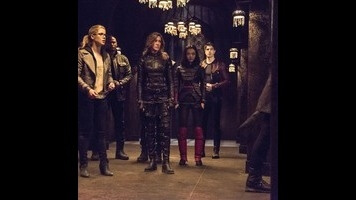
As is often the case on Arrow, the action set pieces are the highlight here. Laurel and Diggle’s gangland brawl is fun, a perfect opportunity to bring back Laurel’s shiny new Cisco-enhanced Canary Call, and though it may not work out for them, the team’s attempt on Ra’s’ plane is an exciting sequence. Having Ray fully onboard for the last push of the season makes sense and his suit has gone through enough modifications and trials that his transformation from adorable try-hard to legit vigilante feels earned. Laurel has similarly cemented her place on the team as well as her abilities as a fighter, believably holding her own against the League, which would have seemed impossible at the start of the season. While their pre-fight exchange loses much of its power thanks to their masks, Maseo and Tatsu’s fight is well choreographed and Maseo’s death, though crushingly over-scored, is given appropriate weight. The only piece sorely missing is Nyssa, whose inaction throughout the episode is frustrating. Given how easily Merlyn, Oliver, and the rest of Team Arrow can sneak into and out of Nanda Parbat when the plot necessitates it, Nyssa’s inability to escape or at least take out some of her father’s goons is disappointing.
Thanks to their strong tie to the main narrative, the flashbacks to Ollie’s first experience with the Alpha-Omega virus are on the whole successful. The stakes are surprisingly low, since Akio’s death in his parents’ arms had already been revealed, but the scenes are still affecting. Which takes us back to the final scene. Unfortunately, Gen. Shrieve’s assertion that just breathing the virus is fatal serves to undermine the episode’s cliffhanger, rather than bolster it—if there’s no hope of an ally popping in with a last second cure for Felicity, Diggle, et al, then the likelihood of there being anything but knock-out gas in that vial is even lower. Arrow may not reach the levels of meta awareness of its cheerier sibling show, The Flash, but there are moments of levity throughout “This Is Your Sword” that speak to the writers’ understanding of the audience’s perspective. Felicity’s reaction to Tatsu, “We haven’t met her, right?” is great, a clear nod to the series’ complicated backstory, as is Felicity’s fleeting excitement over her mad tablet Frisbee skills. It’s a shame this acknowledgement of and respect for the audience doesn’t extend to the episode’s most dramatic moments.
Arrow has struggled through its third season, attempting to reconcile out of character behavior from its leads, nonsensical secret-keeping, and a villain who now seems entirely without motivation. There’s little chance that the finale will recapture the magic of the exhilarating end to season two, but hopefully the resolution of the Nanda Parbat arc and the crucial work this season has done in building up Laurel and Thea will put the series in a strong position for a fresh start in season four.
Stray observations:
- For those keeping track, the episode makes it all of five minutes before the first Felicity cry face. Those tears may well and not fall, but I’m counting it.
- Speaking of Felicity, Oliver has seemingly betrayed them again, after kidnapping and holding Lyla hostage, but Felicity cares that he’s engaged? Seriously? Barry needs to speed over for some real talk with Ms. Smoak, stat.
- Diggle’s scene with Ollie may be brief, but it’s infinitely more effective in establishing stakes than anything involving the Alpha-Omega virus.
- Tatsu singing over Akio’s body is moving. Tatsu singing to Maseo should be an affecting bit of symmetry, except that the soundtrack more than drowns her out. Why include that beat and then stomp all over it?
- Thea’s B plot may start out rather painfully—the only scene with more awkward exposition than Ollie and Merlyn’s is Thea and Merlyn’s—but by the time Roy shows up, their canoodling is a welcome diversion. With Ray and potentially Roy heading to the spinoff and Felicity stuck in cry mode, next season will need a serious injection of good-hearted cute.


 Keep scrolling for more great stories.