Held each summer in Sápmi, the ancestral homeland of the Sámi people, the Riddu Riđđu Festival in Northern Norway exists to foster appreciation for Sámi culture while creating a shared appreciation for Indigenous artists and communities from around the world. It was within this setting that the crew from Paste Studios’ “On the Road” crossed paths with Evan Pang, known by his family and stage name, Aysanabee, whose music felt immediately at home in the Arctic landscape.
My first exposure to Aysanabee came unexpectedly inside the main Riddu Riđđu tent. As ornately decorated and detailed as the multi-roomed tent was from the outside, I was truthfully drawn into the space by the promise of a warm fire and a plentiful supply of Norwegian cheese and beer. Walking into the well-stocked tent, I was greeted with a lively, earthy voice coming from the PA system in the larger room. Alone onstage, the Canadian Oji-Cree singer used a reverb-drenched acoustic guitar, electronic percussion, and his powerful voice to serenade an attentive audience. When his set ended, he stepped down to enjoy the company of his band and those gathered, and we got to chatting. As we exited the tent together, it opened directly onto the Norwegian countryside and distant snowcapped mountains, a quiet reminder of how closely music and land exist at Riddu Riđđu.
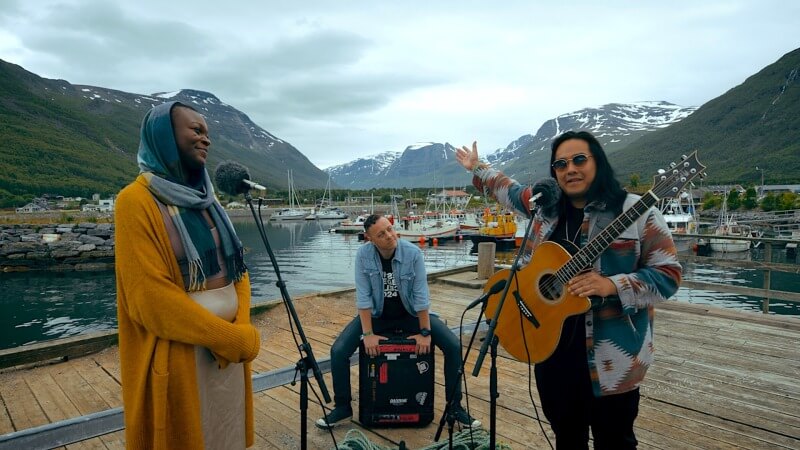
Aysanabee and his band were warm and disarmingly open, and before our session even started, I was already looking forward to what would come next. That openness carried through the weekend as artists and attendees found themselves sharing space on a Norwegian sauna boat, where I found myself hanging with Evan and his crew again, alongside the rest of the small Paste team. We engaged in casual conversation, fueled by the collective awe of our surroundings. Our time together on this boat took down any perceived barriers, allowing the musicians to give a truly genuine performance. The boat was docked in Mandalen, a settlement so small it is referred to online as a human settlement. That same dock later became the setting for the Paste session itself.
They opened with “Home” from his new album, Edge of the Earth, released in June of 2025. The song leaned distinctly folk, grounded by a downtuned, fingerpicked guitar. Aysanabee’s singing voice is notably deep and resonant, blending naturally with the soft vocal support of his backing singer, Kyla Charter. His voice carried weight, doing justice to the almost unbelievable natural beauty behind him. He followed with the title track, “Edge of the Earth,” a fitting choice in a place so pleasantly removed from larger civilization. More intricate fingerpicking unfolded, and the percussionist, Miles Gibbons, used his road case as a makeshift cajón, which was as enjoyable to watch as it was to hear.
Riddu Riđđu was a truly special place to witness this music from Aysanabee. People arrived from many places, sharing Indigenous history in their respective homelands and a clear respect for the land beneath them. The usual barriers that one could predict between people from such different parts of the world were all but gone, and the only thing that seemed to matter was a mutual respect for Indigenous tradition. This spirit culminated in a Sámi ceremony around a fire, in which all members present were invited to contribute something from their native culture, whether that be a chant, poem, or song. Meals were shared, long conversations were frequently had, and laughter drifted between tents at all hours of the day and night. Beer, wine, and an abundance of reindeer hot dogs and burgers passed easily between new friends. In this special setting, Aysanabee’s presence made sense. His music, grounded in personal history and cultural continuity, fit naturally into a community gathered with the same intentions.
A large thanks from the Paste team to Aysanabee and his band, as well as everyone from the Riddu Riđđu Festival who allowed such a great session to occur. Keep your eyes peeled for more from Paste Studios’ “On the Road”!


 Keep scrolling for more great stories.