The salt mine bit is true, as is Luhrmann’s privileged access to recorded interviews from the Graceland archives. But it’s also true that, thanks to the tight control the infamous “Colonel” Tom Parker kept over his most famous and lucrative client, much of what came out Elvis’ mouth took the form of sanitized soundbites. “Reality” is always relative in Elvis-land, and EPiC does little to challenge the legend’s main talking points—arguably even less than Luhrmann’s biopic, which at least engaged with Presley’s drug use and political beliefs. Luhrmann doesn’t go as hard on Tom Parker in EPiC as he did in Elvis—this is a mash note, not an exposé—but a sequence where Parker lurks behind the singer as he deflects a question about artists’ political obligations very much plays like a defense of Luhrmann’s Tennessee idol.
Throughout EPiC, the filmmaker proves himself to be thoroughly enamored with his subject. Luhrmann paints the singer as a ladies’ man and lovable goofball who came alive on stage, where he proved himself to be a surprisingly versatile performer. His vocals are enhanced, as if to defend the singer against detractors who argue he was all stage presence and no talent. Luhrmann frequently cuts away from the stage to shots of ecstatic women in the crowd, and he devotes an entire montage to Elvis kissing starry-eyed female fans on the mouth mid-performance. It’s partially an admiring “attaboy” from the filmmaker, and partially Baz screaming in the stands himself.
The editing of Luhrmann’s film is where the pairing between artist and subject is most sublime. The backstage moments are relatively calm and meditative, with lingering shots of the singer learning the melodies of songs by younger, hipper musicians while surrounded by long-haired session players. In these scenes, Elvis seems lonely, a man out of time. Luhrmann and his work have never fit into any particular era, either: This is the filmmaker who moved Romeo & Juliet to ’90s Miami and set it to an alt-rock soundtrack, and who meshed Jay-Z and Florence And The Machine into the 1920s fantasyland of The Great Gatsby.
Similarly, Luhrmann speeds up his already-manic editing style to match the electrifying singer’s twitchy movements on stage. EPiC is manically paced, jumping between subjects and eras in Luhrmann’s signature nonlinear style. Never content to just leave the camera static, in performance sequences Luhrmann rhythmically cuts on every karate chop and high kick, a sped-up version of the hand claps in the climactic scene of Strictly Ballroom. In Elvis, the camera frequently outpaced star Austin Butler; here, it’s Luhrmann who has trouble keeping up.
Over-the-top sets are another Luhrmann signature, on which the director partners with his wife and production designer Catherine Martin. Here, the filmmaker has also found a spiritual soulmate in Elvis: The singer’s own home, now preserved as a museum, is an overwhelming, overstimulating shrine to midcentury kitsch. (If anyone can appreciate the mirrored velveteen excess of Elvis’ TV room and jungle-themed living room, it’s Baz and Catherine.)
Of course, EPiC is an archival documentary, which leaves no room for Luhrmann to build a lavish rhinestone world around his subject and whip the camera around. But he makes room for maximalism both in the film’s graphics—it features the biggest, most grandiose Bazmark logo yet, and the end credits resemble those of The Great Gatsby, but with bedazzled belts instead of Art Deco designs—and in the film’s color grading. Charmingly, Luhrmann writes in his director’s statement: “In a world where Artificial Intelligence can make all sorts of illusions, the[se] illusions were made from authentic and original material and restored with meticulous human craft.”
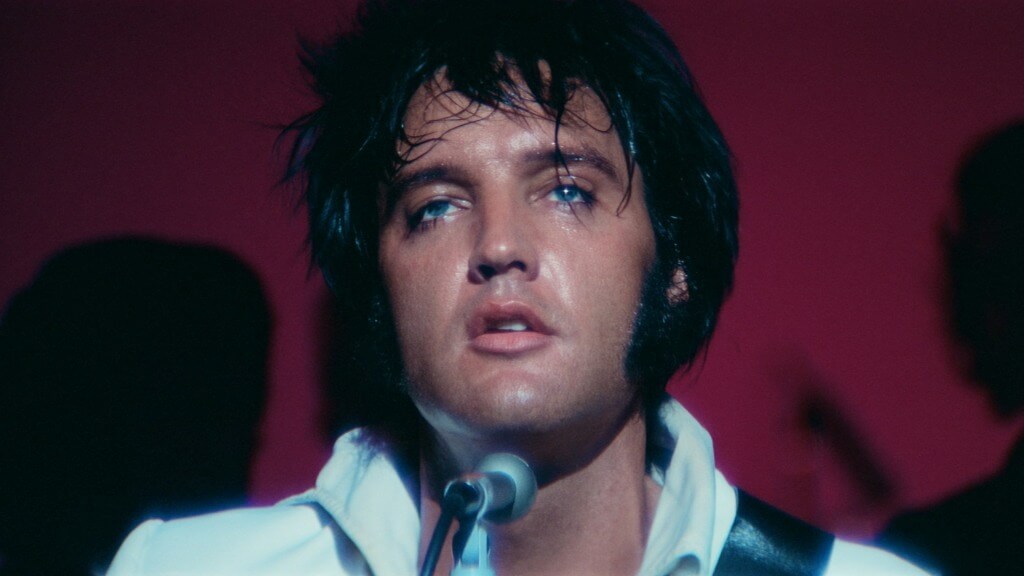
The footage Luhrmann’s team scavenged from that salt mine was all restored for EPiC, over several years and at presumably great expense. The colors in this new-old footage are eye-singeing, and there are moments where they clash and pop off the screen. Special attention is paid to the colors blue and red, recalling a similar color scheme in Moulin Rouge!: Take the bright aqua blue trunks Elvis wears in one of his half-hearted Hollywood roles (which movie? Who cares?), or the billowing red backdrop at his Vegas shows, a wink to Luhrmann’s own “red curtain” trilogy. The sheer saturation of these colors is thrilling in itself: At one point, Elvis straps on a pink paisley guitar while wearing purple sunglasses, and it’s as decadent as the interiors of the Moulin Rouge.
But what really ties Luhrmann and Elvis together is something deeper than aesthetic: They both believe in love. Luhrmann’s earnest, even dorky, belief in “love conquering all” is a recurring theme in his movies, and Elvis sang some of the corniest—and the most beautiful—love songs of his era. Both of their artistic expressions are built on big feelings, expressed in dramatic, maximalist style. Elvis thought he looked great in those spangled bell-bottom jumpsuits, and with the power of his charisma behind them, he actually did. Baz Luhrmann unabashedly, unselfconsciously agrees.




 Keep scrolling for more great stories.