Sing to me of the man, Muse, the man of twists and turns—preferably in a four-quadrant movie format. Christopher Nolan’s adaptation of Homer’s The Odyssey is, according to the director himself, the most challenging film he’s made, filmed across six countries, often on terrain hostile to blockbuster film crews, with a massive A-lister cast and a degree of grit and realism typical to Nolan’s filmed versions of heightened material. But while The Odyssey‘s press run has supplied enough anecdotes of the arduous production to fill its own epic poem (a new cumbersome but silent IMAX camera, practical effects over CGI, cast and crew hiking 45 minutes to set every day), they don’t actually explain what’s so hard about translating Homer’s text into cinema. So much of what makes the Odyssey exciting—its unwieldy structure, themes of yearning and regret, extensive interaction with literal gods—are antithetical to modern adventure cinema.
Noble attempts have been made—1954’s Ulysses, a Kirk Douglas-starring sword-and-sandal vehicle; Franco Piavoli’s elemental and entrancing Nostos: The Return; the Coen Brothers’ Mississippi farce O Brother, Where Art Thou?—but their resources pale in comparison to Nolan’s, and they either contort the material into derivative adventure entertainment or approach Homer’s deeper themes through indirect means. While the story of the Odyssey, about victorious Greek hero Odysseus spending a perilous decade traveling from the Trojan battlefield back to his kingdom of Ithaca, features plenty of high-sea adventure, duplicitous gods, deception, and intrigue, it also has a strong domestic focus, stressing the expectations and stakes of hospitality. Unlike The Iliad, there is no war with cleanly divided factions. Achilles can be played by Hollywood’s hottest star, while the older, craftier, haunted Odysseus cannot. This distinction is what makes the Odyssey so appealing to filmmakers: “Home” is slipperier to define than “war,” and cinema’s ability to create its own sense of time resonates when telling the story of a punishing, delayed homecoming.
The Odyssey has a nonlinear, nested structure. It begins on Ithaca, with Odysseus’ son Telemachus and wife Penelope pining for his return, while a fleet of suitors run amok in the king’s house. It then picks up with Odysseus escaping the nymph Calypso and being hosted by a kind king. It switches to the first-person, with Odysseus explaining his lost wandering years, then back to third-person as he returns to Ithaca for a climactic confrontation/reunion. It’s a terrific gambit for grabbing our attention and teasing a mystery, but while “epic” films can use flashback framing devices, it’s a genre that relies on accumulating momentum—a sense of duration conveyed in sweeping scope and style—for its heroic or tragic payoff to land. Several multi-part miniseries adaptations (like a 1968 Italian version or the 1997 Armand Assante-led version) take advantage of the poem’s extended timeline over their multiple hours, but screenwriters still face an inherent structural dilemma. The setups and payoffs are arresting, the mystery draws us in, but there’s an impulse to trim down the long conversations and extended flashbacks to keep audiences in the moment of peril.
In Ulysses, director Mario Camerini and co-writer Franco Brusati maintain Homer’s broad strokes but reduces it to under 100 minutes. Ulysses has amnesia, which changes the hero’s adventures from stories he tells into memories he recovers. Douglas looks poignantly out to sea as he remembers it all in swashbuckling Technicolor detail, the attempt to bring Homer’s verse into an active tense inadvertently creating additional passivity. The Odyssey‘s extended live storytelling passages intentionally reflect the oral tradition for which the poem was originally composed; weakening Odysseus’ character by turning him from performer to audience is one stilted side-effect of trying to make the Odyssey into snappy historical action fare. Ulysses is the most traditionally cinematic and heroic adaptation of the Odyssey, yet its hero is less alive.
Similarly, while the pantheon of Greek gods directly meddles in Odysseus’ fate—taking human form to give advice or protect him, but also to impede his progress—divine intervention is nearly always softened or erased in film versions. Detailing the perspectives of the gods and their interactions with mortals was second nature to Homer, but that doesn’t quite fit with modern adventure film. If the gods conspire to aid and obstruct our hero, won’t audiences feel like his agency has been reduced? Evidence of the spiritual is all over epic fiction, but the mythic films that most heavily feature the Greek gods, like Clash Of The Titans, are lighter fantastical fare, while 2004’s Troy excises them completely from The Iliad in favor of Hollywood tropes and historical secularism. Ulysses pinpoints Ulysses’ desecration of the Trojans’ temple to Neptune as the reason for his misfortunes, but this godly justification is not personified.
Nostos: The Return engages with the gods indirectly, with an elemental and haunting depiction of temporal and psychological slippage that implies a divine presence, but withholds their logic and insight from our wandering, despairing hero. Nostos conveys the divine as a power utterly out of human reach but embedded in our sense of nature, direction, and time—although Odysseus’ decade of wandering is compressed down to 90 minutes, the lyrical editing suggests time is passing at a pace that he cannot grasp. The gods are disembodied powers designed to remind mortals, as they often do in ancient myths, that they do not understand the world they try to master.
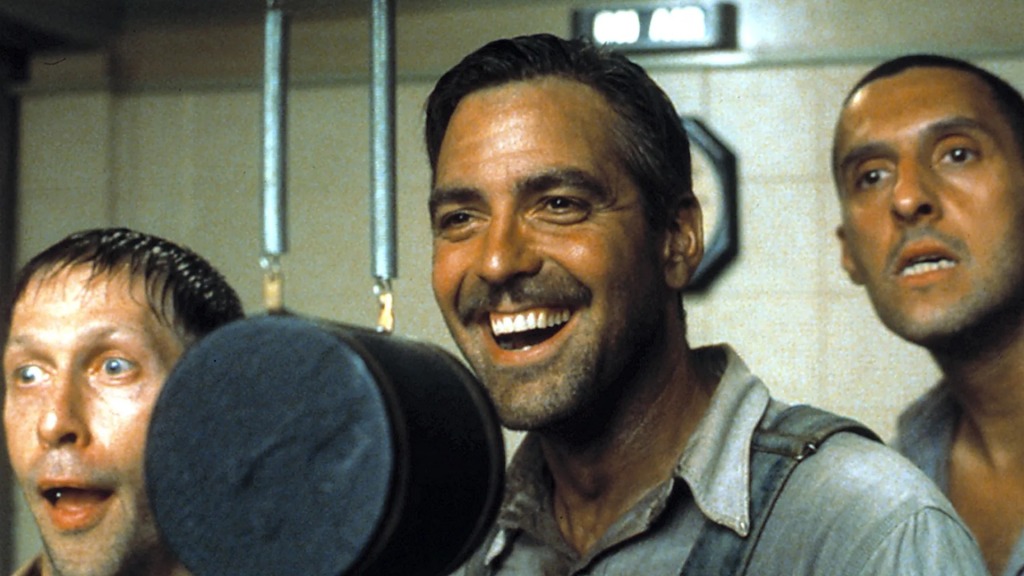
Embedded in Nostos is a question that two loose, genre-bending adaptations of the Odyssey mine for comedy and pathos: What kind of a hero is Odysseus, the cunning man who neglected his family for 20 years? In O Brother, Where Art Thou? and Keyhole, the Coen brothers and certified Canadian weirdo Guy Maddin respectively abstract Homer’s material through comedic, imaginative style, unearthing Odysseus’ less heroic side and proving a gritty, grueling approach may not make an adaptation more psychologically ambitious. O Brother and Keyhole recast Odysseus as American criminal archetypes—Ulysses Everett McGill (George Clooney) is a chain gang escapee in Depression Era Mississippi, while Ulysses Pick (Jason Patric) is an old-timey gangster holed up with his gang in his former (and now haunted) house. Both Everett and Ulysses are crafty leaders, but these (partially) modernized characterizations foreground their flaws and follies.
Everett is an overtalkative, condescending, slick con artist, not to mention a vain and stubborn ex-husband who takes a few un-heroic pratfalls and punches. In changing Odysseus from a wise war hero to a wiseass convict, the Coens find a new way to hang the mythical character out to dry. When he returns to his “Penny” (Holly Hunter), who unlike the dignified Penelope has remarried and told their children their daddy got hit by a train, he now needs to prove that he deserves a homecoming in the first place. Everett is indignant about returning to how things were before his misfortunes, clinging to his version of the past despite his conditions having changed. The film turns Homer’s hero into a cunning rube and suggests that the heroic mode of the Odyssey holds back adaptations that don’t tackle the themes of homecoming from a more prickly perspective.
Ulysses Pick, by contrast, is a man of real authority, but one vulnerable to insubordination, not to mention the disorientation he experiences as he recovers forgotten memories about his family. Keyhole‘s transformation from gangster pastiche to surreal haunted-house story, in keeping with Maddin’s style of early cinema homage and comic psychosexual themes, transplants Odysseus’ journey to a largely psychological plane. Ulysses technically returns to Ithaca at the start of Keyhole, and by exploring his hometown and drawing closer to his Penelope (Isabella Rosselini, here named Hyacinth), he relives Odysseus’ long voyage and “unlocks” his home’s suppressed memories. Ulysses’ homecoming is far from heroic: The Telemachus stand-in resentfully hides from his father, and the glimpse we get of the family reunited—with father, mother, and son together in a cozy approximation of a wholesome midcentury home—is brief and melancholy. Keyhole denies the victorious finale of the Odyssey and underlines the story’s latent grief, not as something that’s overcome but something that has a perpetual effect on those who’ve lived through it.
It’s hard to think of a less heroic film than Ulysses’ Gaze, Theo Angelopoulos’ dreamlike and glacial odyssey across the Balkans with an obsessive filmmaker named A (Harvey Keitel), who’s searching for missing reels shot by some early cinema pioneers. Angelopoulos inverts the direction of Odysseus’ journey, beginning with A’s return to his hometown, where he spots his lost love (from a distance), and ending in a wartorn city (the siege of Sarajevo standing in for the sacking of Troy). Angelopoulos also casts one actress, Maia Morgenstern, as multiple characters who represent the women of Homer’s text (Penelope, Calypso, Circe, and Nausicaa), turning the Odyssey‘s sense of scope into a trick of perception that underlines A’s inward-looking affliction. What Ulysses’ Gaze maintains from its epic source stays inside its characters: an obsession with not just returning, but restoring identity and purpose, a pining for home’s clarity and certainty that cannot be found in the companions we meet along the way.
Like Nostos, Ulysses’ Gaze finds fertile ground in the vague, emotionally cloudy travels; like O Brother and Keyhole, it expands Odysseus’ hints of self-loathing and failure to the point where classical heroism is as remote as Ithaca. This is the potential of loosely adapting a ubiquitous, classic text—you can focus not only on the distance between being lost and finding your way back, but between a modern sense of placelessness and the anchoring power of monumental art. Odysseus’ adventure is specific, but the pains of getting home are not.


 Keep scrolling for more great stories.