Christopher Nolan has said that TheOdyssey is his attempt to recreate the classic films based on mythology he watched in his youth, only with “the sort of weight and credibility that an A-budget and a big Hollywood, IMAX production could do.” When listing these childhood favorites, Nolan name-checked Ray Harryhausen, the legendary stop-motion animator behind many of the most iconic films touching on classical texts. Perhaps then this is a bit of hubris from Nolan, since Harryhausen is something of a god of the genre.
Half a century before Nolan was lugging IMAX cameras across Greek islands, Ray Harryhausen was painstakingly positioning miniature models frame-by-frame to create some of the most astounding special effects of the ’50s, ’60s, and beyond. After being inspired by King Kong and the work of pioneering stop-motion animator Willis O’Brien, who later became his mentor, Harryhausen would break into movies himself with another big gorilla film, 1949’s Mighty Joe Young. He would next do the special effects for a slew of ’50s sci-fi movies, including a picture about flying saucers and The Beast From 20,000 Fathoms, a monster movie adapted from Ray Bradbury that would directly inspire Godzilla. (The stop-motion animation that brought the film’s fictional giant dinosaur, the Rhedosaurus, to life was deemed to be too expensive by Toho, so Godzilla ended up being a man in a suit.) Dynamation, a technique of Harryhausen’s creation that allowed for stop-motion animation to be incorporated into live-action footage, enabled some of the most impressive special effects you could imagine before the CGI era—and much of it holds up better today than quick-aging computer graphics. Steven Spielberg, James Cameron, Tim Burton, and Peter Jackson all cite Harryhausen as a major inspiration, just as Nolan has.
Harryhausen is best known, though, for the sorts of mythological films Nolan’s referencing—a series of five films across four decades looking to Greek myth and One Thousand And One Nights for inspiration. When Tom Hanks presented Harryhausen with an honorary Oscar in 1992, the actor said that Jason And The Argonauts, not Casablanca or Citizen Kane, was “the greatest film ever made.”
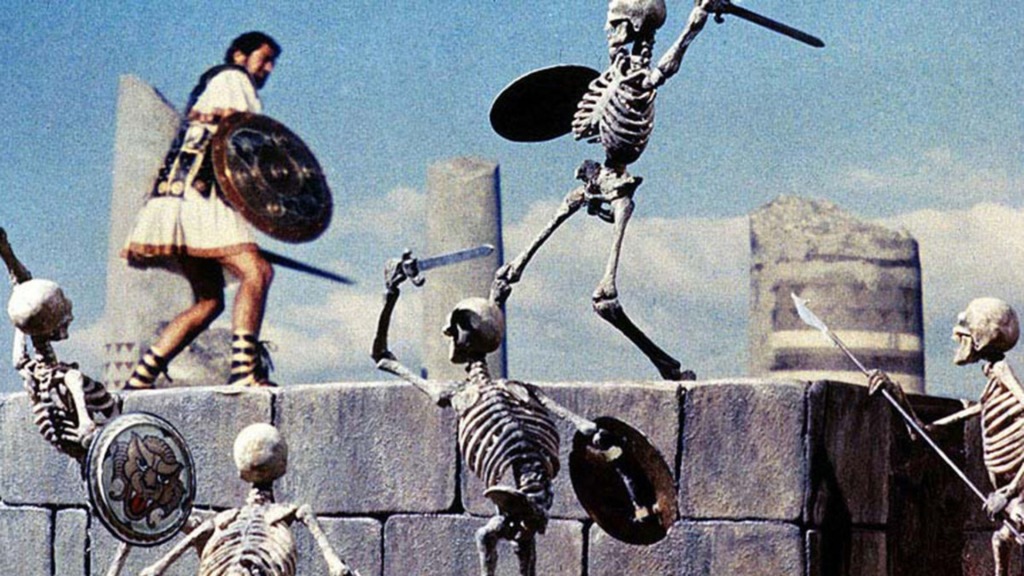
More so than any other movie (Troy included), it’s Jason And The Argonauts that feels like the true predecessor to The Odyssey. For one, both films are about a Greek myth where the hero spends most of the movie at sea trying to get somewhere. For Odysseus it’s home, for Jason it’s in search of the Golden Fleece. Harryhausen regarded Jason And The Argonauts as his best film, and he’s probably right. A tour de force of animation, the movie boasts a colossal bronze statue named Talos who picks up the Argo and chucks it back into the sea, a slithering multiheaded hydra, and a climatic battle sequence where Jason and two of his Argonauts cross swords with seven living skeletons. Harryhausen spent four and a half months animating the skeletons, each with 35 points of articulation and all while matching their movements to live-action footage of the flesh-and-blood actors hacking their swords at empty air where they’d been promised skeletons would eventually be.
Though Jason And The Argonauts was initially something of a disappointment, it didn’t take long before it was regarded as a classic. Harryhausen’s animation is the main reason the movie has a legacy, but the human plot is charming, as is the god plot whenever the action cuts away to Zeus and Hera, who are having something of a contest over how Jason fares on his journey. That the two gods are playing a game with Jason is appropriate to the vibe: There are monsters and deaths, yet this is a fantastic, entertaining adventure first and foremost.
In this way, it very much differs from Nolan’s R-rated, austere Odyssey. There is a coldness to Nolan that’s impossible to find in Harryhausen’s work, perhaps because of the literally human touches that brought his stop-motion creatures to life. Nolan champions practical effects; Harryhausen’s goes beyond that, becoming tangible. It might sound dismissive to describe Jason And The Argonauts as “the best that anybody has ever played with toys,” but that playful charm is part of what makes these films so special.
That charm began not with the Greeks, though, but with the Islamic Golden Age. Despite the number in its title, The 7th Voyage Of Sinbad was the first of the three Sinbad movies Harryhausen worked on, as well as the first movie of his based on a myth or a legend. It was also based more on the sailor’s third and fourth voyages than the seventh, as those two featured giant birds called rocs and an intimidating cyclops, two of the stand-out creatures in Harryhausen’s film. Directed by Nathan Juran, known for helming sci-fi flicks like Attack Of The 50 Foot Woman, The 7th Voyage Of Sinbad is another nautical adventure that mostly knows when to get its human cast out of the way of Harryhausen’s effects.
That compliment may sound backhanded, but it’s sincere: Harryhausen’s animation imbues every creature with an abundance of character. Every part of the cyclops’ body twitches and moves as he observes his island and the sailors who have invaded it. It’s magical to observe and impressive when you remember that every bit of that subtle motion was a deliberate choice from Harryhausen as he almost imperceptibly adjusted the models he’d made. Without ever being dumbed-down, there’s a childlike sense of wonder to Sinbad and most of Harryhausen’s films—it’s no wonder they, and their craftsmanship, stuck with Nolan. Harryhausen would next work on a pair of movies based on classic literature (The 3 Worlds Of Gulliver, and Mysterious Island, two of his lesser films), then finish out the back half of the ’60s with a pair of dinosaur movies (including one where cowboys fight an allosaurus; it rules) before coming back to Sinbad.
The Golden Voyage Of Sinbad shares no discernable continuity with The 7th Voyage, aside from its ensemble of impressive creatures. Sinbad crosses swords with a six-armed statue of Kali, deals with a wooden figurehead that’s been ensorceled to life, and observes a griffin fight against a grotesque centaur. Where The Golden Voyage Of Sinbad falters is the contrived plot, which would lead to modest box office returns and Harryhausen’s next Sinbad being his last.
Harryhausen’s final Sinbad movie, and penultimate film, would come out the same day as Star Wars. (Peter Mayhew, the actor inside Chewbacca’s suit, had a role in both. He’s uncredited inside of a golden mechanical minotaur in Eye Of The Tiger.) When put next to Star Wars, which revolutionized genre filmmaking, The Golden Voyage Of Sinbad feels out of step. It has the vibe of a swashbuckler from a decade or two earlier but without the same straightforward nostalgia, and the creatures in Eye Of The Tiger are among Harryhausen’s most forgettable. Though impressively animated as always, they’re mostly oversized prehistoric creatures, like a saber-tooth cat or inexplicably giant walrus, rather than inventive creatures of myth. Were it not for Harryhausen’s final film, the legendary animator’s run of legend-based films might have ended with a whimper.
But if Eye Of The Tiger felt like it was from another era in an unflattering way, 1981’s Clash Of The Titans is out of time in a fittingly mythical sense, like it’s a relic of a great, forgotten age that still holds great power—even if it’s a little dusty. Computer-generated imagery wouldn’t become the dominant special effect for several more years, but Disney’s Tron came out just a year after Clash Of The Titans. There would still be stop-motion animation after CG’s takeover, but the sort of stop-motion-integrated action that Harryhausen had made into a genre itself was fading.
But it went out with a bang. Harryhausen showed he still had the magic touch with the slithering, snake-haired Medusa who fights Perseus while illuminated by firelight and a massive tentacled kraken. Clash Of The Titans benefitted from a budget that was much bigger than anything else Harryhausen had worked on before, though that likely has something to do with the cast, a much more renowned crop of actors than most of his other films employed. Harry Hamlin stars, supported by heavyweight actors like Laurence Olivier, Maggie Smith, and Burgess Meredith. Critical reviews at the time frequently called Clash stodgy or even boring whenever there wasn’t a monster on the screen, though a more charitable read is that Clash Of The Titans has a retro-at-the-time quaintness to it.
Nolan’s Odyssey will almost certainly not have that problem, even if it’s coming at a time when these types of adaptations have largely fallen out of fashion. Not counting movies that merely echo Greek myths (like O Brother, Where Art Thou?), and putting the Percy Jackson series into its own admirable YA box, there isn’t an overabundance of modern films, especially live-action ones, based on the myths and legends that were once Harryhausen’s bread and butter. But if Nolan’s intention is to make a Harryhausen movie for the modern cinema age, there are far worse places to look for epic imagery, handcrafted detail, and old-school adventuring. Besides, what are legends for if not retelling?


 Keep scrolling for more great stories.