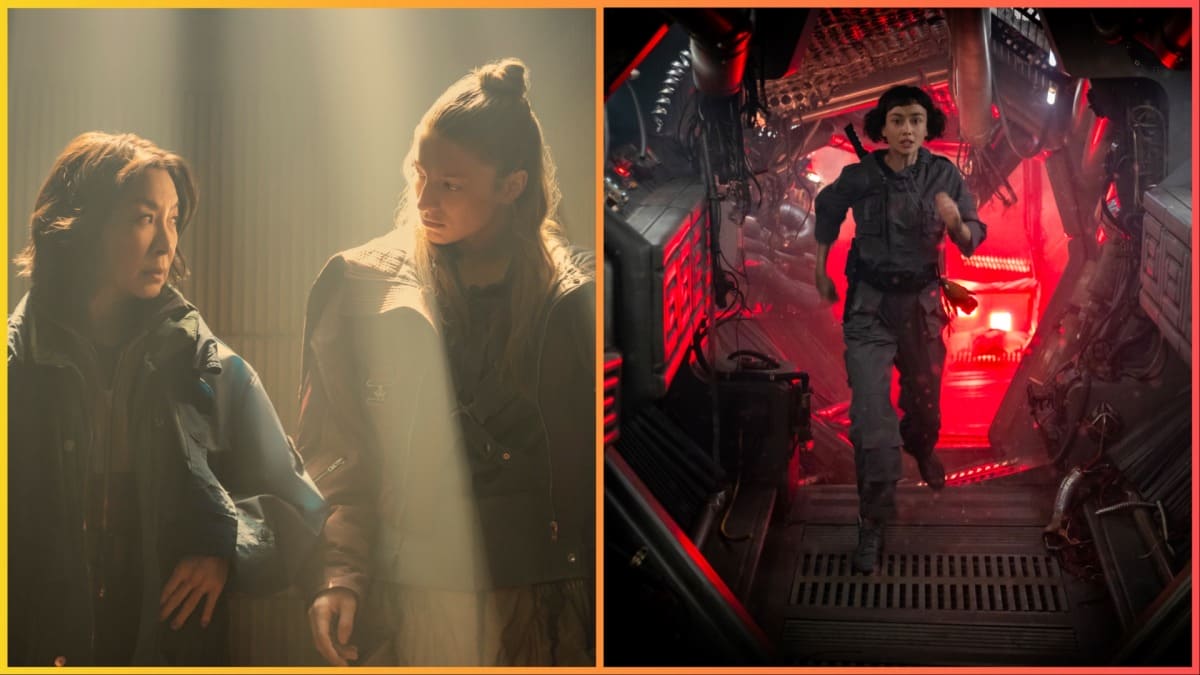
Prime Video’s Blade Runner 2099 is the latest expansion of something that’s coming to resemble a whole new type of media. Not the ongoing cyberpunk saga of conflict between humans and replicants that began with Philip K. Dick’s Do Androids Dream Of Electric Sheep?, or even the growing list of big-budget TV shows based on beloved movies of the past. No, Blade Runner 2099 is forging ahead in a more specific vein that was pioneered by Alien: Earth last year: Welcome to the dawn of the vibes-first Ridley Scott adaptation.
Both directed by Scott, Alien and Blade Runner are two of the most iconic, influential science-fiction movies of all time. Having both spun off their own franchise, they’ve proven that a story’s endurance in the cultural memory may not have much to do with the story itself. Various Blade Runner spin-offs and follow-ups carried the replicant-retiring torch in other media before the arrival of Denis Villeneuve’s Blade Runner 2049, but in the same time period, the movie received countless spiritual sequels in the cinematic dystopias, iconic anime, and entire genres of literature, music, and games influenced by its tone, textures, themes, world-building, sounds, and philosophical preoccupations—for lack of a better term, its vibes. The challenge for 2099 then becomes not just living up to its immediate predecessors but also standing out from a crowd of very successful imitators.
Now think about Alien as a franchise. The first film is a contained haunted house—a plussed-up B-movie, in Scott’s estimation—its strengths built off of the director’s efficient lens and H.R. Giger’s incredible biomechanical designs. The story itself is a much simpler machine. People find a monster, they’re stuck on a spaceship with it, the monster gradually kills them all. The weaker moments in the movies that followed are when too much of the backstory gets filled in and a story about space truckers and quarantine protocols turns into the origins of life itself. The stronger moments work because they’ve morphed into something else, like James Cameron’s balls-to-the-wall Aliens—per the title of that film, all Cameron had to do was pluralize the Xenomorph. Same cramped scares, just mapped onto the formula of an action movie.
At this point, if there’s something new to be done in either of these franchises, the key is all in the vibes. For Alien: Earth that means avoiding canon completely; to tell its story about Peter Pan-ing in artificially constructed bodies and justifying the “Alien” in the title requires all of the intangibles to be spot on. In the first-season episode “In Space, No One…,” showrunner Noah Hawley spends an entire hour faithfully recreating the events of the original Alien—just on the research ship whose crash kicks Alien: Earth’s plot into gear instead of the Nostromo. The way the camera floats through the hallways, the wardrobe (that incredible white uniform on Babou Ceesay’s Morrow!)—the episode ticks all the boxes I needed as a fan of the original. There’s trust there that the filmmakers behind the show understand what’s aesthetically alluring about Alien and why they’re still getting paid to tell stories within this decades-old container in the first place.
Blade Runner 2099, despite being a lesser show, seems to understand this as well. It opens with the same shot-for-shot energy as Blade Runner. The overblown blue lighting, the set design, the camera placement, the way the Tyrell employee attacks that cigarette—it all checks out. The vibes are a carbon copy of those in the film’s opening scene, where Leon takes the Voigt Kampff test. The design of the cityscape—with its massive digital billboards casting textured light onto the small cars flying past for scale—and the spirit of all the Douglas Trumbull photochemical wizardry from 1982 have to show up, or this wouldn’t be a Blade Runner show. We’re many, many years down the franchise’s timeline, but this vision of the future still seems as overwhelming as it was when Syd Mead first illustrated it.
When Blade Runner was released, it was a flop. Its notoriously bad voice over, phoned in by a disinterested Harrison Ford, and the “wait a minute this isn’t Star Wars” pacing led to a pretty forgettable introduction to the world. For years, the kindest words spoken about the movie focused on how it looked. It wasn’t until the release of a director’s cut in 1992 that it started to rise to “established classic” status. There’s a great story about the wrong print being sent to a screening in the early ’90s. It was a version of the film that was much better than the theatrical cut. It was allowed to simmer more, to linger in the intended uncanniness, unicorns and all. Blade Runner became great not because the story was more interesting, but because the vibes were allowed to become the star.Which is where 2099 starts to ignore Alien: Earth’s positive example. Its story, one of a search for more life for both humans and replicants, is about the same thing Blade Runner has always been about. This is Roy Batty’s “tears in rain” speech played out as an eight-episode streaming-TV season—albeit a gorgeous soaked-in-neon-dystopia eight-episode streaming-TV season. The broad thematic strokes and the macro story are the same as they were in 1982, 1992, and 2017, and Blade Runner 2099 offers some very direct references, —including a spectacular new use of the iconic reflective eyeball extreme close-up and a unicorn Easter egg within a minute of each other—but at least it stops short of continuing the same old micro story of Blade Runner Deckard and replicant Rachael. Though there is a moment in the finale that is a little uncomfortably on the nose on that final count, which fittingly proves this entire point. When Blade Runner 2099 gets too close to the Nexus Model 1 forebearer, it starts to fall short.
Ridley Scott created a world with Blade Runner that did all the heavy lifting. It’s a look and feel that creates an emotion. It’s grimy and wet, dark and full of hard shadows —but familiar just the same. His ability to craft a dystopianc Los Angeles that you could feel yourself in was the great contribution of the film. It wasn’t the story. After all, Blade Runner was an adaptation to begin with, —the nuts-and-bolts narrative of artificial intelligence’s relative humanity was already laid out in Do Androids Dream Of Electric Sheep? As with Alien, where claustrophobia and poorly lit corridors full of droning machinery, Scott creates an energy in the environment that’s worth imitating, more so than a story.
You might also compare Alien to Jaws. The story is practically the same. Greed leads to ignoring safety procedure which in turn leads to an isolated struggle against a force of nature. Steven Spielberg is no slouch, and you won’t find many that will argue that Jaws is anything less than expertly crafted. But how would you describe the atmosphere on Amity Island? The defaced billboard, the chalk drawing, Quint’s hat, the mayor’s suit—all iconic pieces of set dressing and wardrobe, but are there any unifying threads there that could be spun out into their own aesthetic? They weren’t quite enough to disguise the lack of Spielberg’s mastery behind the camera of any Jaws sequel, nor were they enough of a jumping off point for, say, inspire a Jaws spin-off series on FX last year. (Maybe they were enough to inform patches within Widow’s Bay‘s crazy quilt of horror references, but I digress.) So there is something unique to what Sir Ridley crafted with Alien and Blade Runner. It’s not the characters, the subject matter, or the genre either. It’s all vibes.


 Keep scrolling for more great stories.