Welcome to Random Roles,wherein we talk to actors about the characters who defined their careers. The catch: They don’t know beforehand what roles we’ll ask them to talk about.
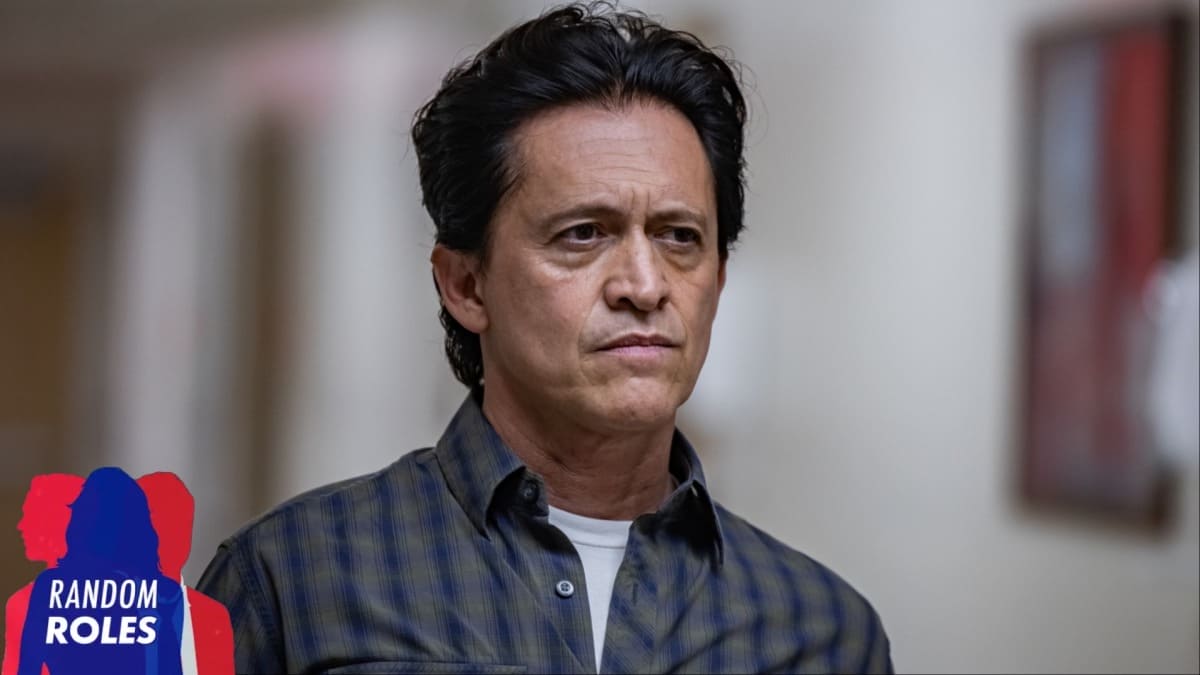
The actor: When Clifton Collins Jr. first started his acting career, he was billed as Clifton Gonzalez Gonzalez, a nod to his actor grandfather, the late Pedro Gonzalez Gonzalez. Nearly 40 years and over 100 roles later, the filmography he’s built under both names is formidable. Deftly bouncing between drama and comedy in both films and television, he’s worked alongside a wide array of co-stars from multiple show business eras: Robert Redford and James Gandolfini in The Last Castle, Sid Caesar and Howard Morris in The Wonderful Ice Cream Suit, James Van Der Beek in The Rules of Attraction, and even Frankie Avalon in The Stoned Age. Currently, Collins is part of the ensemble cast of Sterlin Harjo’s latest FX series, The Lowdown, where he plays Bob Thorne, the husband of Martha Plimpton’s Sheriff Vela Thorne, a man with an, ahem, killer chili recipe who runs a work-release program that may or may not be on the up-and-up.
This interview has been edited and condensed for clarity.
The Lowdown (2026)—“Bob Thorne”
AVC: How did you find your way into The Lowdown in the first place? Did they reach out to you, or was it an audition situation?
CC: I’m not really sure. A dear friend of mine, Zahn McClarnon, called me for Dark Winds. “Cliff,” he goes, “I’ve been wanting to work with you again sinceWestworld, and it’s not a big role. You know, we don’t have a lot of money…” I’m, like, “Okay, none of that matters to me. If there’s a bigger role, or if they could write it through…” He goes, “I’m not even sure if I’m gonna get to go another season.” I’m, like, “Well, sh-t, we’ll still get to hang out. Sign me up, dude. Sign me up, let’s go!” He’s, like, “All right, you sure?” “Yeah, I don’t care, let’s go! Let’s hang out, have some fun. It’s your show! If I can support that in any way, shape, and form, come on, let’s get down in Funkytown!” And then Zahn and Sterlin are friends, and… You know, I don’t know how this happened. [Laughs.] But I know that Sterlin sent Zahn a photo of him and I together, and Zahn went, “Copycat!”
AVC: The Lowdown is pretty dark in its own right. Very fun, to be sure, but certainly dark at times.
CC: Well, dark in its realness. And it gives me hope, truthfully, because… Man, so many of these shows just repeat and regurgitate the same bulls–t. And Sterlin is such a unique voice, the way he starts the scene, the way he enters the scene, and then to have a beautiful, collaborative, thoughtful, loving partner like Ethan Hawke…
There’s a scene with all these extras, and I was there, Martha [Plimpton] was there—and Martha’s a dear friend as well. I haven’t worked with her since the ’90s, and it was like not a day had passed. But I saw both Ethan and Sterlin ask all of the people in that scene to come over, and they were, like, “Look, we know you guys have been going through it, we know it’s hot here, and it’s muggy, and it sucks sometimes, but you guys are giving it your all, you’re bringing it all.” It was just a big thank-you and gratitude to all the actors just for working so hard, for being there, for being a happy spirit, a happy soul, fun to work together, and just being cool. And then Ethan ended it, like, “All right, first five kids get a selfie!” [Laughs.]
The Flash (1990)—“Javier O’Hara”
Freddy’s Nightmares (1990)—“Mickey”
AVC: I usually ask actors about their secret origins and how they got into acting, but I know you came by it honestly. Your grandfather rather famously made Groucho Marx laugh, and it’s on YouTube.
CC: Yeah, that brought Groucho’s ratings back up. Groucho’s ratings were taking a dive. You know, for most actors, even back then, the stigma of going to a game show was considered, like, “Okay, this is the end of your career.” But that wasn’t what it was for Groucho. He was really bored with the mundane humor, and You Bet Your Life gave him the opportunity to interact with the contestants and the audience. But he wasn’t getting a lot of smart people, so he’d reached out to Walter O’Keefe, who had a radio show called Double Or Nothing. He reached out to him and said, “You gotta find me something, they’re gonna pull me off the air.” And then he found my grandpa. Walter O’Keefe had him on the 1953 Cerebral Palsy Telethon, which O’Keefe hosted, and he called Groucho and got him on the show, and the rest is…… what you watched!
AVC: Since they were both the same year, it’s hard to tell if your first on-camera appearance was in an episode of The Flash or an episode of Freddy’s Nightmares.
CC: You know,Somebody approached me recently in Vernon, Texas and he goes, “Oh, I know you from somewhere…” And then he approached me about 15 minutes later and said, “Freddy’s Nightmares!” And I was, like, “Oh, my God!” [Laughs.] I was, like, “Oh, you’ve got a good eye. I need to keep an eye on you!” So to answer your question, I honestly don’t know! They’re very close, though. I had a bigger part in The Flash. And I was excited because I got to play a pachuco. I wore one of the actual outfits that Tony Plana wore in Zoot Suit. And I was really big into Chicano studies at that time. I was 19, still trying to figure out how to act. I mean, I’m still trying to figure it out!
You knowAs an actor, it’s fun to get your first day-player role, and on The Flash, they extended to two days, then they went three days, and then they bumped me to a weekly rate! I think they paid me something like $2,500 for the week, which was like a million dollars when I was 19. [Laughs.] And back then I didn’t have a manager, so I’m giving my agent 10%, and the government takes whatever they take, and then the rest is in my pocket. Woo! So it was a good time.
The Event (2010-2011)—”Thomas”
AVC: A friend of mine said, “Oh, I interviewed him for that, but it was before the series premiered, and he literally could not tell me anything at all.”
CC: [Laughs.] Well, that’s the showrunner’s fault. I wanted to say a lot of sh-t! There was one showrunner who said, “The secrets are only as good as the family that can keep them.” I was, like, “That doesn’t sound like a good motto. A family shouldn’t have any secrets if they’re a good family.” Maybe if you’re part of the Corleone family! [Laughs.] But that was amazing. And I got to work with dear brother [Jason] Ritter. My grandfather was friends with his grandfather, Tex Ritter. I adore Jason. Again, just a fantastic cast, and it sent me down so many rabbit holes. I’m sure my computers are all flagged, the sh-t I was researching, like “how to transport nuclear rods safely,” learning about cesium 132 and 137 and plutonium and all this other sh-t. The sh-t that I’ve had to learn. I’ve got a Masters in quite a few devious, nefarious techniques of doing things. Or who knows, maybe they’re heroic?
But I remember when they called me at Christmastime, we’d wrapped for hiatus, and they were like, “Hey, we just wanted to call you and tell you that in this next episode, we’re gonna kill ya!” “Oh. Oh, great, you’re killing me off one of the shows I’ve been the happiest on and bringing in all the gold.” “Yeah! Happy Christmas!” “Yeah, can’t wait to tell my family!” [Laughs.] And then we never even got to the actual Event! People were mad about that, boy. I’ll go to some of these signings, and they’re, like, “What happened?” I don’t know. Your guess is as good as mine. I’m dead, don’t blame me! Call those guys! Maybe they might have something to say!
Lucky (2026)—”Harris ‘Dutch’ Ocampo”
CC: Oh, I love me some Dutch. [Laughs.] I can’t speak more highly about the entire process and experience on Lucky, from the showrunners to the actors and actresses, my amazing stunt team, transportation, the craft service, Cliff the caterer… Just across the board.
And working with Annette Bening… My God, what a joy. I got beautiful mentorship, and she’s just a beautiful human. She’s just so special, so present, and so insanely talented. You know, Dutch is so stoic, and there’s only so many places that you can go with stoicism. And it doesn’t mean you can’t be innovative or creative or original, but there is—I don’t want to call it a box, because I think a box is too limiting. But there’s a certain creative world, so to speak.
And to watch Annette [Bening]… There’s a scene where she loses her son, and I’m sitting down very stoically at the table, and I’m her confidant/sometime assassin. [Laughs.] Y’know, “Ride or die, I got your back, come Hell or high water.” My loyalty is undeniably 100% bulletproof. Greg Yaitanes directed that episode, and at that moment when her son dies, he gave her this different direction for five different takes, and I watched Annette do just the most incredible, vastly different and varying takes. Five of ’em, from laughing maniacally to completely breaking down in tears to being completely enraged. And I’m just in awe the whole time. I’m on the other end when the camera’s on her, just going, “Holy f- -king sh-t…” And then Greg goes, “All right, everybody, time to turn around and do some coverage on Dutch,” and I’m, like, “Uh, why?” [Laughs.] “After that? What are you gonna cut to me for?” But it made me ask, “Can I find different ways of being stoic that are just as interesting that doesn’t upstage her?” Because that’s the last thing you want to do. You want to fit the mold and fit the world and contribute to it and within it. I hadn’t questioned the way I work in quite some time, and it was that moment that I went, “Oh!” I’m still thinking about it.
The Stoned Age (1994)—”Tack”
AVC: When I put on social media that I was going to be talking to you, I had a flurry of requests from people for what they wanted me to ask you about.
CC: The Stoned Age?
AVC: One person actually said I should spend the whole interview on The Stoned Age.
CC: [Laughs.] Love that movie. LOVE. IT. It was originally called Tack’s Chicks, but much like The Accountant, where people were, like, “I don’t wanna see Bernthal and Affleck do math!” [Laughs.] it was, like, “What, an IRS film about a dude chasing chicks?” I had a Harpo Marx wig… I remember my hair people were very adamant about having my wig stick, and they used gafquat. And every day after work, because they didn’t dilute the gafquat, I’d have to sit under the hot water for 35 minutes just for that sh-t to loosen up!
And I got to meet Frankie Avalon! He did a cameo in it. He sat right next to me, and I said, “Dude, my mom’s a huge fan.” He said, “Oh, is she?” “Yep.” “She liked all my songs?” I said, “Yeah.” And he started singing “Beauty School Dropout” a cappella right there as we’re in the makeup trailer. I was, like, “Oh, man, if my mom was here…” I didn’t have my cell phone on me, or else I would’ve called her right there and said, “Listen to this!”
Scott Pilgrim Vs. The World (2010)—”Vegan Police”
CC: What do I remember about that? I remember getting smacked in the face over and over by Thomas Jane. [Laughs.] I love Edgar Wright. Edgar Wright is so much fun to work with, just a ball of cinematic, fun energy. You know, between martial arts and tap and ballet and muay thai and all these other art forms and all kinds of weaponry I’m capable of and that I’ve been doing for a long time, [that scene had] just a simple little jump over the thing and a high-five… I think that might’ve been what took the longest: trying to get that high-five right. And it needed to be there.
I know [director] Edgar [Wright] loosely played with the idea of doing a Vegan Police spinoff for awhile. I don’t know where that went, but I think it’d still work today!
A Crooked Somebody (2017)—”Nathan”
M.F.A. (2017)—”Kennedy”
The Mule (2018)—”Gustavo”
AVC: You worked with Francesca Eastwood in M.F.A., and the next year you were directed by her dad in The Mule. An Eastwood double feature.
CC: You’re telling me! Ooh, that’s a loaded one. Francesca’s a dear, dear friend, obviously an ex-girlfriend…
AVC: Hand to heart, I did not know that. I just noticed the Eastwood connection and wondered if one led to the other.
CC: Oh, you didn’t? [Laughs.] Well, look, she could call me right now, and I’d be, like, “I’ll call you right back after this interview.” I love her to death. I’d do anything for her, and she knows that. And I just got done working with almost my ex-mother-in-law, Frances Fisher. I was just working with her two weeks ago, for the third time.
So I was wrapping [A Crooked Summer] with Rich Sommer and Ed Harris, and then Francesca calls me and says, “Babe, my lead actor who’s playing the detective dropped out!” I was like, “What’s gonna happen?” “I don’t know! We’re supposed to shoot tomorrow!” And I’m doing a night shoot, which means “tomorrow” is “today,” so I know where this is going, and you probably do, too. [Laughs.] So I was like, “All right, he’s a detective. How big is that first day of detective talk?” So I wrapped at 5 a.m. or something, because the sun was coming up, and I’m petrified, because it’s my girl, y’know? And it’s a major role. I’d already read the script, because we’d read each other’s scripts. So I’m, like, “God, it’s a great opportunity for her, and I’d hate for her to lose the opportunity because of this.” Because it’s kind of a dickhead move. In fact, not kind of. It’s a dickhead move. You don’t sign up for an indie and then bail on the dayof because you got a better opportunity. What kind of actor are you? Who does that? You’re trying to give people a gift and hopefully maybe some good work for yourself, but with new filmmakers and new actors and actresses… That’s not a real actor. So I said, “All right, babe, I’ll do it. Just please email the sides, and I’ll have production print it.”
So I worked all night, and then I’m literally driving from Elysian Park to one of the Long Beach colleges, which was a hell of a drive, and while I’m driving, I’m studying this detective jargon while also trying to fix some of it, because they didn’t have a technical advisor. I could tell by the writing. So I just wanted to tweak it a little, because I’d worked with enough detectives and done enough detective films that I always appreciate and revere all of my tech advisors. They’re so good at what they do, they care, they’re present, and they give you the things to make you look authentic and real.
I remember the director asking me, “You hear this girl screaming, and you’re on the campus. What would you do?” And I’m like, “Well, I think I’d have my firearm at the ready if somebody’s actually screaming in the moment.” She goes, “Well, that means you’d have to run with your gun out.” “Yeah?” “Well, do you know how to do that?” [Pauses.] “I’m Mexican. Of course I know how to run with a gun!” [Laughs.] And I said, “And I don’t know if you’ve seen my resume, but—not to brag—I’ve played a couple of cops. We’ll be fine! Trust me. Let me just do it. Let’s just shoot one, and if you don’t think it’s good, then we’ll do something else! Easy breezy!”
And after that Fran and I broke up, and then a year later, Clint sent me this beautiful script, The Mule, which I loved. Great cast. I got to be reunited with Lobo Sebastian from One Eight Seven, and Andy Garcia, who’s like a dear uncle and mentor. And Clint, he and I had hung out many times before, and he knew my grandpa. John Wayne was Clint’s hero, and John Wayne was my grandpa’s boss for, like, 13 years. So I read the original script for The Mule, and they said, “Okay, you’re not quite right for this role, but Clint’s gonna write you a role.” And I’m, like, “Write me a role? I’ve been broken up with Fran for a year. This sounds a little sus. Are they gonna have cartel techs?” [Impersonates Clint Eastwood.] “Hey, I need you to take a ride with Pablo. He’s gonna show you how to do the cocaine stuff.” [Laughs.] I just couldn’t wrap my brain around it. It was, like, “Writing a role for me? It doesn’t need a role! It doesn’t need another character!” But we had a lot of fun hanging out. Anytime I went to dinner with Clint and the family was just such a beautiful opportunity. He was so gracious and loving and just talking about old Hollywood, which were the stories I grew up with.
But it was a little nerve-wracking, because a dear, dear friend of mine does Clint’s makeup and has done quite a few films, he’s been nominated for Oscars and stuff, a Latino cat. But I’ve known him since the early days of his struggle. And he sat down and said, “Hey, Cliffy, I want to have lunch you.” I said, “How about dinner?” Because I was busy studying. And this cat said, “Just so you know, there’s a chance that Clint’s probably gonna have you do it in Spanish, even though it’s not written in Spanish.” And I said, “We gotta hurry up and finish dinner, ’cause I gotta get to my room!” [Laughs.] So I’m learning my lines in half-Spanish, half-English, all Spanish, all English, every other word Spanish, every other word English.
And he threw a couple of curveballs at some of the actors. [Impersonates Clint Eastwood.] “All right now, let’s do one in Spanish.” “Oh, uh, Clint, the scenes are all in Spanish.” “I know that. But you speak Spanish, right?” “Yeah, but, bro, I don’t speak that kind of Spanish.” “All right, well, let’s try to do it anyway.” “Yeah, but…let’s do it English!” And I didn’t want that to happen to me. So I got there, and Clint said, “You ready to do the scene, kid?” I said, “Yeah, you want it in English or you want it in Spanish?” And he just smiled me and said, “English.” So I did it once in English, and he says, “All right,” and he gave me some very beautiful, very simple direction, and he had me start it, and then said, “From here, do it in Spanish.” I said, “Great, let’s go!” So my rehearsal was my first take as well.
Tigerland (2000)—”Private Miter”
CC: That was a very special one. Joel Schumacher directed. It’s Colin Farrell’s first film, it’s Shea Whigham’s first film, and it wasn’t Michael Shannon’s first film, but he’s wonderful in it, as is Tommy Guiry. It was Neil Brown’s first film, and I think it was Tory Kittles’ first film, too. It just launched so many careers. And the wonderful Mali Finn cast that and discovered all these people.
There are so many great stories, but I remember Colin Farrell and myself are running behind what’s called a deuce and a half. It’s a 2 ½ ton transport vehicle where you can put a cover on it, and you can keep your men in the back. We were in trouble, so we had to jog behind it. Joel was, like, “Okay, Clifton, listen: This f–king deuce and a half is so f–king loud, I’m gonna really need you to give me a lot. You’ve just gotta be really f–king loud, okay?” And I was, like, “Uh, okay, but we haven’t even shot one yet, Joel!” “Look, trust me: It’s very loud.” I said, “How tight are we? It’s right here, Joel!” “Mr. Collins, you’re gonna tell me, ‘Less is more.’ I’m gonna tell you something, Mr. Collins: LESS IS F–KING LESS! I need more from you!” I said, “Okay, you little b–ch, okay. I’m gonna give you more.” And he’s, like, “Thank you. All right, girls, we’re running out of time! Let’s go! Run, run, run!” [Laughs.]
I kept my father’s military card in my pocket the entire time. And the crucifix I wear in the shower, my great-grandmother gave it to my grandfather to carry during World War II, and he would always make me stop by the house and pick it up whenever I traveled. And my uncle carried it with him as a medic the entire time he was in Vietnam. Grandpa got mad one time when I didn’t have time to stop to pick it up before I went to the airport. He got so mad at me! You know, superstition and folklore. If I’d die, he was gonna curse God for the rest of his life. So I got to use it in the movie. It’s one of those little actor tools that makes things more personal. And Tigerland was a very personal film.
Fortress (1992)—“Nino Gomez”
The Wonderful Ice Cream Suit (1998)—“Martinez”
CC: I miss Stuart Gordon. Me and Joe Mantegna were recently talking about him. Fortress was fun. I was 21, still learning how to act, going to Australia for the first time, for three months, right across the street from Surfer’s Paradise. And Stuart, he had done Re-Animator and all these other cool things.
And The Wonderful Ice Cream Suit, I’m working with some beautiful people. You know, Sid Caesar and Howard Morris are on set! I was taking any chance I had to hang out with them. And Stuart got his hands on Your Show Of Shows, so we got to watch that, and just to watch the timing between Sid and Howard and Imogene Coca, and then to have Sid and Howard on set…and even have lunch with them! Their comedy and schtick… It was constant. It never stopped. And it was the exact same thing you saw on the show. It was, like, “Oh, in real life you act like this, too!” [Laughs.]
And then Ray Bradbury would hang out on set! And every time Ray was on set, Joe would go, “Hey, Cliffy! Guess who’s on set?” So we’d go, and Ray would just share these wonderful stories, starting with how he wrote [The Wonderful Ice Cream Suit]. Because I was, like, “How does a white guy, the guy who wrote Fahrenheit 451, write this? And why is he writing this thing about these poor guys sharing a suit?” Because a young Latino family took him in when he was 19 years old and gave him food and clothing. And when he explained the heartfelt story, I was just enamored. And he was always like, “I love you as if you were my very own children!” And Eddie Olmos is there, he’s a wonderful mentor, and Esai Morales, another amazing big brother of a talent. But it was just fun talking to Ray. He’d talk about how he was unhappy with [the movie version of] Something Wicked This Way Comes, which I loved when I saw it in the theater when I was a child.
I was in constant awe. And I was very grateful to Joe Mantegna for educating me and teaching me the value of what it meant to be around a great like Ray Bradbury. Had he not done that, I wouldn’t have all of these wonderful stories, but I also have the admiration and gratitude for having had the opportunity to work with him on such an intimate level.
The Last Castle (2001)—“Corporal Aguilar”
CC: Wow. Bob Redford… And I don’t mean that disrespectfully. I mean it respectfully, because he kept telling me to call him “Bob,” and it was very hard. “Okay, Mr. Redford!” “No, Bob.” “Okay, Robert!” “Bob!” “Okay, Sundance Kid!” [Laughs.] Calling him “Bob,” I just felt like a disrespectful adolescent! Also James Gandolfini, rest in peace. I think I got the biggest lessons from him. And wonderful lessons collaborating with brother [Mark] Ruffalo, because he was coming off of You Can Count On Me, and I was coming off of Traffic.
It was on the heels of maybe the second or third season of The Sopranos, and the fandom of it, the phenomenon of it, had just started to happen. There was this place called the Bermuda Triangle, which was these three bars in Nashville and that’s where the “in” spots were. And I remember one Friday evening we were all planning to go have a good time, so me and Mark and Mike Irby and Sam Ball, we were all driving to these places in maybe two or three cars, and Jim and I were in one car. And we started talking, and we got on the subject of family, and my father’s suicide and the success of The Sopranos and the meanings of family. And he said, “Hey, kid, you know what? You wanna talk about this? F–k that, c’mon.” He pulls over. And we’re in a straight line on the road, we’re following people! But he pulls over, and he says, “C’mon, let’s talk.” “Oh, but we’re gonna lose Mark and…” “We know where they’re going. C’mon, let’s just talk.” And we sat and talked for, like, probably a good 45 minutes. Just parked there on the side of the main strip, with everybody passing us. And we had a really deep, beautiful, healing, loving conversation. And he says, “You good, kid?” And I said, “Yeah, I’m pretty good.” He goes, “Whaddaya say we catch up with the fellas and go have some fun?” “That sounds like a great idea. Let’s go, Jim. Let’s go!” I’ll never forget that. The compassion he had. And the dedication to his work at the same time. It’s not an easy thing to do.
Extract (2009)—“Step”
CC: Boy, I love the Judge. [Impersonates Mike Judge.] “Your dishonorable honor.” Yeah, I love him so much, man.
We had this funny moment where I’m like, “Hey, man, how are we gonna do this whole nut explosion scene?” [Judge] said, “Yeah, well, we’re gonna have, like, a chicken gizzard in there and a little bit of an explosive, and a stuntman. They’ve already done tests, and it worked really great. It’s gonna be great, man. It’s gonna be great.” I said, “Oh, cool, so we got a stunt man!” “Oh, yeah, man, definitely. Not your balls, Cliff.” I said, “Thanks, Mike!” [Laughs.]
I think I was rocking a 32 waist at that time, and my stunt man was 31. So one day I get a knock on my door, and I go, “Who is it?” “Wardrobe! Here, we want to see if these pants fit.” “Uh, well, I have these pants.” “Right, but these pants are a little different. They’ve got the squib for the chicken gizzard and stuff. They’re size 31s.” I said, “Right, for a reason: Because the stuntman is a size 31…and I am a size 32!” And Mike came to my trailer later and said, “Holy sh-t! Cliff, you don’t have to wear those at all, man! G-ddammit, I can’t believe they came to you and told you that! S–t! G-ddamn!” I mean, they’re my balls! [Laughs.] So I said, “Mike, if you think it’s safe, I’ll do it for you, man.” Sacrificing for the art! And it’s Mike. Mike knows I’d do anything for him.
Conversely, there was a moment when for some reason we had four days off, I can’t remember why. Zac Brown had a song called “Chicken Fried” that was climbing the charts, and Zac had called me and said, “Man, I’d really love for you to direct this video.” And I said, “Aw, f–ck, I’m on this movie. But I am kind of playing a redneck. It’d kind of make sense to go off and shoot a redneck music video…” [Laughs.] So I said, “Hey, Mike, I gotta talk to you in private.” And this is just to show you what a good friend he is and how dedicated he is and why I’d do anything for him: I said, “Hey, man, Zac just called and said he wanted me to direct and shoot ‘Chicken Fried.’” And he goes, “Holy sh-t, man! ‘Chicken Fried,’ the Zac Brown Band? Holy sh-t! Wow! When?” I said, “Well, it’s this four-day weekend that’s coming up, but I don’t want to ask the producers, because they’re gonna shoot me down.” He said, “G——it, you know what? F–k ’em! Go do it! I won’t tell ’em a g——ed thing. ‘Chicken Fried’! I love me some Zac Brown. Goddamn, yeah, go f–king shoot that music video!” And we ended up winning the CMT Award For Breakthrough Video Of The Year, and it put them on the map. I love Mike. He’ll do anything for you, but he won’t compromise his work to do it. He’ll just find ways to make it work. He’s a special dude.
The Rules Of Attraction (2002)—“Rupert”
Once Upon A Time… In Hollywood (2019)—“Ernesto The Mexican Vaquero”
CC: Okay, so they originally wanted me to read for the pretty boy, the one that Ian Somerhalder got. But I was, like, “Well, I’m not a pretty porcelain doll like it says in the screenplay.” [Laughs.] I just remember reading the screenplay, and I kept thinking, “G—–n, who the hell’s gonna play Rupert? That dude’s gotta have big ol’ donkey balls to play that role. He says ‘motherf–ker’ 25 times in one monologue! Who the f–k talks like that?” So I met Roger [Avary] and Greg Shapiro, who’s a great guy, and after I helped out with the table read—not doing Rupert!—they called me, and they were both very excited. “Clifton, Clifton, we wanna talk to you. We love you. Not for the other role, but for a different role.” “Which one’s that?” “Rupert!” I’m, like, “Oh, my God, that’s the scary role! Holy bejesus, I don’t know if I got big donkey balls, but…holy s–t!” And I thought the challenge would be worth it. And Roger, he was, like, “I wrote this screenplay 13 years ago, and I’ve been wanting to adapt it ever since.” So I spent—and I kid you not—probably five days nonstop, all day, running this monologue, trying to figure out what kind of cadence to use.
I did it over and over. I did it sober, I did it stoned, I tried it with a little bit of alcohol. Alcohol’s not a creative tool for me, so no mas. And finally I found a cadence that landed: Jules from Pulp Fiction. That was the way that worked. So when Roger asked me to perform it for him, we were out in the parking lot, and he said, “Let me see what you got!” And I did it, and he said, “I really, really like what you’re doing. I love it, in fact! You just… You bear a striking resemblance to somebody.” I said, “Well, duh: You wrote Pulp Fiction.” He goes… [Smacks his forehead.] “I forgot.” And I forget sh-t like that all the time, where you’re so deep in the forest and all that. But it was, like, yeah, you already adapted before and you called him Jules, and now you’re adapting him again, and you’re calling him Rupert! [Laughs.]
And I remember on Once Upon A Time… In Hollywood, QT was standing on the porch of this little production house, and Bill Clark said, “Hey, Quentin, you know Cliffy did that cool thing with Roger, The Rules Of Attraction.” He said, “What do you mean? I didn’t get to see it.” He goes, “Oh, you didn’t see it? They got that cool line where he goes, ‘I need you like I need an asshole on my elbow!” And then QT was like, “Wait a minute! What? What?! That’s the s–t my stepdad used to say to me! What the f–k?!” So he found out in that moment that Roger had used that line that his stepdad used to yell at Tarantino! [Laughs.] But they’re both awesome. They’re both legends.
Jockey (2021)—“Jackson Silva”
CC: Oh, yeah, that was very special. Clint Bentley and Greg Kwedar, I consider us a trilogy of brothers, the three of us, and they gave me a beautiful opportunity. They’re, like, “Clifton, you haven’t had a chance to play a great lead like we want to write for you, and we know you’re capable.” Which is so humbling and just a gift, truthfully.
I drove to Turf Paradise in northern Phoenix early to embed with the jockeys. And I drove because I was wrapping a different film, and I didn’t want to fly there because I wouldn’t have enough time to do the kind of prep I liked to do. So I figured that by driving I’d get a little bit of the lay of the land, so to speak. So I got there, and I was with the jockeys every single day, and while they’re doing rewrites and writing and location scouting, I’m gathering intel from the jockeys and certain key words that they use and situations. So we’d get together at night and go through rewrites and polishes and all this other stuff. We had a crew of nine, and we’re on a live racetrack, and none of our nine crew members is a horse wrangler. [Laughs.] We had no horse wranglers on a jockey movie!
But there’s certain indies you do when—truly, metaphorically and literally—the stars align. The first day of shooting was all of us on the field at night, and we saw a giant shooting star, and on our very last day, another giant shooting star. But every day there were inexplicable things. The horses coming in front of me? That happened by itself. But it was also written. That’s the trippy part. It was written that Jackson’s there, and a family of unbroken stallions go by me. But the day was ending, and we tried to get one shot, but the sun was behind me, and there were a couple of stallions that were jumping up and playing, and it was very far away. And it would’ve worked, push come to shove, but we’re just trying to see what else we can do. But you can’t chase down turkeys, and you can’t chase down wild, unbroken stallions. They hear you. Their senses are keen.
Well, I was walking, and then I remember squatting down, the sun’s starting to go down behind the mountains, and I’m there in my cowboy boots, watching the mayflies jump off the water, I’m skimming a couple of stones. Really, I just wanted to have a private moment and go, “Hey, SAG Gods, I really appreciate all the crazy, unexplained magic that happened these last four days on this seemingly impossible film to do. Not to be greedy, but if you could stick around for the next three weeks with the rest of the main actors, that’d be really clutch. If you can’t stick around, and these four days were just meant to teach me a lesson of what can happen and what can be when everybody’s here for the right reason, I’ve learned the lesson, I’m grateful for the lesson, and I promise I’m gonna give it my all every day, all the time, like we all have been.”
And then I heard this ginormous splash and nostril flaring as I’m looking down, and it’s very close to me. The water’s not that big where I’m at. And I slowwwwwly look up—and I look right into the eyes of this dominant white mare. And she was stomping the water. And I just looked at her, and she looked at me, and the whole world disappeared. And then she started to back up a little bit, I started to stand up a little bit, and then she turned around and went back to the place where she’d come from. I mean, she can do whatever the f–k she wants, I was in her territory! So I stood up, and I was, like, “If she comes to me, I’m going to parry left or right, and I’m gonna bareback her, because she’s gonna take me someplace magical.” I couldn’t think, “She’s gonna kill me, ’cause she’s got babies nearby.” That thought could not enter my mind. It was all pure love with a sentient being, and I’m in her neighborhood, not mine. I’m a Crip, she’s a Blood, and I’m in the Blood’s neighborhood, y’know? So we friends! [Laughs.]
So she started to go back, and I had this moment where I just kind of put my hand up, and I started to squat down again. [In the movie] you see her put her head down and her tail wag, and she drinks some water, and she’s looking up at me. And I just squat there. And she calmly turns back and starts to cross. And then unbeknownst to me, she’s got three little babies following her. And they walk right past in front of me, so calmly, so relaxed, so present with one another, like we were all a family. And I can’t turn around, because I’m present in this moment. Making a movie doesn’t even exist in my head right now.
I don’t know if they’re filming this, I have no way of knowing anything at this point except that I’m alive. [Laughs.] And then I went to go turn around, and, of course, [cinematographer] Adolpho Veloso had broken down the camera and was on his belly, pulling focus. And I’m, like, “Holy s–t, Adolpho, did you get that?” And he’s a very calm DP. He said, “Um, let me see. I think so. I think so!” And then the rest of the crew caught up, running, and my producer’s crying, my boom operator is crying. I was, like, “Oh, my God, did we get that?!” And we did.


 Keep scrolling for more great stories.