InCult Of Criterion, The A.V. Club highlights a new release from The Criterion Collection each month, examining the films entering an increasingly accessible film canon.
James Joyce’s short story collection Dubliners comes to a jarring close with “The Dead,” a novella-length stretch of familial holiday melancholy, issued from a twentysomething who’d just been confronted by his own mortality. Finished in the wake of an incapacitating bout of rheumatic fever, “The Dead” is a story with a young man’s preoccupation with death. When it was first adapted to film almost 80 years later, it was an old man’s final statement as he looked into the nearing void—the prolific John Huston directed The Dead from a wheelchair, and would not live to see its release. Joyce ironically frets in the present, a romantic quarter-life crisis brought on by sickness and poverty and ambition; using the same work, Huston memorializes lives lost or squandered far in the past, a personal elegy that’s as much reflection as adaptation.
This latter point springs naturally from the creative team that Huston surrounded himself with: Any adaptation where an ailing Huston worked with two sons and a daughter would inevitably become an intimate and revealing project. The Dead was written by his son Tony (briefly escaping the screenwriting slums of Curse Of The Swamp Creature and Mars Needs Women before he left the profession entirely), stars his daughter Anjelica, and had its second unit directed by his son Danny. The elder Huston, who helmed adaptations throughout his career (tackling everything from The Red Badge Of Courage and Moby Dick to Annie and the Bible), turned his final translation into a deathbed family farewell, an adaptation that—despite its closeness to the source material, finished as Joyce convalesced in 1907 on the eve of his daughter’s birth—was essentially colored by its octogenarian filmmaker’s 1987 reality.
But perhaps it would be impossible to make an impersonal film about milquetoast Gabriel Conroy (Donal McCann) taking his wife Gretta (Anjelica Huston) to the annual holiday party thrown by his elderly aunts Kate (Helena Carroll) and Julia (Cathleen Delany). There’s just something about the holidays, the family and friends, the snow on the ground, the big table and fine china and the rich cooking. It’s all so sweet it can reek of death. So nostalgic one can find their emotions eroded by the sands of time. For Gabriel in particular, as he floats through the traditional goings-on and rote conversations, placating a blathering old woman and rebuffing a critical Irish Republican, there’s a sense of detachment. This is present in Joyce’s story, colored with the kind of sadness that accompanies dread—the writer hopes he doesn’t ever become such a middling, apolitical, tepid man. But in The Dead, McCann and Huston imbue Gabriel’s nod-and-smiler with regret. His life has been lived, and any revelation gleaned by the end of the night is too little, too late.
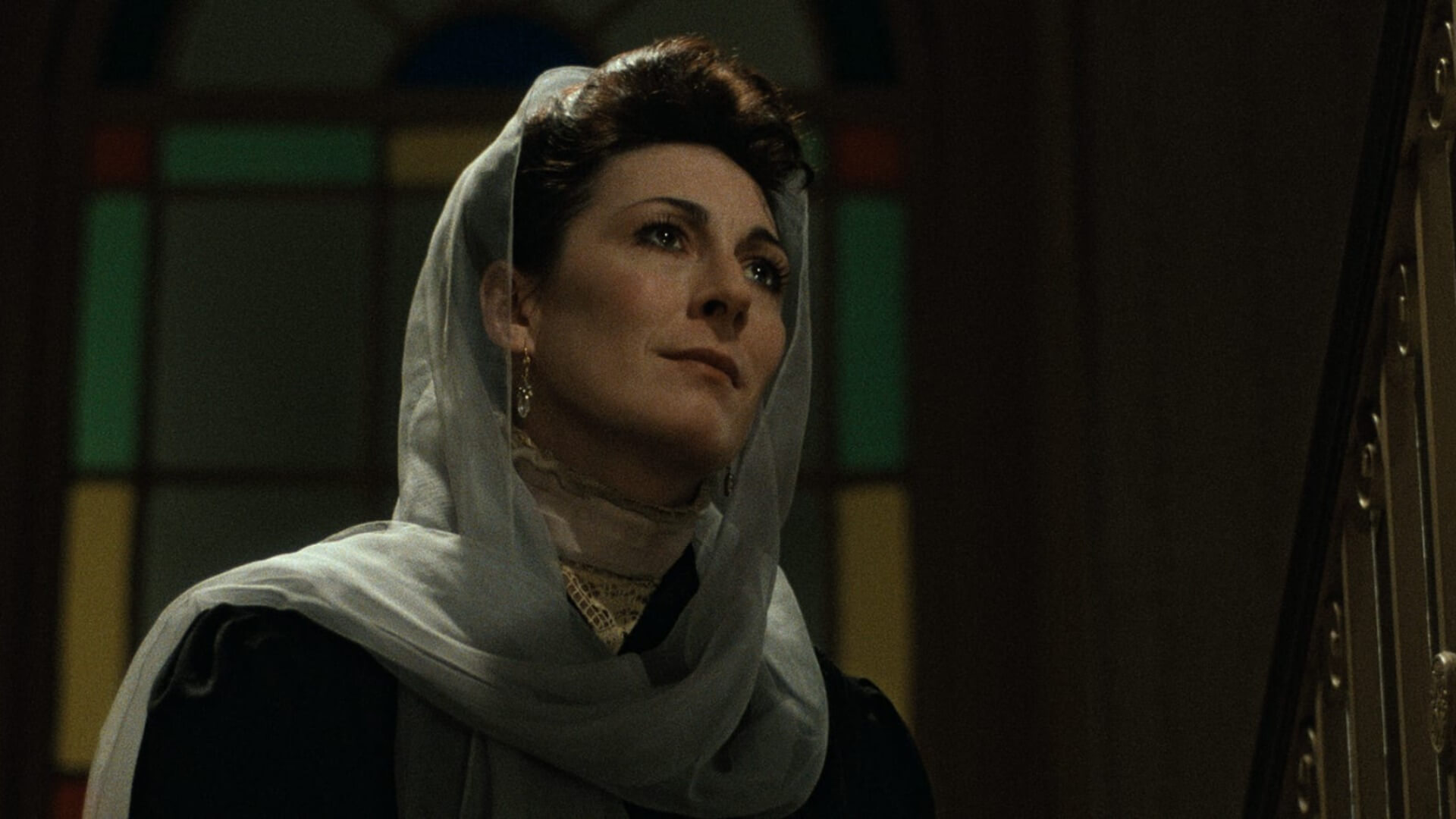
Gabriel wanders through the party—the conversation and atmosphere as alternatively prickly, awkward, warm, drunk, mean, icy, and geopolitically specific as one could hope for from Joyce—there is a dreaminess to the fidelity, one that lingers on endings. Gabriel’s drive through much of the film is his anxiety around the toast he always gives at dinner. Both this midpoint speech and his late-night musings, alone with his thoughts in the finale, inevitably return to the mounting age of his aunts. He envisions himself at one’s funeral, projecting himself as both mourner and mourned. Just as his wife holds onto the ghost of her past love—Anjelica Huston, showstoppingly poignant, is silently struck on the stairs by a song that still haunts her—Gabriel grasps at the ghosts of the near future, hoping to eulogize them appropriately in the present. Death is around the corner, and he knows it. There is a desperation to get ahead of it, to say what needs to be said and do what needs to be done. Julia’s brittle singing voice, flickering like a candle about to go out, is just the loudest and most direct sign of time’s cruel march.
But the most revealing piece of filmmaking is that which unfolds during her rendition of “Arrayed For The Bridal.” Fred Murphy’s meandering camera wanders the home’s halls and back rooms like a stranger browsing an estate sale. It considers all the little things left behind, distracted yet somber. Crossfades bleed into one another as slowly as the image navigates the spiraling stairs. If there are ghosts here, the audience might be counted among them. It’s here where Joyce’s immediate anxiety around the future, around age and failure and personal irrelevance, melt away. The same fate awaits us all, and Huston nudges us towards this through his lazy tour of the home’s memorabilia. The filmmaker still engages with the nagging question of legacy, of the effect one has had on those around them and the world at large—how could he not, at the end of such a storied career?—but that grows muffled under the snowfall, an equalizing procession that erases the world, scrubbing it out into a blank white canvas ready for all the artists yet to come.


 Keep scrolling for more great stories.