InCult Of Criterion, The A.V. Club highlights a new release from The Criterion Collection each month, examining the films entering an increasingly accessible film canon.
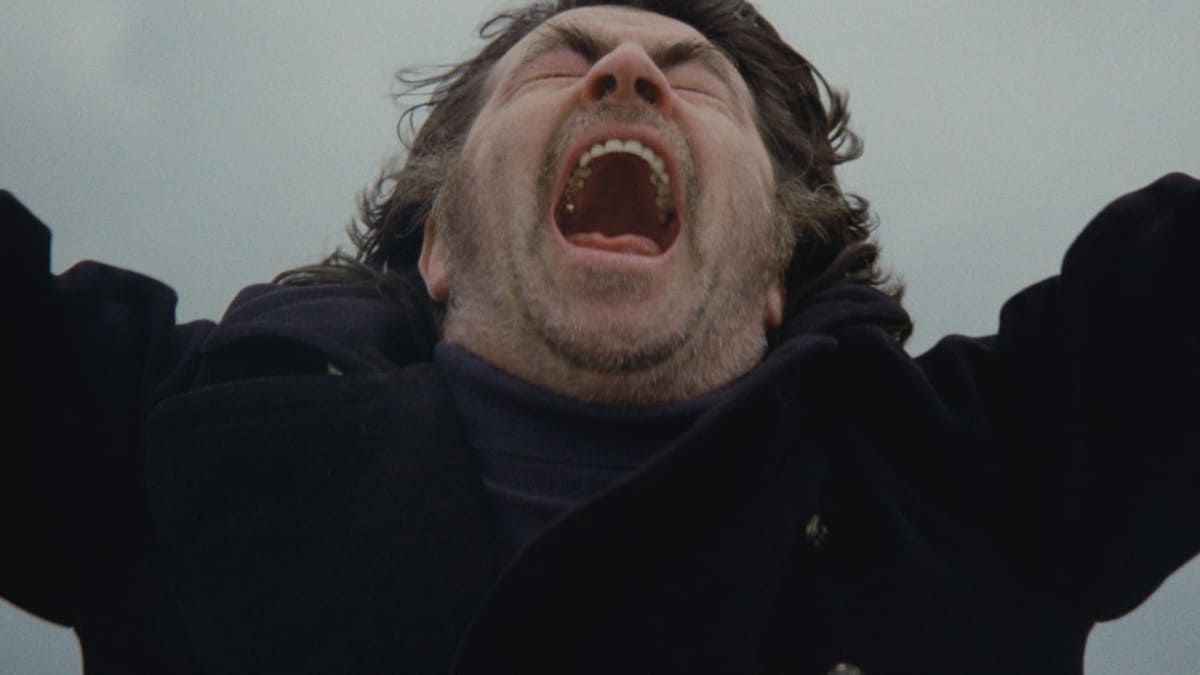
A psychosexual thriller about a drifter who claims to be able to yell people to death is surely one of the strangest winners of a prize at Cannes Film Festival. Of course, The Shout, from director Jerzy Skolimowski (EO), shared the 1978 Grand Prix with Bye Bye Monkey, in which Gérard Depardieu raises a baby chimp he finds being held by a King Kong sculpture, so equal evidence exists that the French were welcoming all comers, no matter how odd. But even that multilayered monkey business can’t hold a candle to The Shout, which presages the sound-forward horror work of Peter Strickland with a surrealist edge.
Based on a 1929 short story by Robert Graves (played here in a small role by Tim Curry), The Shout‘s nested narrative offers two possibilities for interpretation: Everything Charles (Alan Bates) tells Robert, while the pair help score a cricket match at an asylum, is true; or, the tale Charles spins about a fellow patient is simply the rambling fantasy of a sick mind. Either read keeps the tension found in the story alive—Robert and Charles are confined in a wooden wheel-away scorebox, its close quarters both a little dangerous and evocative of a confessional.
That wouldn’t be so pressing if Charles’ recounting of events wasn’t so harrowing and uncanny. From his vantage in the box, he points out Anthony (John Hurt) as he steps up to bat, then explains how the man lost his wife. Unsurprisingly, Charles is involved, and the whole thing is a nightmare of sexual power and mysticism. This all stems from the real-life throuple Graves was navigating at the time with his first wife, Nancy Nicholson, and their live-in lover, poet Laura Riding. It’s unclear, however, if Riding could scream in a specific way that would magically murder people.
Skolimowski picks up this fascinating, weird concept in his film’s avant-garde sound design, the oddball soundtrack by Genesis members Michael Rutherford and Tony Banks, and in the profession of his main character, Anthony, who is an experimental composer of electronic-influenced soundscapes. Oscillating in volume and often unnaturally linked with images, the sounds of The Shout unconsciously serve to make its audience think that, yes, perhaps noise could have some larger, damaging physical effect on us. For Anthony’s part, his music incorporates effects like wet marbles rolling in a pan, electronically modulated puffs on a cigarette, and flies buzzing as loud as jet engines. It’s Blow Out by way of Berberian Sound Studio, veering into the sensory strangeness of Flux Gourmet.
More conventionally, Anthony plays organ at the local church, is having an affair with one of the attendees, and has a staid relationship with his wife, Rachel (Susannah York). This relative normalcy exists uninterrupted until the two, dozing in the sun on the sandy North Devon coastline, share an ominous dream, from which Charles emerges.
Akin to its weirdo, countercultural ’70s peers, films like The Last Wave and Zardoz, The Shout exists in a spiritually rich unreality where magic is dead-serious business. In this corner of the lily-white British Empire, Australian Aboriginal practices are exotic, potent, and tangible; when Charles wanders up to Anthony babbling about the soul, it’s not long before the stranger confesses his long years spent among those people. It’s from them that he learned the ability to employ what he calls “The Terror Shout,” though his proficiency with other spells—like deadly bone-pointing (also found in The Last Wave) and voodoo-like enthrallment—becomes even more important to the film.
Bates, physically imposing and always leering in his dark greatcoat like an oversexed and unshaven Matt Berry, commands the film with a Cape Fear-like power. Violence surrounds him like an aura while he pushes past social niceties and entrenches himself in Rachel and Anthony’s home. Hurt shrinks, feeble, from this power, while still displaying some of the same attraction that consumes York’s performance. Both seem like they might get seduced by their houseguest, but it’s Rachel whose bloodshot eyes and enraptured body language totally succumbs to his (perhaps literal) spell. Juxtaposed with this horny horror are off-putting freeze-frames, jagged cutaways, and unsettling background images, like a print of Francis Bacon’s screaming Head VI sitting among the oddities in Anthony’s studio. Even that haunting painting, however, couldn’t kill.
It all adds a dreadful heft to a film that can otherwise drift into silliness (“Get out of here, Anthony, or I’ll shout your bloody ears off,” Charles threatens), classical reference (Anthony, aiming to hear the shout for himself, plugs his ears like Odysseus before the Sirens), and hallucinatory absurdity (there is, eventually, a lot of talk about cobbling). But Skolimowski is invested in the upsetting idea that something out there might exist that is so fascinating, so alluring, that it draws you in despite being obviously destructive. That might be a professional fixation, a foolish infidelity, or something even darker. In The Shout, it all blurs together, the follies of desire and the comeuppance sure to follow.


 Keep scrolling for more great stories.