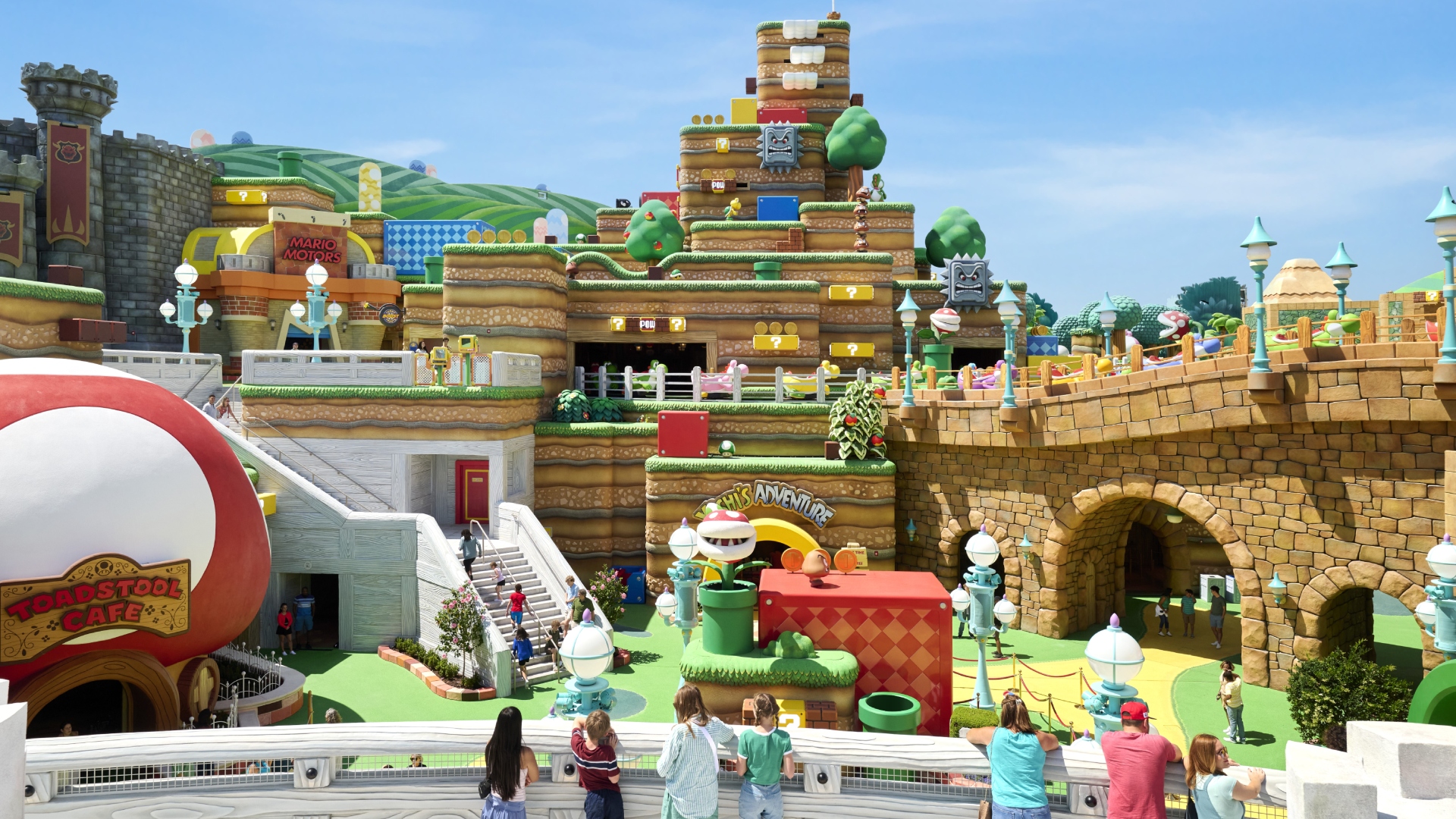
2025 was Epic Universe’s year. Universal’s newest park, and the first new American theme park from either of the industry’s two biggest players since 2001, opened in May after years of hype and anticipation. It’s a great park, full of world class rides and immaculately designed spaces, and its greatest achievements—the chaotic dark ride Monsters Unchained, the interactive experiences in Super Nintendo World, the immersive architecture and world-building of the Isle of Berk—set new standards for theme parks. But for some theme park fans, Epic Universe represents the culmination of something they’ve dreaded for years: intellectual property’s total victory over original theming.
Two things can be true about Epic Universe. Its individual lands show the best possible way to turn popular movies and games into living, breathing, transportive physical spaces—and, despite that, the park as a whole feels a little hollow due to the lack of a clear overarching theme or signature original creation. It’s a collection of amazing experiences built on presold concepts with a hole at its center—a hole that has a name (Celestial Park), a barely sketched cosmic concept, and an incredible roller coaster, but that feels both aesthetically and practically like the public space at an outdoor shopping mall. As we wrote after the park’s opening, Epic Universe comes off as a post-theme park—one that seems to argue that an overriding theme isn’t really necessary as long as a park recreates IP as impressively as possible.
Disney added more fuel to that fire this year. The industry’s overwhelming fixation on IP also led to a dramatic, almost unthinkable change at Disney World: a crucial part of the Magic Kingdom since day one was closed permanently to make way for a Cars ride. Disney scrapped the Liberty Belle Riverboat and Tom Sawyer Island this summer and drained the Rivers of America, gutting Frontierland, getting rid of most of Disney World’s cool fake caves, and discarding what have been key pieces of the park’s identity as long as it’s existed—and which have helped define Disney’s so-called “castle parks” since Disneyland opened in 1955. Disney concocted a backstory for the Cars ride that tries to tie it to the theme of the two lands this space borders, explaining that the new ride will take passengers on a tour of national parks that starts on the east coast of Liberty Square and ends in the wild west of Frontierland. They made an effort to keep the new project on theme, but it’s a bit like forcing a puzzle piece into the wrong spot.
IP isn’t new for theme parks, of course. It’s been a cornerstone of the business for about as long as theme parks have existed. When Disneyland opened in 1955, Fantasyland boasted a number of rides based on Disney movies, and Frontierland was full of references to Disney’s then-new TV hit Davy Crockett. Tom Sawyer Island itself is obviously based on a preexisting novel that most visitors in 1955 would’ve been familiar with—although there’s a bit of difference between referencing an enduring (if controversial) literary classic that had a deep impact on American culture and a corporately-owned cartoon about talking cars that’s been popular for a couple of decades.
IP was just part of what made Disney’s parks popular, though. For decades Disney also created new concepts for its parks, and themed lands not after specific properties but broad concepts or specific real-world locations. Pirates of the Caribbean was a ride first, decades before it ever became a movie, based in a part of Disneyland themed after New Orleans. The Haunted Mansion, Space Mountain, Big Thunder Mountain Railroad, and It’s a Small World were all created for the theme parks. EPCOT, Disney’s first non-castle park, opened in 1982 without any preexisting IP whatsoever. Disney’s commitment to theming reached its apex with the 1998 opening of Animal Kingdom, where every detail was designed to reflect the park’s nature and ecological themes, with a show based on Pixar’s A Bug’s Life as the only IP-based attraction.
Universal’s commitment to theming and original concepts was never as strong as Disney’s. When it opened its second Orlando park, Islands of Adventure, in 1999, it at least tried harder than it has with Epic Universe, with two heavily detailed lands that weren’t based on specific properties. Even those marginal efforts came to an end after the massive success of the Wizarding World of Harry Potter, whose first outpost, Hogsmeade, opened at Islands of Adventure in 2010. Since then both Universal and Disney have focused almost exclusively on building rides and even entire lands themed to specific properties—Star Wars, Avatar, Minions, The Simpsons, more Potter. At their best these spaces are spellbinding displays of architecture and design, but as amazing as it can be to see movies and shows you love turned into a real place, it’s all a little uninspired. It’s emblematic of the larger flattening of culture—of our franchise-mad entertainment industry regurgitating the things people are proven to recognize and enjoy instead of creating something new. The truly new experience once expected from Disney’s theme parks is long gone, replaced by the comfortable nostalgia and corporate synergy that Universal built its parks around.
If you believe thematic cohesion and original concepts are vital to a good park, you’re best served looking beyond the big two. Dollywood’s latest expansion, 2019’s Wildwood Grove, has a detailed backstory that ties its attractions together and reflects the local culture of the Great Smokies; it’s already received one major update with the 2023 launch of the Big Bear Mountain roller coaster, and in 2026 Wildwood Grove will welcome the largest project in Dollywood’s history, the coaster/whitewater hybrid NightFlight Expedition. Mexican luxury resort brand Vidanta expects to open VidantaWorld’s BON in Nuevo Vallarta in late 2026, with a roster of attractions that evoke Mexican culture instead of popular movies. IP is bricked into the very concept of Legoland, but the constructive, open-ended nature of the toy is reflected in the approach the theme parks take to their attractions. Sea World’s push into a greater emphasis on rides instead of animal shows has resulted in a number of new attractions based on original concepts, and smaller parks that can’t afford to license popular properties often have to get creative with their ideas. They might not be able to match the extreme budgets of Disney or Universal, but parks like Dollywood and Sea World prove there’s still space for original theming in today’s theme parks.
Hopefully those smaller parks can continue to grow and innovate despite a flagging economy. The signs aren’t especially great: Six Flags has struggled greatly since its 2024 merger with Cedar Fair, closing one park this year, announcing the closure of a second when its lease expires, and publicly revealing that they’re actively looking to close or sell off other underperforming parks. Meanwhile one of the two major players might have those regional parks squarely in their sights: Universal is branching out beyond Orlando and Southern California, launching a year-round Halloween Horror Nights-style attraction in Las Vegas earlier this year, and opening the Universal Kids Resort in Texas in 2026. That park’s lineup will be dominated by IP, naturally.
Again, preexisting IP isn’t inherently a problem. It’s always had a place in theme parks. But when it becomes the entire place—as it basically does in Epic Universe—the charm and magic you expect from a theme park wears off a bit. There’s nothing epic about commercials, and that’s what a day in a Disney or Universal theme park can feel like now: living, breathing, immersive ads for their upcoming sequels and remakes.


 Keep scrolling for more great stories.