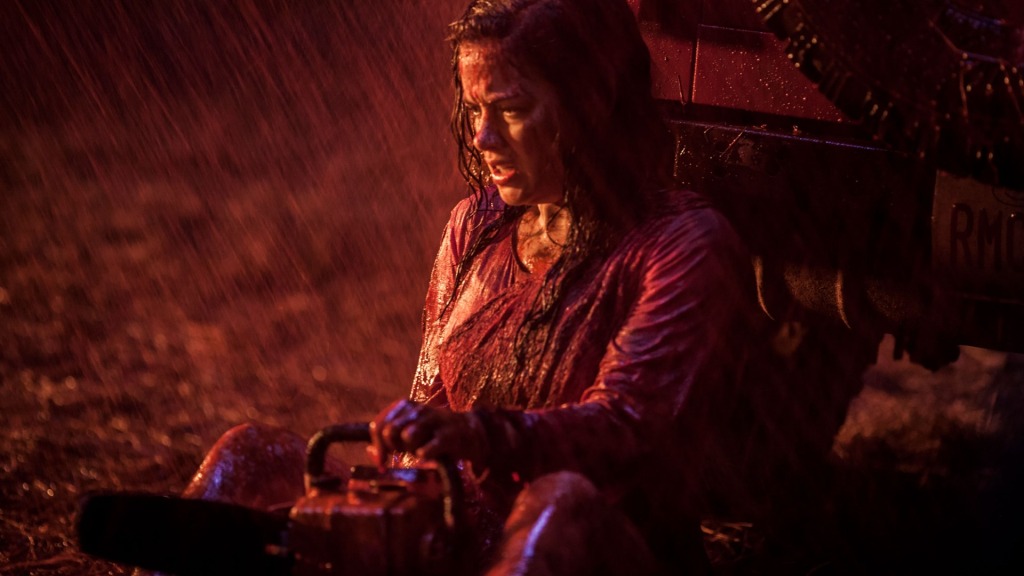
That helped Álvarez’s 2013 remake stay loosely faithful to the original Evil Dead (including the infamous tree scene), but he made it his own by changing the reason these friends venture out to the woods. This time, it’s to detox their friend struggling with drug addiction, and her erratic withdrawal symptoms initially mask her possession by a demon. As the demonic possession spreads like a virus, Álvarez’s film quickly ups the ante on bodily harm, showing off Saw-like injuries as the demon makes characters burn themselves, carve up their own face, stab another with a needle near their eyes, or in an effort to escape, take a machete to the knee or tear off one’s arm. Although Álvarez’s short features no main characters, it does feature the same kind of encompassing, all-hell-breaks-loose chaos—which here meets a similarly destructive conclusion, featuring a blood-soaked chainsaw and a torrent of red rain.
Instead of following the characters from the remake, the next installation, Evil Dead Rise, was a standalone film from Irish director Lee Cronin. After a series of shorts, Cronin broke out with 2019’s The Hole In The Ground, a suspenseful mystery where a mother begins to doubt that the little boy who lives with her is her son. The house where the son and mother live is in a remote area surrounded by a large forest, not unlike the cabin in the woods of many of the Evil Dead movies. Already, Cronin is playing with some of the domestic tensions also in the Evil Dead movies, where demonic possession turns loved ones against each other. While The Hole In The Ground is not as juicy as the gore-filled Evil Dead films, there’s enough to hint that the director would be up to spilling buckets of fake blood.
That opportunity would come the following year. Riding the Sundance wave with The Hole In The Ground, Cronin began working with Raimi on a new Evil Dead story, which the filmmaker first teased on Reddit. Before that film came to fruition, though, Raimi invited Cronin to work on his Quibi anthology show 50 States Of Fright. Cronin helmed the two-part story “13 Steps To Hell,” which followed a grieving family unwittingly walking into a curse in a cemetery. The split short lays the groundwork for Evil Dead Rise, as that family happens upon the Book Of The Dead and some deeply cursed records below the parking garage of their building. Further, while previous iterations of Evil Dead mostly cast adults as the victims of demonic possessions, Cronin put kids in the crosshairs. Like in The Hole In The Ground, children were not safe from violence, and could, thanks to the supernatural, wreak some gnarly havoc of their own. But of course, this bloody family affair comes to an end thanks to a chainsaw, until the next victim arrives.
If the work of Cronin’s Evil Dead successor, Sébastien Vaniček, is any indication, the spilling of blood and guts will continue until morale improves. The French director’s previous film, Infested, is quite possibly the most disturbing audition film of the revived Evil Dead trio. Set in a state-run housing complex, one young man’s obsession with spiders accidentally unleashes a mutant arachnid that rapidly multiplies and attacks residents throughout the building, unassisted by authorities who have abandoned their neighborhood. The body count is high, the kills become increasingly more creative as the spiders grow in number and size. For the arachnophobes among us, it might be some version of hell. It’s also a monster movie with a social message and plenty of kindling for nightmare fuel, like spiders bursting out of walls or under the furniture.
It’s easy to see what attracted Raimi to Vaniček’s film, as Infested had many of the hallmarks of an Evil Dead premise: a group of friends/relatives stuck in a claustrophobic scenario they can’t escape as dangerous forces creep closer and closer, thinning their numbers. The trailer for Vaniček’s Evil Dead Burn hints that the story, while different from Cronin’s Evil Dead Rise, will once again focus on a family torn apart by loss and about to get besieged by Deadites. The violence is wince-inducing, with one character drinking melted wax, one landing on a pile of knives, and another possessed figure’s rigor mortis movement looks right at home with the rest of the franchise. Vaniček looks like he’s returned the series to the woods and, with a bigger budget than his previous film, intensified the gore with plenty of close-ups of burning flesh.
Each incarnation of Evil Dead takes the series in wild and unexpected directions. From The Evil Dead to Evil Dead II, Raimi developed a horror-comedy that was gruesome and disturbing yet wickedly twisted. The next entry, Army Of Darkness, took its main hero’s battle to a new dimension. While these latest iterations have returned to the earthly realm, each new director has taken a different approach to the lore, the aesthetic, and the rampant bodily harm while keeping a few mainstays of the series intact: gallons of blood, a dash of campy flair, and a free-floating camera searching for its next victim. Like the song example given by Raimi, the Evil Dead series is in the hands of the next generation of filmmakers, who, like DJs, sample and remix familiar beats until something unique to their sensibilities crawls out. The classics will always stay golden, but this is the rare franchise that views those classic elements as the basic tools for the new kids on the block.


 Keep scrolling for more great stories.