By the time Deltarune is finished, its best version will already be gone

Toby Fox's Undertale follow-up draws a healthy chunk of its narrative power from its status as an unfinished story.

By the time Deltarune is finished, its best version will already be gone

I like to play unfinished games. I suspect that says something about me—a disproportionate focus on novelty, maybe, or a deficit in delayed gratification skills—but it also says something about the games. Serialization came late to the world of gaming, brought about mostly by the internet, and now we all live in a world where “true endings” arrive in patches months after release, narrative satisfaction delivered like just another update to weapon balance. I get the frustration this engenders, the sense that you’re being sold a story piecemeal. (I’ve also read enough comics to deeply feel the way infinite serialization, adopted in gaming with the “seasonal” model that recently lost one of its great champions with Destiny 2, can rob stories of any sense of an actual climax or conclusion.) “I’ll play it when it’s actually done” is just as relatable a sentiment as “I’ll play it when the bugs are all patched out.” But, nevertheless: Damn, do I love playing an unfinished game.

These thoughts brought to you, unsurprisingly, by a new chapter of Toby Fox’s Deltarune, now well on its way to being one of the most impressive serialized stories in modern gaming. Fox’s follow-up to his landmark indie hit Undertale presumably embarked on its status as a serve-as-you-go story at least partly for fiscal reasons: Undertale sold ridiculously well, sure, but probably not well enough to subsidize eight full years and counting of ongoing development; releasing the game’s first four chapters (two that had been released for free in 2018 and 2021, and then two new ones) as a paid product in 2025 presumably helped fuel some of the stupidly ambitious ideas that each new Deltarune installment arrives with. (To say nothing of funding the much-expanded team Fox now works with to make each chapter.)

But regardless of its financial benefits, the serial approach has also become fundamental to my understanding of Deltarune as a story. Set in a small town where two kids discover a magical kingdom lurking inside their school’s supply closet, Deltarune takes as its macro structure the mystery story. Sure, each new chapter runs the player through a fairly complete narrative, centered on certain formulaic elements—usually taking the form of an extended trip through a “Dark World” based on prosaic “real” locations like the family TV room or the local church—but Fox is deliberately playing a much longer game with what any of it actually means, including how the hell this story relates to Undertale’s, besides seeming to reimagine many of its characters in subtly different roles. 

The steady drip of new information—prophecies, intimations of dark forces, and above all else the increasingly unsteady and unsettling relationship between the player and Kris, the character they’re very literally taking control of within the story—serves as a mind-occupying lozenge for me to suck on during the multi-year gaps between installments. (That pace has accelerated, by the by; after a three-year pause between Chapters 1 and 2, Fox and his team have now released three chapters in the span of two years, with the penultimate installment slated for 2027.) Undertale proved that Fox had a gift for burying dark and ambiguous stories beneath far more straightforward and cheerful ones, and teasing out the ugly bones lurking underneath the perky smiles is a fantastic way to keep the mind occupied between episodes.

At the same time, the gaps also serve Deltarune’s mechanical interests. The game’s formulaic nature—town scene, Dark World, town scene—can occasionally leave things feeling a little too repetitive, the mechanical improvements between chapters less sharp or radical. (Jumping from Chapter 1 to Chapter 5 will serve as a stark illustration of how much more complex the game’s bullet hell take on RPG combat has gotten, but it’s been a game of steady improvements.) Coming back to it fresh, on an annual basis, helps shake off some of those blues, and makes the moments when the game takes a huge, ridiculous swing—as with one of the big marquee moments of Chapter 5, which had me laughing out loud at how much effort Fox and his team had gone to to introduce the chapter’s flagship character—land even harder. 

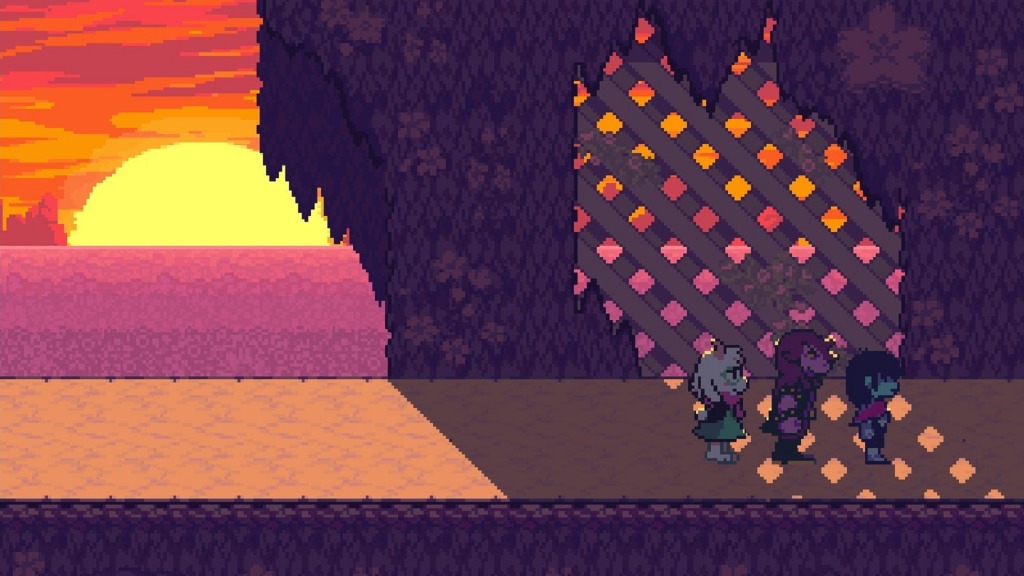
Even more than that, though, these enforced breaks have evolved my tonal relationship with this story. Deltarune is a game at least in part about longing, with many of its best moments and relationships channeling the late summer sensation of lengthening shadows, as joyful times with friends give way to night. Having to bid its characters farewell every year—and Chapter 5 is absolutely brutal on this score—forces me to not just see but embody those feelings, a wistfulness that informs everything else I think about the game. Handled properly, serialization isn’t an attack on climaxes so much as a celebration of them; every time I say goodbye to Kris, Ralsei, and Susie, I get a reminder of all the ways the game is about something joyful and childlike steadily slipping away.

Which is, of course, also the fate of everything I’m writing about here. One day, Deltarune will be complete, and everyone who comes to it will be able to binge all seven of its chapters in one massive gulp. (Barring the kind of self-discipline us instant gratification folks can only dream of, of course.) The game will still be good at that point, a funny, mysterious, occasionally terrifying ode to the power of imagination. But while the “Play it when it’s finished” types are celebrating, I’ll have a certain measure of sadness in my heart. Something unique—the unfinished Deltarune—will have been lost. And I do love an unfinished game.

 
Join the discussion...
Keep scrolling for more great stories.