This article discusses plot points from the latest episode of House Of The Dragon and the later seasons of Game Of Thrones.
It happened at last: Rhaenyra Targaryen, the first woman to be named heir to the Iron Throne, has taken her rightful seat. The ascension has felt preordained from the beginning; after all, she’s the series’ clearest protagonist and point-of-view character, unjustly denied power following the death of her beloved father, King Viserys I. Still, the possibility of the self-proclaimed Queen Rhaenyra and her faction (a.k.a. the Blacks) successfully taking back King’s Landing from her half-brother Aegon II felt far off, especially during the sluggish second season. But at the end of last week’s appropriately titled “Queen’s Landing,” she finally did it: flew to the capital with her husband and two other dragonriders, arrested Aegon’s supporters (a.k.a. the Greens), and took the Throne. Who knew it could be so easy?
Of course, Rhaenyra achieving her greatest fantasy shortly after the halfway point of this series doesn’t bode well for her longevity as a ruler—suspicions any reader of the show’s source material, George R.R. Martin’s fantasy history Fire & Blood, is surely happy to validate. Few of the characters on House Of The Dragon are likely to survive the Dance Of Dragons, a war of succession destined to weaken House Targaryen and leave dragons nearly extinct. There are no true “rightful rulers” in this universe, no matter whom Viserys wanted as his successor. There is no ethical way of taking and maintaining power in Westeros, only force. That’s how the Targaryen dynasty came to be in the first place: Aegon The Conqueror wasn’t exactly a pacifist, and Rhaenyra doesn’t have a clean slate, either
But it’s in this week’s episode, “Rhaenyra Triumphant,” that it becomes clear just how in over her head Rhaenyra is. This is a woman who has spent her life believing she was meant for this, that she and her father both had the realm’s best interests at heart. But actually sitting on the Iron Throne to listen to the concerns of the smallfolk is a lot easier in theory than in reality, especially with a depleted treasury making it nearly impossible to allocate funds where they’re needed. Staring out the window while her advisors enumerate all the issues that need addressing, Rhaenyra shows how little she’s thought about the practicalities of ruling the Seven Kingdoms. All she can focus on is getting a bigger, more official coronation than Aegon.
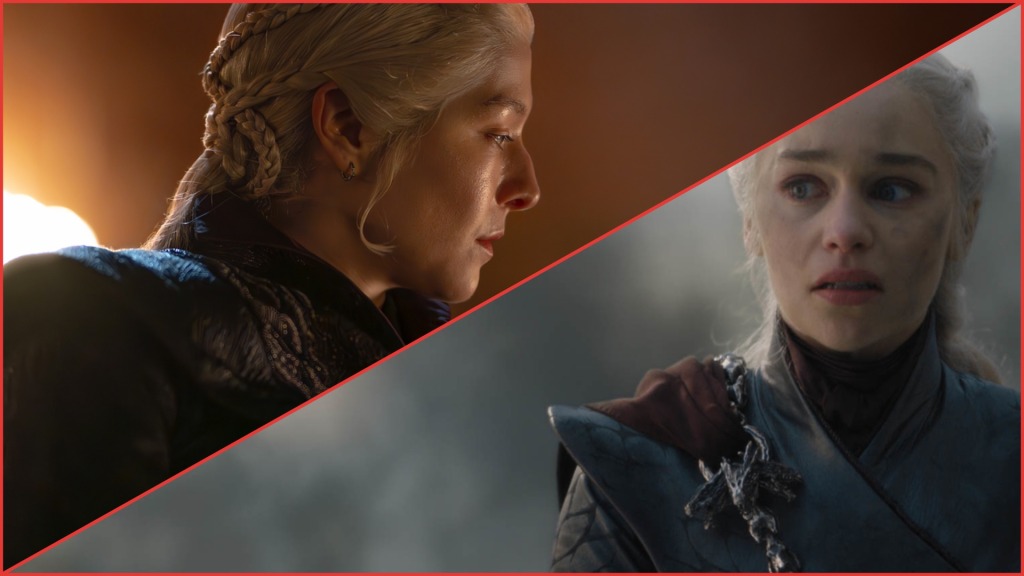
It all recalls the journey of an even more famous Targaryen: Daenerys, one of the biggest heroes (and then arguably the biggest villain) of Game Of Thrones. She too was a well-intentioned queen-to-be who risks losing herself in the pursuit of her perceived birthright, resorting to endless bloodshed and forgetting what she told herself she was fighting for—although House Of The Dragon’s take on this story of power and pride is more coherent and streamlined. In fact, in light of the negative reception to Daenerys’s heel turn at the end of Game Of Thrones, House Of The Dragon feels like it’s attempting a do-over with Rhaenyra.
The defining moment of the Game Of Thrones final season is also the most shocking and most unearned: Daenerys raining hellfire upon King’s Landing after the city surrendered to her, “liberating” the people under the weak pretense of establishing a better world. She lost her mind, to put it simply, continuing the cycle of her Mad King father and necessitating a tearful assassination by her nephew and lover, Jon Snow. And while Dany’s desperation to hold onto power was easy to understand, her behavior overall—her paranoia, and her jealousy of Jon—felt rushed and out of character. Power corrupts everyone, sure, but Game Of Thrones didn’t properly build to this particular conclusion.
That’s not to say there wasn’t any foreshadowing that something like this would happen, both in the show and the books it adapted. Daenerys’ story has always followed the traditional beats of a hero’s journey, but with a gleefully vengeful and gender-norms-subverting twist. As Game Of Thrones progressed, her thirst for justice became more brutal, like when she crucified 163 Great Masters in return for the crucifixion of 163 slave children. Burning Samwell Tarly’s father and brother to death in season seven also wasn’t her finest moment.
Yet for most of its run, the show painted Daenerys’ actions in a heroic light. In season one, she was a submissive and fearful teenager, learning to resist her brother’s abuse and see herself as a leader instead of deferring to the men in her life; for the next few seasons, she honed her skills at conquering and razing, applying her strong moral compass in merciless wars against the slavers of Astapor, Yunkai, and Meereen. It was almost always easy to support the massacres she orchestrated.
Yet those cathartic storylines couldn’t disguise a faltering dramatic engine. Unpredictable and unsparing as Game Of Thrones could be, it was clear Daenerys wasn’t going to fall at the hands of some minor villain on the long journey back to Westeros. But the show couldn’t pull the trigger on her return until the final two seasons, leaving the character in a strange stasis. Perhaps that’s why House Of The Dragon has been able to succeed in telling a leaner, more focused story: Rhaenyra is front and center throughout, and the show makes it easy to feel for her without ever downplaying the pettiness and entitlement sustaining her quest for power.
In showing the difficult realities of ruling, “Rhaenyra Triumphant” actually most resembles the Meereen stretch of Game Of Thrones, during which Daenerys gets served several slices of humble pie. In season four, with the news that her Astapor council has been overthrown and Yunkai is bringing back slavery, she decides to remain in Meereen and learn how to govern for real. In the process, she learns genuine sacrifice and the difficulties of diplomacy, struggling to balance the interests of the formerly enslaved and their resentful masters. Still, those next couple seasons feel more like time-killing than a deliberate or useful interrogation of her flaws as a leader and person. In the end, Tyrion Lannister becomes the chief negotiator—and when Daenerys eventually sails off to Westeros to claim her inheritance, she simply leaves Daario Naharis and the Second Sons in Meereen to keep the peace. With all said and done, it’s unclear how exactly the show feels about her rule there, perhaps a result of the hesitance to show its hand regarding her eventual, villainous transformation.
That’s not the case with House Of The Dragon, which had a clear view of Rhaenyra from the beginning. In season three, she’s the same woman she’s always been; she insists that her desire for a grand coronation is “a matter of legitimacy” rather than “mere vanity,” but that fixation on legitimacy points to a bone-deep insecurity and pride that won’t fade just because she’s in the top position now. Sitting on the Iron Throne typically just turns people colder and crueler, forcing them to think less about serving the realm and more about holding onto power. That’s just as true for female rulers like Daenerys and Rhaenyra, who face added scrutiny for their perceived harmlessness. The world never lets either of them forget that they are women, and that the world will always treat them accordingly.
“Rhaenyra Triumphant” shows the best and worst of Rhaenyra, acknowledging her lofty ideals while shining a light on her inability to deliver on her promises. During a feast, she informs the noble attendees that her gold cloaks are ransacking their homes, delivering a passionate speech about inequality and wealth redistribution; moments later, someone points out that the inspiration for this reparitive measure—bread scarcity among the smallfolk—was caused by Rhaenyra’s own blockade. Appearance is all that matters now to her, as she makes clear by refusing to grant Alyn of Hull his father’s name. That wouldn’t look good considering the allegations of illegitimate children that dog the new queen, would it?
Rhaenyra will likely always fall victim to the dreams of empire and adoration, and her uncle-husband Daemon knows that. That’s what he’s counting on when he whispers temptations in her ear, pointing out that she has higher aspirations than her father. Viserys “never strove for greatness,” but Rhaenyra can’t see anything less than greatness for herself, and that will likely doom her. It’s a story that has been told before in this world, but never quite this well.


 Keep scrolling for more great stories.